
Rapid Review·Cardiovascular
Select any text to highlight it or add a note.
PATHOLOGY
T1Must knowDiagnosis Of Myocardial Infarction
P309
Focus on
Which test at which hour, and how the ECG leads localize the infarct.
Key takeaways
Which test at which hour
In the first 6 hours the ECG is the gold standard
the biomarkers have not risen yet.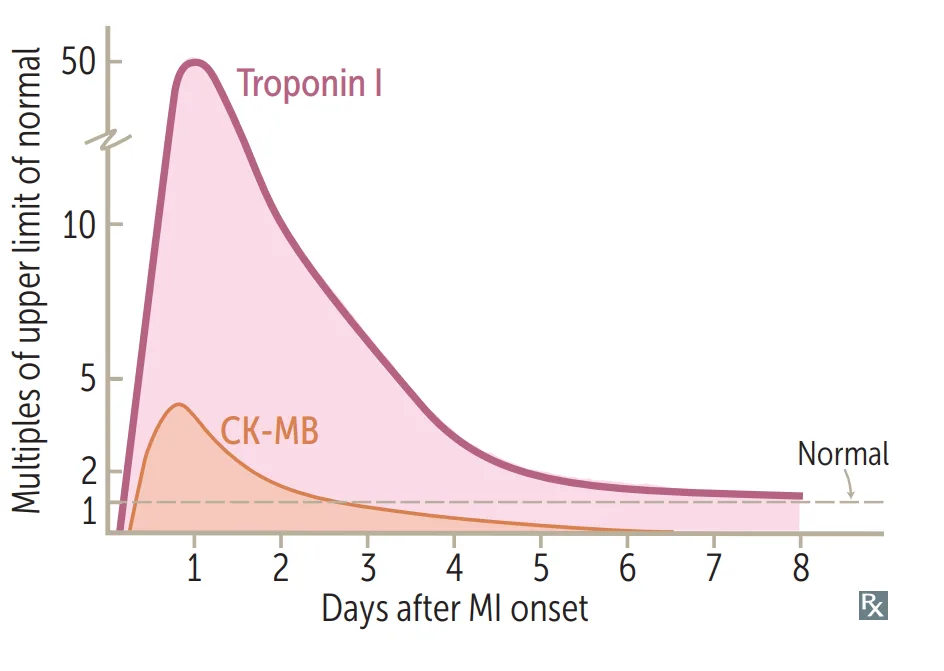
What this shows
Troponin I
rises at 4 hours, peaks at 24 hours, and stays elevated 7 to 10 days. The most specific marker, and the standard. Serial measurements are required in suspected NSTEMI.CK-MB
rises at 4 to 6 hours, peaks at 24 hours, and is normal by 2 to 3 days. Mostly myocardial, but skeletal muscle releases some too. Its short window is exactly what made it useful historically for detecting reinfarction, since a second rise after normalization means a second event while troponin is still elevated from the first. Largely replaced by high-sensitivity troponin.| Marker | Rises | Peaks | Normalizes | Use |
|---|---|---|---|---|
| Troponin I | 4 hours | 24 hours | 7 to 10 days | Most specific, the standard |
| CK-MB | 4 to 6 hours | 24 hours | 2 to 3 days | Historically for reinfarction, thanks to the short window |
| ECG | Immediate | Not applicable | Not applicable | Gold standard in the first 6 hours |
Reading the ECG
ST elevation
STEMI, i.e. transmural infarction.ST depression
NSTEMI, i.e. subendocardial infarction.Hyperacute (peaked) T waves
the earliest change.T-wave inversion.
Pathologic Q waves or poor R wave progression
an evolving or old transmural infarct.Lead localization
laid out with the lead positions on the ECG localization table. Two of them carry their own mnemonic: Lateral is I and aVL, and inFerior is II, III and aVF.| Infarct location | Artery | Leads |
|---|---|---|
| Anteroseptal | LAD | V1-V2 |
| Anteroapical | Distal LAD | V3-V4 |
| Anterolateral | LAD or LCX | V5-V6 |
| Lateral | LCX | I, aVL |
| InFerior | RCA or LCX | II, III, aVF |
| Posterior | PDA | V7-V9; ST depression in V1-V3 with tall R waves |
Five days after an MI the chest pain returns. Troponin is still up. Which marker tells you whether this is a second infarct?
CK-MB. It normalized by day 2 to 3, so a fresh rise means a fresh event, whereas troponin is still elevated from the first one.
How it's tested
Troponin is more specific and stays elevated 7 to 10 days, which is precisely why CK-MB was historically useful for reinfarction: it normalizes by day 2 or 3, so a second rise means a second event, whereas troponin would still be up from the first. Posterior infarcts are the trap: they show ST depression in V1 through V3 with tall R waves, which looks like the opposite of a STEMI until you recognise you are viewing a posterior injury current from the front.
Go deeper
First Aid 2026 — CV/Pathology (p.309) · B&B — Cardiac biomarkers & ECG localization · Mehlman — HY Cardio (troponin vs CK-MB, lead map)
High-yield images2
Flashcards for this page
Card 1 of 5 · try-out only, nothing is saved
An evolving (...)
You just read one page of 944
The rest of Step 1, written exactly like this.
Rapid Review is the reading layer of a full Step 1 platform: a schedule fitted to your exam date, flashcards for every page, and a mentor a message away.
Every Step 1 system
Written the same way: what to know, how it’s tested, where to go deeper.
A plan built to your exam date
Tell us when you sit, and the schedule fits the whole library and your question bank to it.
Flashcards for every page
Ready-made spaced-repetition decks linked to each topic, so nothing you read gets forgotten.
