
Rapid Review·Cardiovascular
Select any text to highlight it or add a note.
PHARMACOLOGY
T1Must knowNitrates & Cardiovascular Drug Targets
FA P322
Focus on
Venodilation, preload reduction, and the three settings where nitrates are dangerous.
Key takeaways
Nitrates
Drugs
nitroglycerin, isosorbide dinitrate, isosorbide mononitrate.Mechanism
raise NO (and S-nitrosothiols) in vascular smooth muscle, which raises cGMP and relaxes the muscle. They dilate VEINS far more than arteries, so the effect is on preload.Clinical use
angina, acute coronary syndrome, pulmonary edema.Adverse effects
reflex tachycardia (treated by adding a beta-blocker), methemoglobinemia, hypotension, flushing, headache.Tolerance
patients on daily maintenance nitrates need a nitrate-free period every day, or the drug stops working."Monday disease"
in industrial nitrate exposure, tolerance builds through the working week and is lost over the weekend, so re-exposure on Monday brings tachycardia, dizziness, and headache.| Contraindication | Why |
|---|---|
| Right ventricular infarction | RV output is preload-dependent, so lowering preload collapses cardiac output |
| Hypertrophic cardiomyopathy | Lower preload gives a smaller LV cavity and worse outflow obstruction |
| PDE-5 inhibitor use (sildenafil) | Both raise cGMP, giving profound hypotension |
Hydralazine, the vasodilator in the other bed
Mechanism
raises cGMP and relaxes smooth muscle, but in the arterioles far more than the veins, so it lowers afterload.Clinical use
severe (especially acute) hypertension, heart failure together with a nitrate, and hypertension in pregnancy, where it is safe. Usually given with a beta-blocker to blunt the reflex tachycardia.Adverse effects
compensatory tachycardia (so it is contraindicated in angina and CAD), fluid retention, headache, angina, and drug-induced lupus.| Feature | Nitrates | Hydralazine |
|---|---|---|
| Dilates | Veins far more than arteries | Arterioles more than veins |
| Reduces | PRELOAD | AFTERLOAD |
| Second messenger | Raised cGMP, via NO | Raised cGMP |
| Use | Angina, ACS, pulmonary edema | Severe hypertension, heart failure with a nitrate |
| In pregnancy | Not first line | Safe |
The molecular map
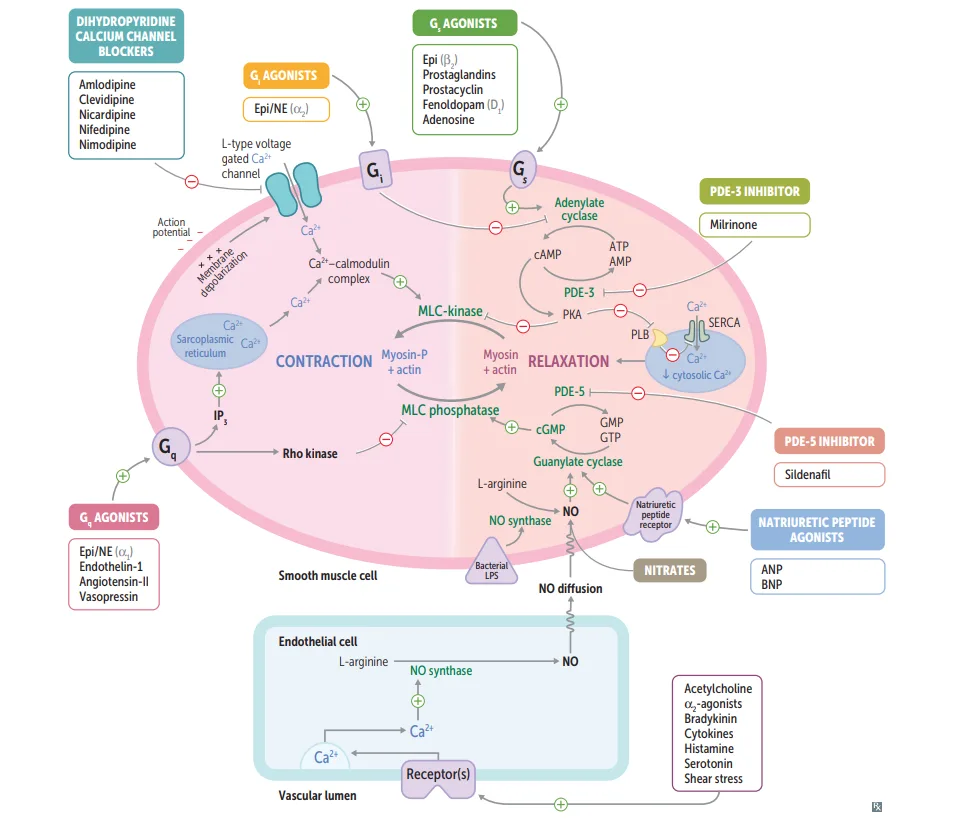
What this shows
Read it once as a whole
every cardiovascular drug class sits somewhere on this map.Gq agonists cause contraction
epinephrine and norepinephrine at alpha-1, endothelin-1, angiotensin II, vasopressin.Gs agonists cause relaxation
epinephrine at beta-2, prostaglandins, prostacyclin, fenoldopam at D1, adenosine.Gi agonists
epinephrine and norepinephrine at alpha-2.The NO arm
NO is made from L-arginine by NO synthase, diffuses into smooth muscle, and activates guanylate cyclase to make cGMP. Endothelial NO release is triggered by acetylcholine, beta-2 agonists, bradykinin, cytokines, histamine, serotonin, and shear stress.| Class | Agonists | Effect |
|---|---|---|
| Gq | Epi/NE at alpha-1, endothelin-1, angiotensin II, vasopressin | Contraction |
| Gs | Epi at beta-2, prostaglandins, prostacyclin, fenoldopam (D1), adenosine | Relaxation |
| NO/cGMP pathway | Nitrates, acetylcholine, bradykinin, histamine, shear stress | Relaxation |
Inferior STEMI with RCA involvement, hypotension, clear lungs. Why is nitroglycerin the wrong drug, and what do you give?
The infarcted right ventricle is preload-dependent; nitrates drop preload and collapse its output. Give IV fluids. Same rule as HCM: do not empty a ventricle that needs filling.
How it's tested
Nitroglycerin is contraindicated in a right ventricular infarct, because the failing RV depends on preload to generate any output at all, which is why an inferior STEMI with RCA involvement gets IV fluids instead. That is the same reasoning as the HCM contraindication, so learn the two together as "do not empty a ventricle that needs filling." Combining nitrates with sildenafil produces catastrophic hypotension because both raise cGMP by different routes.
Go deeper
First Aid 2026 — CV/Pharmacology (p.322) · B&B — Nitrates · Mehlman — HY Cardio (preload, Monday disease, nitrate contraindications)
High-yield images1
Flashcards for this page
Card 1 of 5 · try-out only, nothing is saved
(...)
(...)
You just read one page of 944
The rest of Step 1, written exactly like this.
Rapid Review is the reading layer of a full Step 1 platform: a schedule fitted to your exam date, flashcards for every page, and a mentor a message away.
Every Step 1 system
Written the same way: what to know, how it’s tested, where to go deeper.
A plan built to your exam date
Tell us when you sit, and the schedule fits the whole library and your question bank to it.
Flashcards for every page
Ready-made spaced-repetition decks linked to each topic, so nothing you read gets forgotten.
