
Rapid Review·Cardiovascular
Select any text to highlight it or add a note.
PATHOLOGY
T3Take a glancePeripheral Artery Disease, Acute Limb Ischemia & Subclavian Steal
Videos
1 to play here
Play 1 here
Focus on
Atherosclerosis of the limbs: chronic claudication, sudden ischemia, and the artery that steals from the brain.
Key takeaways
Peripheral artery disease
What it is
atherosclerosis of the lower extremity arteries. Risk factors: smoking (the biggest), hypertension, hyperlipidemia, diabetes, CKD, and CAD.Claudication
the first symptom, calf pain brought on by walking and relieved by rest (it points to the external iliac territory), with diminished pulses, hair loss, cool shiny skin, and atrophic changes.When it is severe
rest pain, cyanosis, ulcers and muscle atrophy, and Buerger's sign: the raised foot turns pale, then flushes bright red when it is lowered.Diagnosis
an ABI below 0.9 (normal 0.9 to 1.3).Management
supervised exercise, smoking cessation, cilostazol, a statin, and an antiplatelet agent.Leriche syndrome
aortoiliac occlusion, giving a triad of bilateral buttock and thigh claudication, erectile dysfunction, and absent or diminished femoral pulses. The proximal block starves the internal pudendal and gluteal branches of the internal iliac artery.Acute limb ischemia
What it is
sudden arterial occlusion, either an embolism from atrial fibrillation or a mural thrombus, or an acute thrombosis on an existing plaque.The 6 P's
Pain, Pallor, Pulselessness, Paresthesia, Poikilothermia (a cold limb), Paralysis.A surgical emergency
treated with embolectomy or revascularization.| Feature | Peripheral artery disease | Acute limb ischemia |
|---|---|---|
| Onset | Gradual, over months to years | Sudden |
| Pain | On walking, relieved by rest | Constant and severe |
| Pulses | Diminished | Absent |
| Skin | Cool, shiny, hairless, atrophic | Pale and cold |
| Source | In-situ atherosclerosis | Embolus (AF, mural thrombus) or acute thrombosis |
| Management | Exercise, smoking cessation, cilostazol, statin, antiplatelet | Surgical emergency: embolectomy |
Chronic venous insufficiency
What goes wrong
normal flow runs one way, from the superficial to the deep veins through the perforators. When the valves fail, blood refluxes into the superficial veins and pools in the limb, venous pressure climbs, and varicose veins form.Why the skin breaks down
protein and leukocytes leak out, free radicals damage the capillary basement membrane, plasma proteins leak and cause edema, oxygen delivery falls, and the hypoxic, inflamed tissue atrophies and ulcerates.Risk factors
obesity, prolonged standing (soldiers), female sex, pregnancy, and a family history of vascular disease.Findings
leg heaviness or pain that improves with walking (the opposite of PAD), varicose veins, edema, stasis dermatitis, and chronic venous stasis ulcers.Diagnosis
duplex ultrasound showing bidirectional flow in the great saphenous vein.| Feature | Peripheral artery disease | Chronic venous insufficiency |
|---|---|---|
| Pain | Worse with walking, better with rest | Better with walking, worse standing |
| Skin | Cool, shiny, hairless; pale on elevation | Stasis dermatitis, edema, varicosities |
| Ulcer | Distal, punched-out | Medial malleolus, irregular |
| Test | ABI 0.9 or below | Duplex ultrasound: reflux in the great saphenous vein |
Subclavian steal syndrome
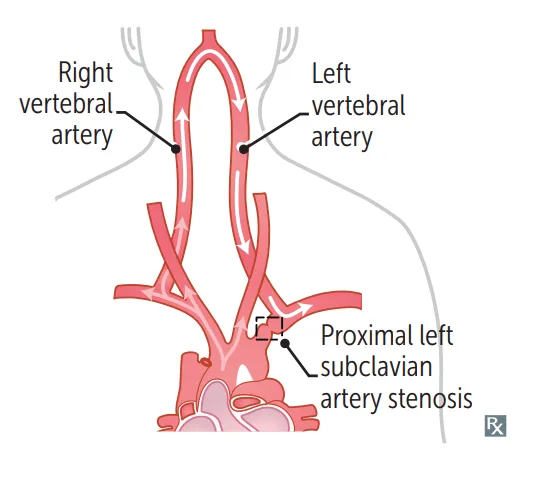
What this shows
Mechanism
stenosis of the subclavian artery proximal to the vertebral artery origin drops pressure distally, so blood flows retrograde down the ipsilateral vertebral artery to supply the arm. Using the affected arm (rowing, for instance) therefore steals blood from the posterior cerebral circulation.Findings
arm ischemia, pain, paresthesia, vertebrobasilar insufficiency (dizziness, vertigo), and a more than 15 mm Hg systolic difference between arms.Causes
atherosclerosis (most common), Takayasu arteritis, and prior heart surgery.| Feature | Subclavian steal | Vertebral artery stenosis |
|---|---|---|
| Lesion | Proximal subclavian, before the vertebral branch | The vertebral artery itself |
| Arm BP difference | YES, more than 15 mm Hg | NO, the subclavian is unaffected |
| Symptoms | Dizziness on arm exertion, plus arm ischemia | Unexplained dizziness |
| Umbrella term | Vertebrobasilar insufficiency | Vertebrobasilar insufficiency |
Leg pain that gets better when the patient walks. Arterial or venous?
Venous. Walking works the calf pump and empties the pooled veins; arterial claudication does the opposite and forces the patient to stop.
How it's tested
Calf pain reproducibly brought on by walking and relieved by rest, with an ABI below 0.9, is peripheral artery disease. The contrast is drawn sharply: a suddenly cold, pale, pulseless leg in a patient with atrial fibrillation is acute embolic limb ischemia and needs surgery, not exercise therapy. The triad of buttock claudication, erectile dysfunction, and absent femoral pulses names Leriche syndrome and localizes the lesion to the aortoiliac segment. Subclavian steal announces itself as dizziness brought on by using the arm, because a proximal subclavian stenosis reverses flow down the vertebral artery and diverts blood away from the posterior circulation.
Go deeper
First Aid 2026 — CV/Pathology (PAD, subclavian steal) · B&B — Peripheral vascular disease · Mehlman — HY Cardio (claudication, ABI, 6 P’s, subclavian steal)
High-yield images1
Flashcards for this page
Card 1 of 3 · try-out only, nothing is saved
Arm (...)
(...)
(...)
(...)
You just read one page of 944
The rest of Step 1, written exactly like this.
Rapid Review is the reading layer of a full Step 1 platform: a schedule fitted to your exam date, flashcards for every page, and a mentor a message away.
Every Step 1 system
Written the same way: what to know, how it’s tested, where to go deeper.
A plan built to your exam date
Tell us when you sit, and the schedule fits the whole library and your question bank to it.
Flashcards for every page
Ready-made spaced-repetition decks linked to each topic, so nothing you read gets forgotten.
