
Rapid Review·General Pathology
Select any text to highlight it or add a note.
NEOPLASIA
T2High yieldImmune Checkpoints & Checkpoint Inhibitors
P218
Focus on
The two brakes tumors press to shut off T cells, and the drugs that release them.
Key takeaways
What a checkpoint is
What a checkpoint is
a signal that dials down T-cell activation, and therefore the immune response against tumor cells. Tumors upregulate them to evade killing.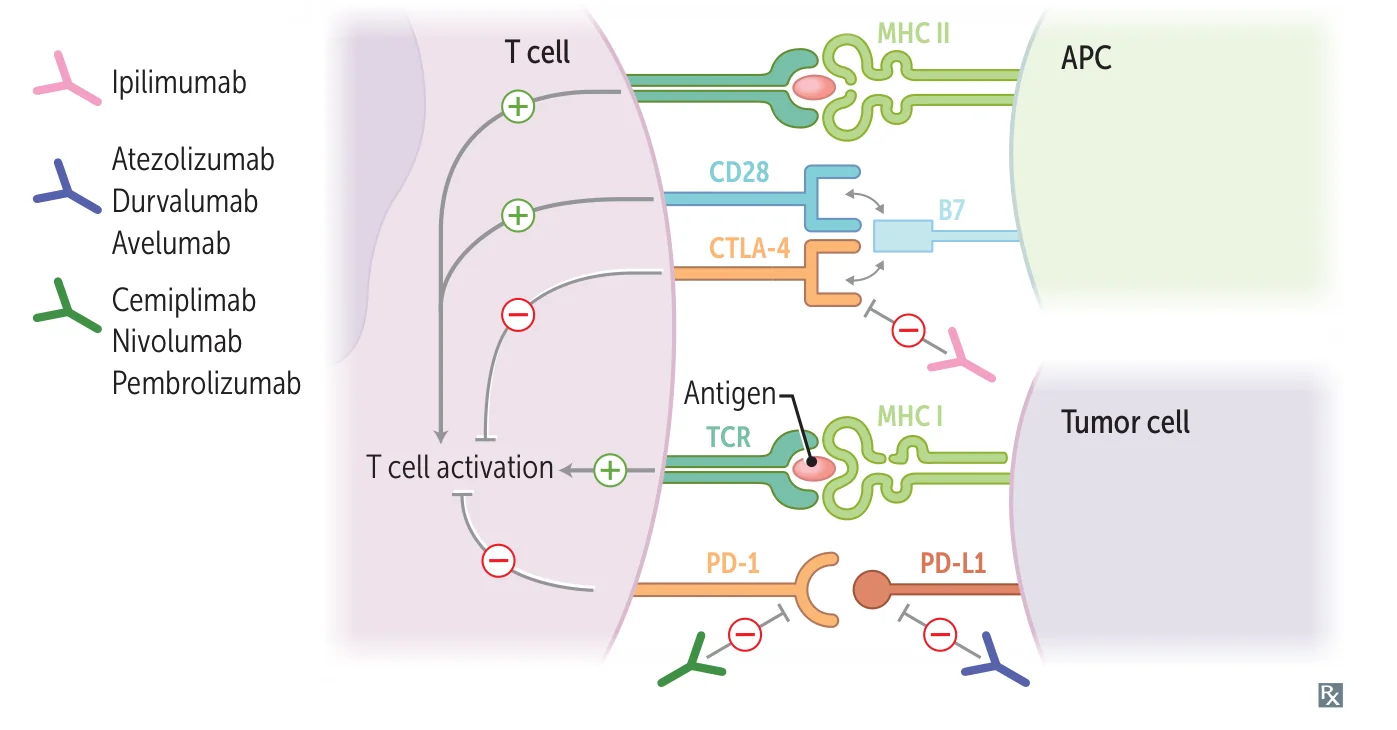
What this shows
The two brakes
PD-1 / PD-L1: the effector-phase brake
PD-1 / PD-L1 axis, the effector-phase brake
PD-1 on T cells binds PD-L1 or PD-L2 on tumor cells or on immune cells in the tumor microenvironment → T-cell dysfunction, known as exhaustion.- Anti-PD-1: cemiplimab, nivolumab, pembrolizumab.
- Anti-PD-L1: atezolizumab, durvalumab, avelumab.
CTLA-4: the priming-phase brake
CTLA-4 axis, the priming-phase brake
CTLA-4 on T cells outcompetes CD28 for B7 on APCs → the costimulatory second signal is lost → the T cell is never activated.- Anti-CTLA-4: ipilimumab.
| Feature | PD-1 / PD-L1 | CTLA-4 |
|---|---|---|
| Phase | Effector (in the tumor) | Priming (at the APC) |
| Brake | PD-1 on T cells binds PD-L1/PD-L2 on tumor or immune cells | CTLA-4 on T cells outcompetes CD28 for B7 |
| Result | T-cell exhaustion | No costimulation, T cell never activated |
| Drugs | Anti-PD-1: cemiplimab, nivolumab, pembrolizumab. Anti-PD-L1: atezolizumab, durvalumab, avelumab | Anti-CTLA-4: ipilimumab |
Toxicity
Toxicity of checkpoint inhibitors
releasing the brake causes immune-related adverse events, namely colitis, hepatitis, dermatitis, pneumonitis, and autoimmune endocrinopathies such as hypophysitis and thyroiditis.A patient on pembrolizumab for melanoma develops diarrhea, then fatigue and hypotension with a low ACTH. What is the drug's target, and what has happened?
Pembrolizumab blocks PD-1. Releasing the brake has caused immune-related adverse events: colitis, and hypophysitis, an autoimmune endocrinopathy that has taken out ACTH.
How it's tested
Know where each drug acts. Ipilimumab works at the priming phase in the lymph node, since CTLA-4 competes with CD28 for B7 and removes signal 2, whereas nivolumab and pembrolizumab work at the effector phase in the tumor, reversing PD-1/PD-L1 exhaustion.
A patient on a checkpoint inhibitor who develops severe diarrhea has autoimmune colitis from unrestrained T cells, the expected consequence of the drug rather than a chemotherapy side effect.
Go deeper
First Aid immune evasion; Pathoma Ch. 3; SketchyPharm checkpoint inhibitors. Anchor the PD-1/PD-L1 and CTLA-4 axes (targets of pembrolizumab/nivolumab/ipilimumab) and the immune-related adverse events that follow from taking a brake off.
High-yield images1
Flashcards for this page
Card 1 of 5 · try-out only, nothing is saved
(...)
(...)
You just read one page of 944
The rest of Step 1, written exactly like this.
Rapid Review is the reading layer of a full Step 1 platform: a schedule fitted to your exam date, flashcards for every page, and a mentor a message away.
Every Step 1 system
Written the same way: what to know, how it’s tested, where to go deeper.
A plan built to your exam date
Tell us when you sit, and the schedule fits the whole library and your question bank to it.
Flashcards for every page
Ready-made spaced-repetition decks linked to each topic, so nothing you read gets forgotten.
