
Rapid Review·Neurology
Select any text to highlight it or add a note.
PATHOLOGY
T1Must knowDementia
P534–P535
Videos
3 to play here
Play 3 here
Focus on
Cognitive decline with intact consciousness, sorted by the one feature that is not typical dementia.
Key takeaways
Delirium first
Delirium
an acute and fluctuating disturbance of attention and awareness, which is the state you must exclude before calling anything a dementia.- Waxing and waning course over hours to days, ↓ attention and impaired concentration, disorganized thinking, altered level of consciousness, visual hallucinations or illusions, sleep-wake disturbance, and either agitation or a hypoactive presentation.
- Delirium = acute + fluctuating + inattentive. Dementia = chronic + progressive.
- Causes: usually an underlying medical problem or a medication.
- Infection, metabolic or electrolyte abnormality, CNS disease or trauma, substance intoxication or withdrawal.
- Urinary retention or fecal impaction, so in an older patient with delirium and no clear cause, order a urinalysis.
- Medications: anticholinergics, antihistamines, opioids, benzodiazepines, sedatives.
- EEG: diffuse slowing.
- Treatment: treat the underlying cause, with supportive measures: frequent reorientation, family and familiar objects, normal day-night lighting, reduced noise, glasses and hearing aids, early mobilization, and avoiding restraints and unnecessary psychoactive drugs.
- An antipsychotic such as haloperidol is only for severe agitation that threatens safety.
DEMENTIA
cognitive decline with intact consciousness, which separates it from delirium, and not explained by delirium or another medical condition.- Montreal Cognitive Assessment (MoCA) under 26 out of 30.
- Reversible causes worth screening for: depression (pseudodementia), hypothyroidism, vitamin B12 deficiency, neurosyphilis, and normal pressure hydrocephalus.
The differential road map
Is daily functioning preserved
if yes, this is normal aging (mild forgetfulness with no objective impairment) or mild cognitive impairment (objective decline in at least one domain with independent function preserved). If no, think delirium, dementia, or depression.Look at the time course
delirium runs over hours to days with fluctuating attention and a clear trigger, usually reversible; dementia runs over months to years, progressive, with alertness preserved; depression with cognitive symptoms runs over weeks to months, with prominent depressive symptoms and cognition that improves when the depression is treated.Alzheimer disease
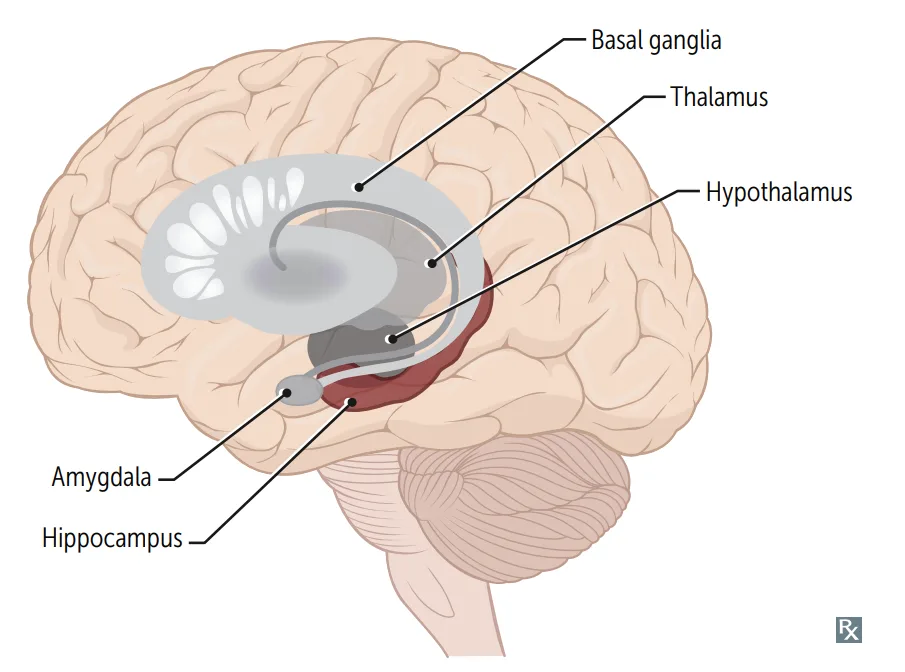
What this shows
ALZHEIMER DISEASE
the most common cause of dementia in older adults, with advanced age as the strongest risk factor.- On NBME: usually present with someone old who is brought by a family member due to difficulty remembering recent stuff, falling his job, unable to live on his own, keeps getting lost.
- late: neuropsychiatric symptoms, such as apathy, depressive symptoms, delusions, hallucinations, disinhibition, and agitation.
- Pathophysiology: β-amyloid → neuronal stress → excitotoxicity (glutamatergic NMDA overactivity) → diffuse cortical atrophy → loss of cholinergic neurons → impaired memory and cognition. amyloid precursor protein processing
- Down syndrome patients get early-onset disease, because amyloid precursor protein sits on chromosome 21. ↓ ACh in the brain.
- Altered proteins: the alleles decide risk and age of onset.
- ApoE-2 lowers risk of the sporadic form,
- ApoE-4 raises it,
- APP, presenilin-1, and presenilin-2 cause the familial forms with earlier onset.
- Widespread cortical atrophy, most marked in the hippocampi, with narrowed gyri and widened sulci. hippocampi
- Senile plaques in gray matter are EXTRAcellular amyloid-β, derived from cleavage of APP, and may cause amyloid angiopathy with lobar intraparenchymal hemorrhage. Alzheimer histology
- Neurofibrillary tangles are INTRAcellular hyperphosphorylated TAU, and the number of tangles correlates with the degree of dementia, not the number of plaques.
- Hirano bodies are intracellular eosinophilic actin rods in the hippocampus.
- New delirium with a low-grade fever in a patient with Alzheimer disease calls for a urinalysis.
- Treatment: symptomatic only, since neither drug class improves neuron survival.
- Mild to moderate: acetylcholinesterase inhibitors, donepezil, rivastigmine, galantamine, contraindicated in cardiac conduction abnormalities.
- Moderate to severe: add memantine, an NMDA receptor antagonist that reduces glutamate-mediated excitotoxicity.
| Alzheimer Pathology | Location | Composition | Correlates With |
|---|---|---|---|
| Senile plaques | EXTRAcellular, gray matter | Amyloid-β from APP cleavage | Amyloid angiopathy and lobar hemorrhage |
| Neurofibrillary tangles | INTRAcellular | Hyperphosphorylated TAU | DEGREE OF DEMENTIA |
| Hirano bodies | Intracellular, hippocampus | Actin rods | Not correlated |
The other dementias
Frontotemporal dementia (formerly Pick disease)
early changes in PERSONALITY and BEHAVIOR in the behavioral variant, or aphasia in the primary progressive aphasia variant. Frontotemporal dementia- Frontal or temporal lobe atrophy.
- Inclusions of hyperphosphorylated TAU as round PICK BODIES, or ubiquitinated TDP-43.
- Memory is relatively spared early, which inverts the Alzheimer pattern. The classic triad is personality change, apathy, and disinhibition, and the vignette often involves socially inappropriate behavior.
Dementia with Lewy bodies
progressive dementia with FLUCTUATING cognition and alertness, VISUAL HALLUCINATIONS, REM SLEEP BEHAVIOR DISORDER, and PARKINSONISM.- "haLEWYcinations."
- α-synuclein inclusions in the CORTEX, in contrast with Parkinson disease where they concentrate in the substantia nigra pars compacta.
- Timing rule: cognitive and motor symptoms within a year of each other means dementia with Lewy bodies; more than a year apart means Parkinson disease dementia.
Vascular dementia
the second most common dementia in older adults, from multiple arterial infarcts or chronic ischemia. Vascular dementia on MRI vascular dementia subtypes- Classically described as a step-wise decline, but Mehlman notes NBME rarely leans on that. What the exam actually gives is dementia plus motor or sensory abnormalities, for example 3 out of 5 strength in one arm buried in a long stem, indicating prior strokes.
Creutzfeldt-Jakob disease
rapidly progressive dementia over WEEKS TO MONTHS with MYOCLONUS and ataxia, and it is fatal. Creutzfeldt-Jakob spongiform change- Caused by prions, where the normal α-helical protein misfolds into a protease-resistant β-pleated sheet that induces the same change in neighboring proteins, so the process is exponential.
- SPONGIFORM cortex, meaning vacuolation without inflammation.
- Periodic sharp wave complexes on EEG and elevated 14-3-3 protein in the CSF.
- Usually sporadic, but transmissible by corneal transplant and contaminated neurosurgical equipment.
- Startle myoclonus is the discriminating detail, and its absence should steer you away from Creutzfeldt-Jakob disease when it appears as a distractor.
HIV-associated dementia
SUBCORTICAL dysfunction in advanced HIV, with cognitive deficits, gait disturbance, irritability, and depressed mood.- Diffuse gray matter and subcortical atrophy, with microglial nodules and multinucleated giant cells. multinucleated giant cells
- Can present as wet, wobbly, and wacky, mimicking normal pressure hydrocephalus.
| Dementia | Signature Feature | Pathology |
|---|---|---|
| Alzheimer | Memory loss first, gradual | Amyloid plaques and tau tangles; hippocampal atrophy |
| Frontotemporal (Pick) | Personality and behavior change first | Pick bodies (tau) or TDP-43; frontotemporal atrophy |
| Dementia with Lewy bodies | Fluctuating cognition, visual hallucinations, parkinsonism | α-synuclein in the CORTEX |
| Vascular | Motor or sensory deficits alongside the dementia | Multiple infarcts |
| Creutzfeldt-Jakob | Rapid over weeks, with startle myoclonus | Spongiform, no inflammation; 14-3-3, sharp waves |
| HIV-associated | Subcortical, in advanced HIV | Microglial nodules, multinucleated giant cells |
The reversible ones
The reversible dementias are the ones worth screening for
treatment changes the outcome.- Pseudodementia: depression presenting as cognitive decline. Watch for short, quiet answers and low mood. The patient may fail the clock face but complete it quickly when prompted.
- Hypothyroidism: check TSH, but only after screening for depression.
- Vitamin B12 deficiency: subacute combined degeneration, with raised MCV and hypersegmented neutrophils. The buzzy histories are gastrectomy, pernicious anemia, and veganism.
- Neurosyphilis: a positive VDRL in an older patient with cognitive decline, treated with penicillin.
- Neuro-Lyme disease: consider in an endemic area with wilderness or pet exposure.
- Normal pressure hydrocephalus: wet, wobbly, and wacky, improved by CSF drainage.
| Reversible Cause | Clue | Treatment |
|---|---|---|
| Depression (pseudodementia) | Recent onset, low mood, "I don't know" answers | Antidepressant therapy |
| Hypothyroidism | ↑ TSH | Levothyroxine |
| Vitamin B12 deficiency | ↑ MCV, subacute combined degeneration | B12 replacement |
| Neurosyphilis | Positive VDRL; Argyll Robertson pupil | Penicillin |
| Normal pressure hydrocephalus | Wet, wobbly, wacky | CSF drainage or shunt |
A 68-year-old declines over 6 weeks with memory loss, ataxia, and jerks when startled, and the EEG shows periodic sharp waves. Diagnosis, and which CSF marker?
Creutzfeldt-Jakob disease. The speed (weeks, not years) plus startle myoclonus is the pattern, the cortex is spongiform without inflammation, and the CSF shows elevated 14-3-3 protein.
How it's tested
The tangle count, not the plaque count, correlates with dementia severity, which is a favorite discriminator and part of why anti-amyloid strategies have disappointed.
ApoE-4 raises risk while ApoE-2 is protective, and Down syndrome causes early Alzheimer disease because APP sits on chromosome 21, so three copies mean a lifetime of excess amyloid.
Each of these is identified by the one thing that is not typical dementia. Personality change before memory loss is frontotemporal;
a step-wise decline or focal motor findings is vascular;
a dementia progressing over weeks with startle myoclonus is Creutzfeldt-Jakob;
visual hallucinations with fluctuating alertness plus parkinsonism is Lewy body dementia. The Lewy body and Parkinson dementia split is purely a one-year timing rule.
Mehlman's practical reframing of vascular dementia is worth adopting. Rather than hunting for the phrase "step-wise," scan the stem for a motor or sensory abnormality, since a buried note about asymmetric strength is what actually signals prior infarcts.
Go deeper
First Aid + Boards & Beyond; Mehlman HY Neuro pp. 22-24, 43, HY Neuroanatomy pp. 35-36, 60. Anchor Alzheimer (plaques, tangles, tangle count tracking severity), the non-Alzheimer types by their signature feature, and the reversible causes worth screening for.
High-yield images9
Flashcards for this page
Card 1 of 5 · try-out only, nothing is saved
Risk is (...)
You just read one page of 944
The rest of Step 1, written exactly like this.
Rapid Review is the reading layer of a full Step 1 platform: a schedule fitted to your exam date, flashcards for every page, and a mentor a message away.
Every Step 1 system
Written the same way: what to know, how it’s tested, where to go deeper.
A plan built to your exam date
Tell us when you sit, and the schedule fits the whole library and your question bank to it.
Flashcards for every page
Ready-made spaced-repetition decks linked to each topic, so nothing you read gets forgotten.
