
Rapid Review·Neurology
Select any text to highlight it or add a note.
PATHOLOGY
T1Must knowNeurocutaneous Disorders
P539
Videos
1 to play here
Play 1 here
Focus on
Five phakomatoses, each with a chromosome, a skin finding, and a tumor. The chromosome numbers are the anchor.
Key takeaways
Sturge-Weber syndrome
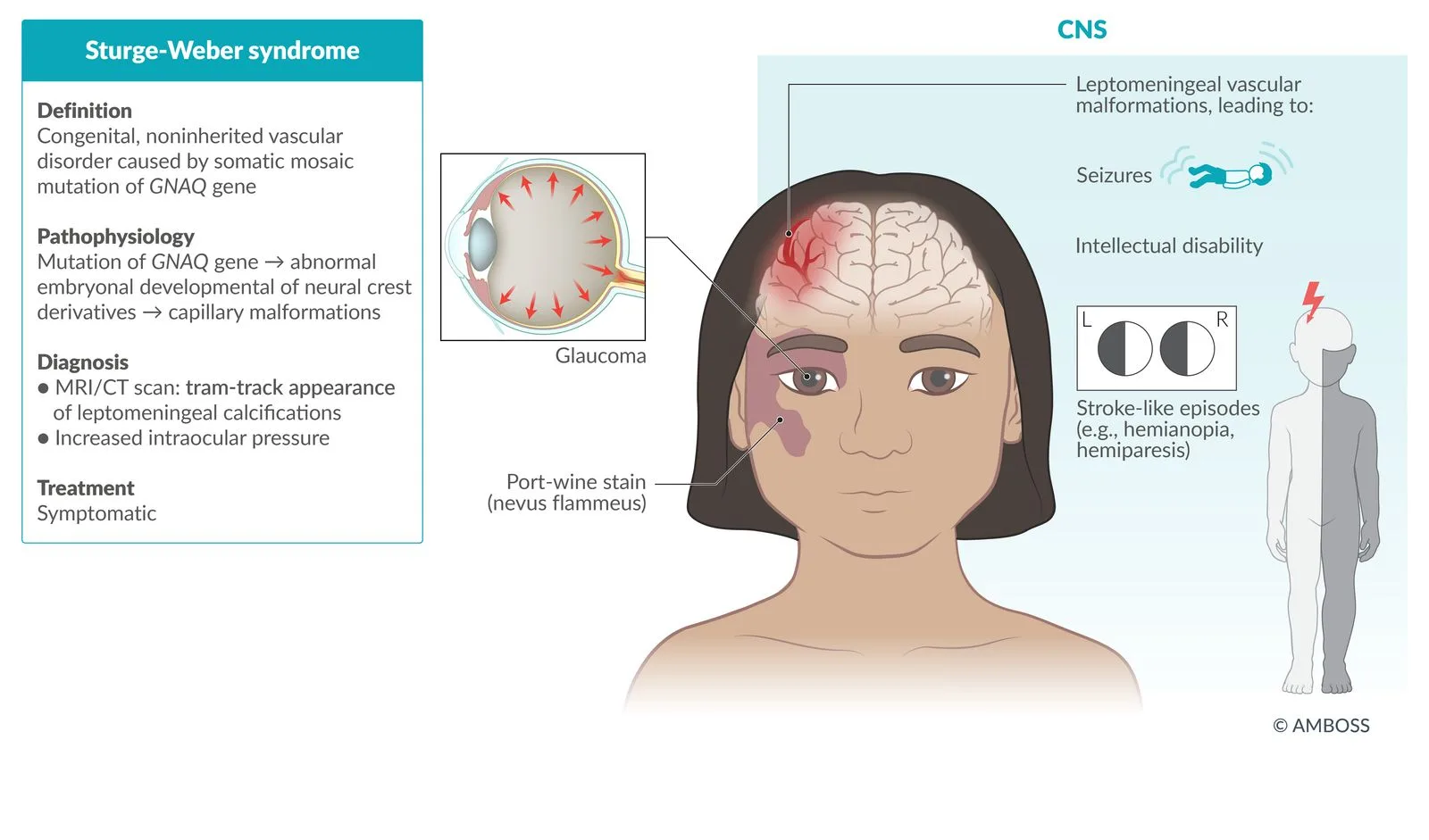
Sturge-Weber syndrome (encephalotrigeminal angiomatosis)
congenital and NOT hereditary, from somatic mosaicism of an activating mutation in GNAQ, affecting neural crest derivatives.- (جيناك عالجلد والمخ)
- Capillary vascular malformation giving a PORT-WINE STAIN in the CN V1 and V2 distribution.
- Ipsilateral LEPTOMENINGEAL ANGIOMA with "tram-track" calcifications, causing seizures and intellectual disability.
- Episcleral hemangioma raising intraocular pressure, causing early-onset GLAUCOMA.
Tuberous sclerosis complex
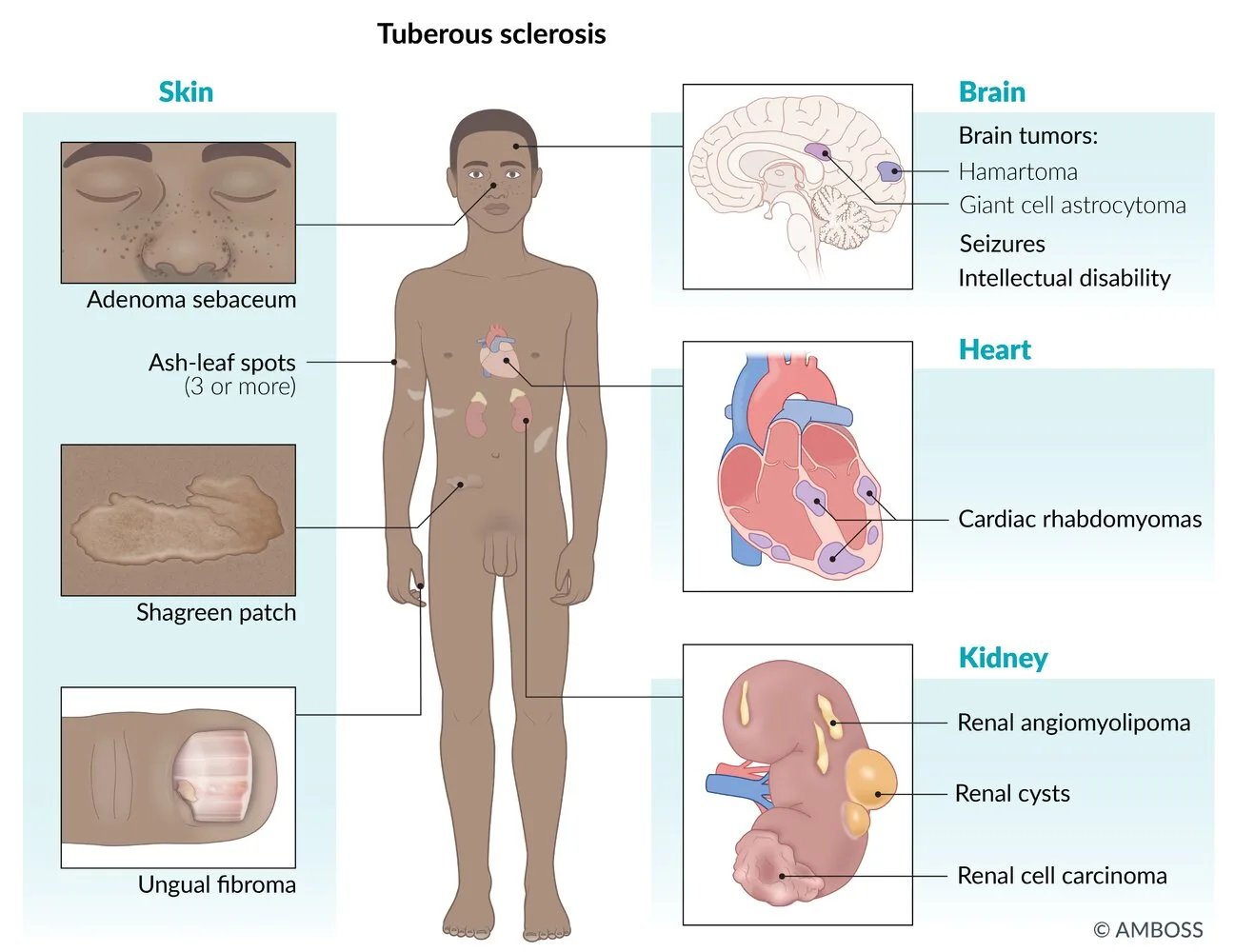
- (هام يا انجي آش المتخلف خد عربيته الشاهين وصرع عبده)
- HAMartoma, ANGIofibroma, Ash-leaf, intellectual disability SHAgrEEN, Seizures, RHABDOmyoma)
- Hamartomas in the CNS and skin, ANGIOFIBROMAS (adenoma sebaceum), ASH-LEAF SPOTS (hypopigmented macules), SHAGREEN PATCHES (hyperpigmented velvety lesions), subungual fibromas, CARDIAC RHABDOMYOMA, RENAL ANGIOMYOLIPOMA, mitral regurgitation, seizures, and intellectual disability.
- The "tubers" are hamartomas, described on imaging as periventricular or cortical nodules, and there is an increased incidence of subependymal giant cell astrocytoma.
The Neurofibromatosis
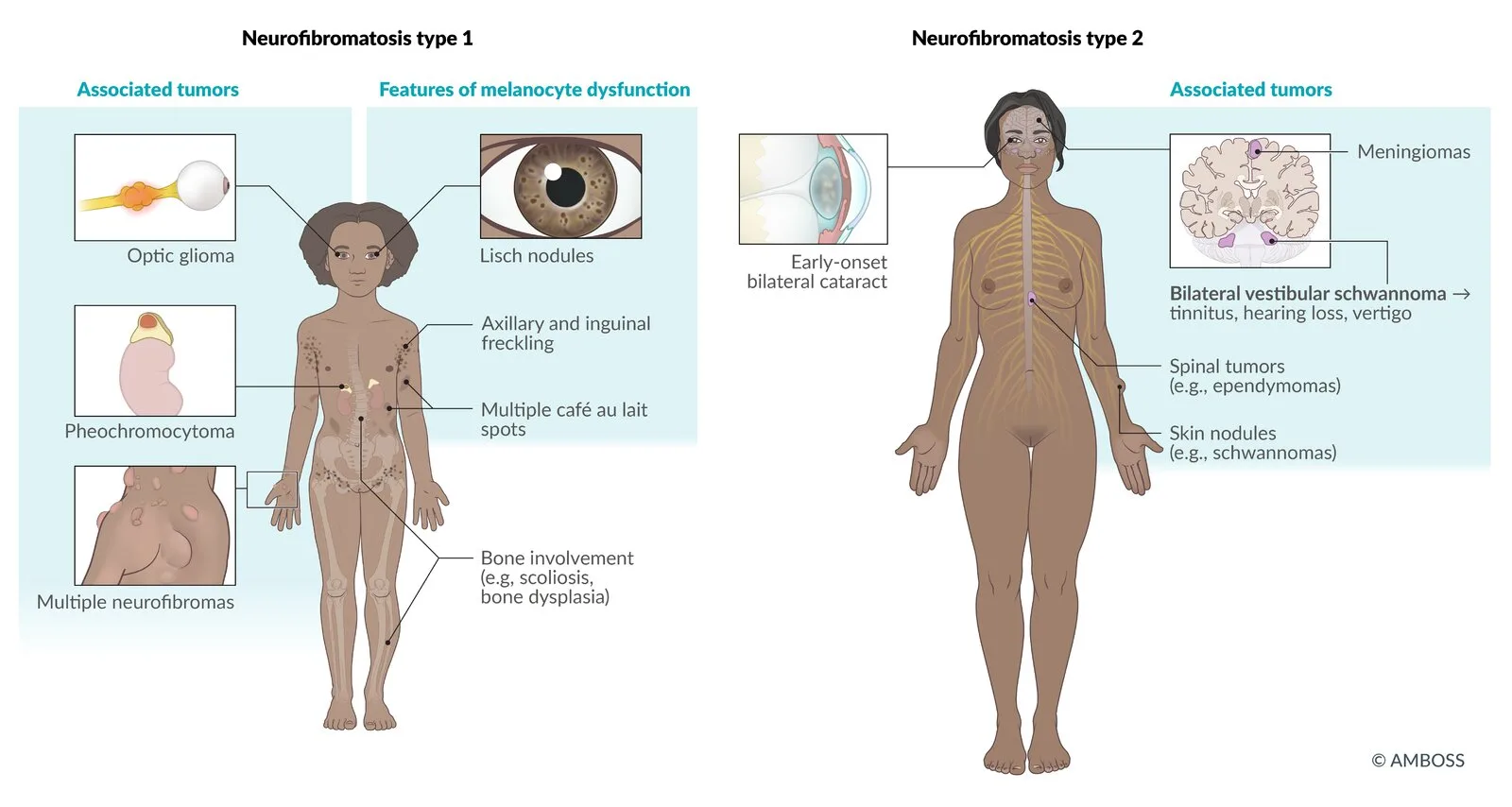
Neurofibromatosis type I (von Recklinghausen disease)
autosomal dominant with 100% penetrance, from NF1 on CHROMOSOME 17, encoding neurofibromin, a negative regulator of RAS. Neurofibromatosis type I- Café-au-lait spots, cutaneous neurofibromas, axillary and groin freckling, LISCH NODULES (pigmented iris hamartomas), OPTIC NERVE GLIOMA, PHEOCHROMOCYTOMA, seizures, and bone lesions including sphenoid dysplasia.
- The CNS tumors associated with NF1 also include oligodendroglioma and ependymoma.
Neurofibromatosis type II
autosomal dominant, from NF2 on CHROMOSOME 22, encoding merlin.- BILATERAL VESTIBULAR SCHWANNOMAS, plus meningiomas and ependymomas. In children it can present as bilateral cataracts, which is a useful early clue.
- "NF2 affects 2 ears and 2 eyes."
von Hippel-Lindau disease
von Hippel-Lindau disease
autosomal dominant, from deletion of VHL on CHROMOSOME 3p. The pVHL protein normally ubiquitinates hypoxia-inducible factor, so the mutation causes its constitutive activation. Von Hippel-Lindau disease- HEMANGIOBLASTOMAS (highly vascular, hyperchromatic nuclei) in the retina, brainstem, cerebellum, and spine, plus bilateral RENAL CELL CARCINOMA, pheochromocytoma, and pancreatic cysts.
- Von HARP Lindau:VHL = 3 letters = Chromosome 3 = RCC (Renal cell carcinoma)
- Hemangioblastomas (high vascularity with hyperchromatic nuclei) in retina, brainstem, cerebellum, spine
- Angiomatosis
- Bilateral Renal cell carcinomas
- Pheochromocytomas
| Disorder | Gene / Chromosome | Skin Finding | Signature Tumor |
|---|---|---|---|
| Sturge-Weber | GNAQ, somatic mosaic, not inherited | Port-wine stain (V1/V2) | Leptomeningeal angioma; early glaucoma |
| Tuberous sclerosis | TSC1 (ch 9) or TSC2 (ch 16) | Ash-leaf spots, shagreen patches, angiofibromas | Cardiac rhabdomyoma, renal angiomyolipoma |
| Neurofibromatosis I | NF1 (ch 17), neurofibromin | Café-au-lait spots, cutaneous neurofibromas | Optic glioma, pheochromocytoma; Lisch nodules |
| Neurofibromatosis II | NF2 (ch 22), merlin | None characteristic | BILATERAL vestibular schwannomas, meningioma |
| von Hippel-Lindau | VHL (ch 3p) | None characteristic | Hemangioblastoma, bilateral renal cell carcinoma, pheochromocytoma |
| Syndrome | CNS Tumors |
|---|---|
| NF1 | Optic nerve glioma, oligodendroglioma, ependymoma |
| NF2 | Bilateral vestibular schwannoma, meningioma, ependymoma |
| Tuberous sclerosis | Subependymal giant cell astrocytoma, cortical tubers |
| von Hippel-Lindau | Hemangioblastoma of cerebellum, retina, spine |
| Sturge-Weber | Leptomeningeal angioma (vascular, not neoplastic) |
A 5-year-old has hypopigmented macules on the trunk, a heart murmur from an intracardiac mass, and seizures. Which syndrome and which genes?
Tuberous sclerosis complex, from TSC1 (chromosome 9, hamartin) or TSC2 (chromosome 16, tuberin). The macules are ash-leaf spots and the cardiac mass is a rhabdomyoma; cortical tubers explain the seizures.
How the NBME diagnoses each
Sturge-Weber
clinical diagnosis from a port-wine stain in the V1 distribution, confirmed by contrast MRI showing the leptomeningeal angioma; CT shows tram-track calcifications, and eye pressure is checked for glaucoma.- Vignette: A newborn with a port-wine stain over the forehead and upper eyelid develops focal seizures and an enlarged, cloudy eye on the same side.
Tuberous sclerosis
clinical diagnosis from skin and organ findings; a Wood's lamp brings out ash-leaf spots, echocardiography finds the rhabdomyoma, and brain MRI shows cortical tubers and subependymal nodules. TSC1/TSC2 testing confirms it.- Vignette: An infant with infantile spasms has oval hypopigmented macules that stand out under a Wood's lamp.
Neurofibromatosis I
clinical diagnosis needing 2 or more of: 6 or more café-au-lait spots, axillary or groin freckling, 2 or more neurofibromas, Lisch nodules on slit-lamp exam, optic glioma, a typical bone lesion, or an affected parent.- Vignette: A 7-year-old with multiple café-au-lait spots and axillary freckling has small pigmented bumps on the iris on slit-lamp exam.
Neurofibromatosis II
gadolinium MRI of the internal auditory canals showing bilateral vestibular schwannomas; audiometry shows sensorineural hearing loss.- Vignette: A 22-year-old who had cataracts as a teenager now has hearing loss, tinnitus, and imbalance, with masses at both cerebellopontine angles.
von Hippel-Lindau
MRI of the brain and spine for hemangioblastomas, dilated fundoscopy for retinal angiomas, abdominal CT or MRI for renal cell carcinoma and pancreatic cysts, and plasma metanephrines for pheochromocytoma; VHL gene testing confirms it.- Vignette: A 30-year-old with gait ataxia from a cystic cerebellar mass has a retinal angioma, bilateral renal masses, and polycythemia (the hemangioblastoma secretes erythropoietin).
How it's tested
The chromosome numbers are recoverable rather than memorized. Von Recklinghausen has 17 letters and NF1 sits on chromosome 17; NF2 affects 2 ears and 2 eyes and sits on chromosome 22; VHL is 3 letters, sits on chromosome 3, and causes renal cell carcinoma, also 3 letters.
Sturge-Weber is the odd one out, because it is not inherited at all but a somatic mosaic GNAQ mutation, which is why it never runs in families.
Mehlman adds a genuinely useful pediatric clue for NF2: a teenager with bilateral cataracts who later develops unilateral tinnitus and hearing loss has NF2, and the mass at the cerebellopontine angle is an acoustic schwannoma arising from neural crest cells.
Go deeper
First Aid "Neurocutaneous disorders"; Boards & Beyond; Mehlman HY Neuro p. 46, p. 62, HY Neuroanatomy pp. 43-44. Anchor the gene and finding pairs (Sturge-Weber GNAQ port-wine, tuberous sclerosis TSC1/2 with ash-leaf and rhabdomyoma, NF1 chromosome 17 with café-au-lait and Lisch nodules, NF2 chromosome 22 with bilateral acoustic neuromas, VHL chromosome 3 with hemangioblastoma and renal cell carcinoma).
High-yield images10
Flashcards for this page
Card 1 of 5 · try-out only, nothing is saved
(...) disease
You just read one page of 944
The rest of Step 1, written exactly like this.
Rapid Review is the reading layer of a full Step 1 platform: a schedule fitted to your exam date, flashcards for every page, and a mentor a message away.
Every Step 1 system
Written the same way: what to know, how it’s tested, where to go deeper.
A plan built to your exam date
Tell us when you sit, and the schedule fits the whole library and your question bank to it.
Flashcards for every page
Ready-made spaced-repetition decks linked to each topic, so nothing you read gets forgotten.
