
Rapid Review·Cardiovascular
Select any text to highlight it or add a note.
PHYSIOLOGY
T2High yieldCardiac Output Equations & Starling Curves
FA P289
Videos
2 to play here
Play 2 here
Focus on
Six equations the exam expects you to manipulate, plus the curve that explains why preload matters.
Key takeaways
The equations, in the order they build on each other
Stroke volume
SV = EDV − ESVEjection fraction
EF = SV / EDV = (EDV − ESV) / EDV. Normal EF is 50 to 70%. EF indexes contractility, so it falls in systolic heart failure and is usually normal in diastolic heart failure.Cardiac output
CO = SV × HRCardiac index
cardiac output per body surface area.Fick principle
CO = rate of O2 consumption / (arterial O2 content − venous O2 content). Rarely asked.Pulse pressure
PP = SBP − DBP. Pulse pressure is directly proportional to stroke volume and inversely proportional to arterial compliance.Mean arterial pressure
MAP = CO × TPR. At resting heart rate, MAP = 2/3 DBP + 1/3 SBP, i.e. DBP + 1/3 PP.| Feature | Systolic dysfunction (HFrEF) | Diastolic dysfunction (HFpEF) |
|---|---|---|
| EF | Reduced | Normal |
| EDV | Raised | Normal or reduced |
| Primary problem | Reduced contractility | Reduced compliance |
| Wide pulse pressure | Narrow pulse pressure |
|---|---|
| Aortic regurgitation | Aortic stenosis |
| Aortic stiffening (isolated systolic hypertension in older adults) | Cardiogenic shock |
| Obstructive sleep apnea (raised sympathetic tone) | Cardiac tamponade |
| High-output states (anemia, hyperthyroidism) | Advanced heart failure |
| Exercise (transient) |
Heart rate and stroke volume
Exercise
in early stages cardiac output is maintained by raising both heart rate and stroke volume; in later stages by heart rate alone, because stroke volume plateaus.A fast heart shortens diastole
as in ventricular tachycardia, so filling time falls, stroke volume falls, and cardiac output falls despite the higher rate.The Starling curve
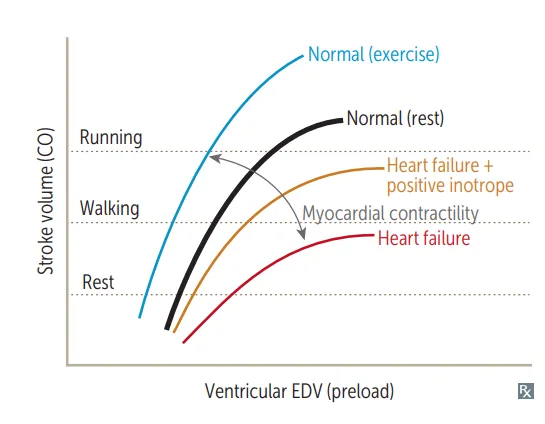
What this shows
The law
force of contraction is proportional to the end-diastolic length of the cardiac muscle fibre, i.e. to preload.What contractility does to it
the curve family shows how contractility slides the whole curve rather than moving you along it.| Curve shifts up and left (more contractility) | Curve shifts down and right (less contractility) |
|---|---|
| Catecholamines | Loss of functional myocardium after MI |
| Positive inotropes: dobutamine, milrinone, digoxin | Beta-blockers, acutely |
| Exercise | Nondihydropyridine calcium channel blockers |
| Heart failure |
A patient has aortic regurgitation. Is the pulse pressure wide or narrow, and why?
Wide. Pulse pressure is proportional to stroke volume, and the regurgitant ventricle ejects a larger stroke volume; aortic stenosis does the opposite.
How it's tested
Ejection fraction is reduced in systolic heart failure and normal in diastolic heart failure, and that single distinction drives a large share of all heart failure questions, including which drugs have a mortality benefit. For pulse pressure, aortic regurgitation widens it and aortic stenosis narrows it, which you can derive rather than memorise, since pulse pressure is proportional to stroke volume. The Fick principle appears as a calculation, so be ready to solve it for cardiac output given oxygen consumption and an arteriovenous difference.
Go deeper
First Aid 2026 — CV/Physiology (p.289) · B&B — Fick principle & Starling curve · Mehlman — HY Cardio (ejection fraction, HFrEF vs HFpEF)
High-yield images1
Flashcards for this page
Card 1 of 5 · try-out only, nothing is saved
Cardiac output = (...) × (...)
You just read one page of 944
The rest of Step 1, written exactly like this.
Rapid Review is the reading layer of a full Step 1 platform: a schedule fitted to your exam date, flashcards for every page, and a mentor a message away.
Every Step 1 system
Written the same way: what to know, how it’s tested, where to go deeper.
A plan built to your exam date
Tell us when you sit, and the schedule fits the whole library and your question bank to it.
Flashcards for every page
Ready-made spaced-repetition decks linked to each topic, so nothing you read gets forgotten.
