
Rapid Review·Cardiovascular
Select any text to highlight it or add a note.
PHYSIOLOGY
T3Take a glanceResistance, Pressure, Flow & Cardiac/Vascular Function Curves
FA P290
Videos
1 to play here
Play 1 here
Focus on
Why radius dominates resistance, and how two intersecting curves find the heart’s operating point.
Key takeaways
Normal cardiac pressures
The values
marked on the Normal cardiac Pressure figure.- Right atrium < 5 mm Hg
- Right ventricle (pulmonary artery pressure) 25/5 mm Hg
- Left atrium (pulmonary capillary wedge pressure) < 12 mm Hg (higher than left ventricular pressure in mitral stenosis)
- Left ventricle 130/10 mm Hg
Flow and resistance
Flow
volumetric flow rate Q = flow velocity (v) × cross-sectional area (A).Resistance
R = ΔP / Q = 8ηL / πr⁴, so R is inversely proportional to r⁴. Radius overwhelms every other term.Pressure drop
ΔP = Q × R, which is the exact analogue of Ohm's law (V = I × R).Series and parallel
in series R total = R1 + R2 + R3. In parallel 1/R total = 1/R1 + 1/R2 + 1/R3. Never asked, just to understand.Viscosity
depends mostly on hematocrit. It rises in hyperproteinemic states (multiple myeloma) and polycythemia, and falls in anemia.Where each vascular segment dominates
- Arterioles account for most of total peripheral resistance.
- Capillaries have the highest total cross-sectional area and therefore the lowest flow velocity, which is what allows time for exchange.
- Veins provide most of the blood storage capacity.
| Segment | Dominant property |
|---|---|
| Arterioles | Most of total peripheral resistance |
| Capillaries | Highest total cross-sectional area, lowest flow velocity |
| Veins | Most of blood storage capacity |
Cardiac and vascular function curves
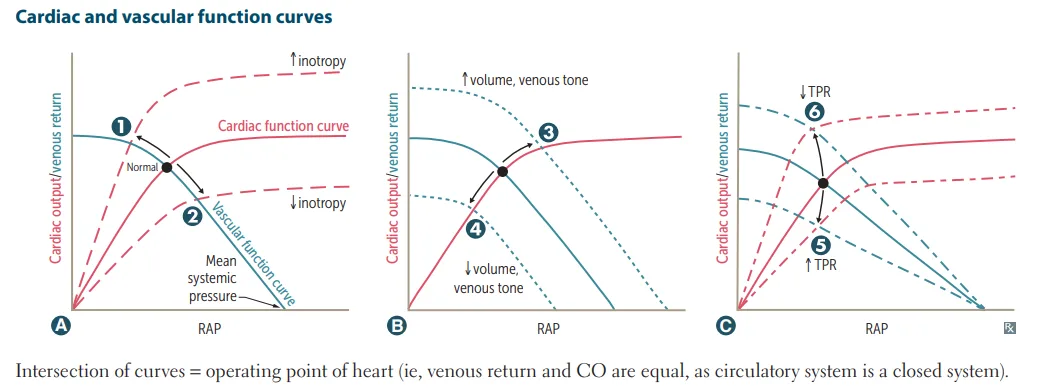
What this shows
The operating point
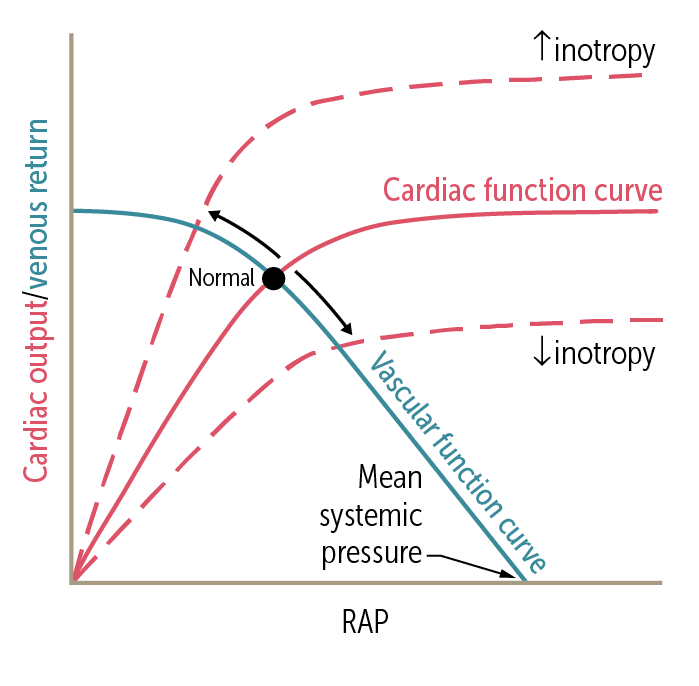
the intersection of the cardiac and vascular function curves is the operating point of the heart. Venous return and cardiac output must be equal, because the circulation is a closed system. The three panels show what each intervention moves.Changes usually occur in tandem, in one of two patterns
- Reinforcing: exercise raises inotropy and lowers TPR, both acting to maximise cardiac output.
- Compensatory: heart failure lowers inotropy, so fluid is retained to raise preload and defend cardiac output.
| Graph | Effect | Raised by | Lowered by |
|---|---|---|---|
| Inotropy | Changes contractility, so SV and cardiac output change | Catecholamines, dobutamine, digoxin, exercise | HFrEF, narcotic overdose, sympathetic inhibition |
| Venous return | Changes circulating volume, so RAP and then SV change | Fluid infusion, sympathetic activity, AV shunt | Acute hemorrhage, spinal anesthesia |
| Total peripheral resistance | Changes cardiac output; effect on RAP is unpredictable | Vasopressors | Exercise, AV shunt |
A vessel's radius is halved. By how much does its resistance change?
Sixteen-fold, because resistance is inversely proportional to r⁴. Length only enters linearly, which is why a larger-bore catheter beats a longer one.
How it's tested
Resistance is inversely proportional to the fourth power of the radius, so halving a vessel's radius raises resistance sixteen-fold. That is why arterioles, not the aorta, set total peripheral resistance. The same relationship is tested clinically: asked how to speed up large-volume fluid resuscitation, with the options being a second catheter, a longer catheter, or a larger-bore catheter, the answer is the larger bore, because radius enters to the fourth power while length only enters linearly. Mehlman's hypertension point is a good check on understanding: high arterial pressure does not flood the interstitium, because increased pre-capillary resistance shields the capillary bed.
Go deeper
First Aid 2026 — CV/Physiology (p.290) · B&B — Vascular function curves · Mehlman — HY Cardio (Poiseuille, pre-capillary resistance and edema)
High-yield images2
Flashcards for this page
Card 1 of 5 · try-out only, nothing is saved
(...) of the heart
You just read one page of 944
The rest of Step 1, written exactly like this.
Rapid Review is the reading layer of a full Step 1 platform: a schedule fitted to your exam date, flashcards for every page, and a mentor a message away.
Every Step 1 system
Written the same way: what to know, how it’s tested, where to go deeper.
A plan built to your exam date
Tell us when you sit, and the schedule fits the whole library and your question bank to it.
Flashcards for every page
Ready-made spaced-repetition decks linked to each topic, so nothing you read gets forgotten.
