
Rapid Review·Cardiovascular
Select any text to highlight it or add a note.
PHARMACOLOGY
T2High yieldClass I Antiarrhythmics
FA P326
Videos
1 to play here
Play 1 here
Focus on
Three subclasses of sodium channel blocker, ranked by how tightly they bind.
Key takeaways
How sodium channel blockers work
Class I mechanism
slow or block conduction, especially in depolarized cells, by reducing the slope of phase 0.State-dependent, so stronger at faster heart rates
a faster rate shortens diastole, so sodium channels spend less time in the resting state where the drug dissociates.The binding-strength ranking
the effect is most pronounced in IC > IA > IB. "Fast taxi CAB." The full mnemonic scene is on the class I antiarrhythmics mnemonic.The three subclasses, compared on the action potential
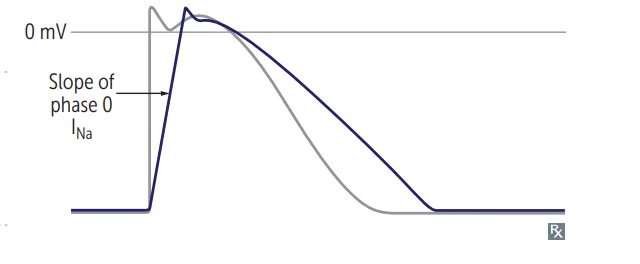
What this shows
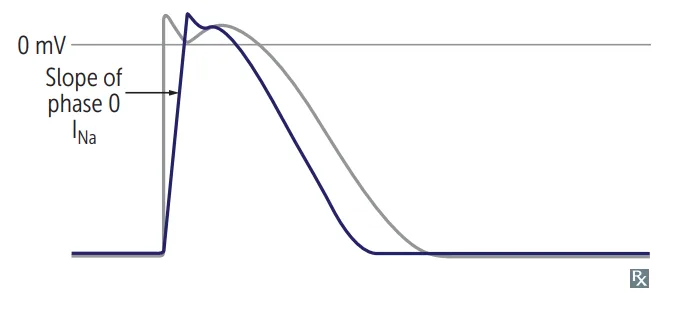
What this shows
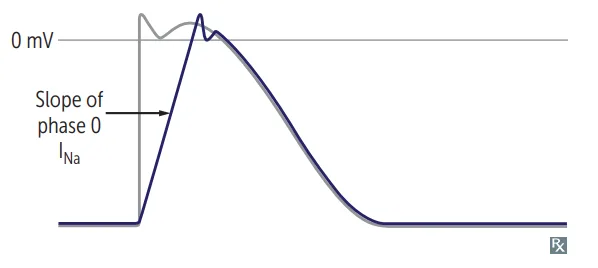
What this shows
Class IA, quinidine, procainamide, disopyramide
"The queen proclaims Diso's pyramid."- Moderate sodium blockade, plus some potassium blockade, so AP duration, ERP and QT all lengthen.
- Use: both atrial and ventricular arrhythmias, especially reentrant and ectopic SVT and VT.
- Adverse: cinchonism (headache, tinnitus) with quinidine, a reversible SLE-like syndrome with procainamide, heart failure with disopyramide, thrombocytopenia, and torsades from the long QT.
Class IB, lidocaine, mexiletine
"I'd Buy Liddy's Mexican tacos."- Weak sodium blockade (it dissociates easily), and it shortens AP duration. Preferentially affects ischemic or depolarized Purkinje and ventricular tissue, which is why it targets damaged myocardium.
- Use: acute ventricular arrhythmias, especially post-MI, and digitalis-induced arrhythmias. "IB is Best post-MI."
- Adverse: CNS stimulation or depression, cardiovascular depression.
Class IC, flecainide, propafenone
"Can I have fries, please?"- Strong sodium blockade with minimal effect on AP duration. Significantly prolongs ERP in the AV node and accessory bypass tracts, but has no effect on ERP in Purkinje and ventricular tissue.
- Use: SVTs including atrial fibrillation, and only as a last resort in refractory VT.
- Adverse: proarrhythmic, especially post-MI, so it is contraindicated in structural and ischemic heart disease. "IC is Contraindicated."
| Feature | IA | IB | IC |
|---|---|---|---|
| Drugs | Quinidine, procainamide, disopyramide | Lidocaine, mexiletine | Flecainide, propafenone |
| Sodium blockade | Moderate | Weak | Strong |
| AP duration | Lengthened | Shortened | Minimal change |
| QT | Lengthened | Unchanged | Unchanged |
| Use | Atrial and ventricular: reentrant and ectopic SVT and VT | Acute ventricular arrhythmias post-MI, digitalis-induced | SVTs including AF; last resort in refractory VT |
| Signature toxicity | Cinchonism (quinidine), drug-induced lupus (procainamide), torsades | CNS stimulation or depression | Proarrhythmic, contraindicated post-MI |
A patient on quinidine develops tinnitus and headache; another on procainamide develops a malar rash and arthralgia. Name each toxicity.
Cinchonism for quinidine, drug-induced lupus for procainamide. Both are class IA, and both also prolong the QT.
How it's tested
The two rules that carry most questions are IB is Best post-MI and IC is Contraindicated in structural or ischemic heart disease, where the CAST trial showed increased mortality. Beyond that, the subclasses are separated by their effect on the action potential duration: IA prolongs it, which is why quinidine and procainamide cause torsades, IB shortens it, and IC leaves it unchanged while slowing conduction the most. Procainamide's own vignette is drug-induced lupus, and quinidine's is cinchonism.
Go deeper
First Aid 2026 — CV/Pharmacology (p.326) · B&B — Class I antiarrhythmics · Mehlman — HY Cardio (IA/IB/IC, post-MI arrhythmia)
High-yield images4
Flashcards for this page
Card 1 of 5 · try-out only, nothing is saved
Class IA → (...) blocking
Class IB → (...) blocking
Class IC → (...) blocking
You just read one page of 944
The rest of Step 1, written exactly like this.
Rapid Review is the reading layer of a full Step 1 platform: a schedule fitted to your exam date, flashcards for every page, and a mentor a message away.
Every Step 1 system
Written the same way: what to know, how it’s tested, where to go deeper.
A plan built to your exam date
Tell us when you sit, and the schedule fits the whole library and your question bank to it.
Flashcards for every page
Ready-made spaced-repetition decks linked to each topic, so nothing you read gets forgotten.
