
Rapid Review·Cardiovascular
Select any text to highlight it or add a note.
PHARMACOLOGY
T1Must knowDigoxin
FA P326
Focus on
One drug, two mechanisms, and the narrowest therapeutic window in cardiology.
Key takeaways
Two mechanisms, two uses
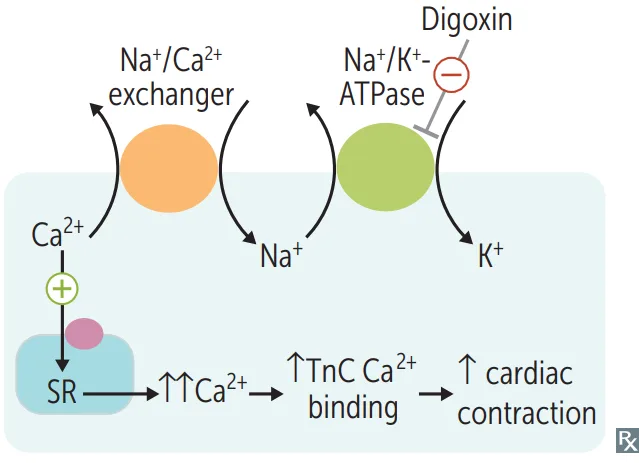
What this shows
Inotropy
direct inhibition of Na+/K+-ATPase, which indirectly stalls the Na+/Ca2+ exchanger, so intracellular calcium rises and contractility increases.Vagal tone
it stimulates the vagus nerve, slowing AV nodal conduction and the heart rate. This only works at rest: during exercise the sympathetic surge overrides it and AV conduction speeds up again.Uses
heart failure, through the inotropy, and atrial fibrillation, through slowed AV nodal conduction and SA node depression.Adverse
cholinergic effects (nausea, vomiting, diarrhea), blurry yellow vision ("van Glow"), arrhythmias (the cause of death), and atrial tachycardia with AV block.| Mechanism | Effect | Clinical use |
|---|---|---|
| Na+/K+-ATPase inhibition raising intracellular Ca2+ | Positive inotropy | Heart failure |
| Vagal stimulation | Slows AV nodal conduction and the SA node | Rate control in atrial fibrillation |
The narrow window
Clearance
mostly renal, so the dose comes down in older patients, whose GFR is lower.What predisposes to toxicity
renal failure (reduced excretion), hypokalemia (permissive for digoxin binding at the K+ site on the pump), drugs that displace digoxin from tissue binding sites, and reduced clearance from verapamil, amiodarone, or quinidine.Antidote
slowly normalize potassium, cardiac pacing, anti-digoxin Fab fragments, and magnesium.| Factor | Mechanism |
|---|---|
| Renal failure | Reduced excretion |
| Hypokalemia | Permissive for digoxin binding at the K+ site on Na+/K+-ATPase |
| Verapamil, amiodarone, quinidine | Reduced clearance |
| Drugs displacing digoxin from tissue | Raise the free drug level |
A digoxin-toxic patient has a potassium of 6.2. Is that a cause of the toxicity or a result of it?
A result, and a bad sign: the poisoned pumps can no longer keep potassium inside the cells. The potassium that causes toxicity is a low one.
How it's tested
Hypokalemia potentiates digoxin toxicity because potassium and digoxin compete for the same binding site on the Na+/K+-ATPase, so less potassium means more digoxin bound. But hyperkalemia in an already-toxic patient is a marker of severity, not a cause, and that directional distinction is exactly what gets tested. The two mechanisms map onto two uses and should be stated separately: inhibiting the pump raises intracellular calcium and gives inotropy for heart failure, while vagal stimulation slows AV nodal conduction for rate control in atrial fibrillation.
Go deeper
First Aid 2026 — CV/Pharmacology (p.326) · B&B — Digoxin · Mehlman — HY Cardio (digoxin toxicity, hypokalemia)
High-yield images1
Flashcards for this page
Card 1 of 5 · try-out only, nothing is saved
Depresses (...) node activity
Slows (...) node conduction
You just read one page of 944
The rest of Step 1, written exactly like this.
Rapid Review is the reading layer of a full Step 1 platform: a schedule fitted to your exam date, flashcards for every page, and a mentor a message away.
Every Step 1 system
Written the same way: what to know, how it’s tested, where to go deeper.
A plan built to your exam date
Tell us when you sit, and the schedule fits the whole library and your question bank to it.
Flashcards for every page
Ready-made spaced-repetition decks linked to each topic, so nothing you read gets forgotten.
