
Rapid Review·Cardiovascular
Select any text to highlight it or add a note.
PHYSIOLOGY
T2High yieldHeart Sounds: S1-S4 & Splitting of S2
FA P291, 293
Videos
1 to play here
Play 1 here
Focus on
The four sounds, what each one says about the ventricle, and the four splitting patterns that each name a lesion.
Key takeaways
The four heart sounds
S1
mitral and tricuspid closure. Loudest at the mitral area.S2
aortic and pulmonary closure. Loudest at the left upper sternal border.S3
early diastole, during rapid ventricular filling. Best heard at the apex in the left lateral decubitus position. Associated with raised filling pressures (mitral regurgitation, aortic regurgitation, heart failure, thyrotoxicosis) and with dilated ventricles. Can be normal in children, young adults, athletes, and pregnancy. Think volume overload.S4
late diastole, the "atrial kick." Turbulence as blood enters a stiffened LV against high atrial pressure. Associated with ventricular noncompliance, i.e. hypertrophy. Abnormal if palpable, and common in older adults. Think pressure overload.| Feature | S3 | S4 |
|---|---|---|
| Timing | Early diastole (rapid filling) | Late diastole ("atrial kick") |
| Mechanism | Raised volume and preload, reverberation against the wall | Raised pressure and afterload, blood striking a stiff ventricle |
| Hypertrophy | Eccentric (sarcomeres in series) | Concentric (sarcomeres in parallel) |
| Associated with | MR, AR, heart failure, thyrotoxicosis, dilated ventricles | Hypertension, aortic stenosis, hypertrophy |
| Can be normal? | Yes, in children, young adults, athletes, pregnancy | Never (Mehlman: always pathologic) |
| Best heard | Apex, left lateral decubitus | Apex, left lateral decubitus |
Splitting of S2
Physiologic splitting
inspiration drops intrathoracic pressure, so venous return rises, RV filling rises, RV stroke volume rises, RV ejection time lengthens, and pulmonic closure is delayed. Rising pulmonary impedance during inspiration contributes as well.Wide splitting
anything that delays RV emptying, i.e. pulmonic stenosis and right bundle branch block. It is an exaggeration of the normal pattern, not a different one.Fixed splitting
the signature of an ASD. The left-to-right shunt raises RA and RV volumes, so flow across the pulmonic valve is high and P2 is delayed regardless of respiration.Paradoxical splitting
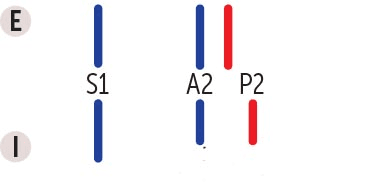
anything that delays aortic closure, i.e. aortic stenosis and left bundle branch block.- The normal order of semilunar closure is reversed, so P2 comes before A2.
- On inspiration P2 moves later and therefore closer to A2, so the split disappears. On expiration the split is heard. This is the exact opposite of physiologic splitting.
| Pattern | Mechanism | Causes | Mehlman's shorthand |
|---|---|---|---|
| Physiologic | Inspiration raises venous return and RV ejection time, delaying P2 | Normal | |
| Wide | Delayed RV emptying | Pulmonic stenosis, RBBB | = RVH |
| Fixed | ASD raises RA and RV volume, delaying P2 regardless of respiration | ASD | "Wide, fixed" = RVH from an ASD |
| Paradoxical | Delayed aortic closure, so P2 precedes A2; split vanishes on inspiration | Aortic stenosis, LBBB | = LVH |
| Finding set | Means |
|---|---|
| Wide splitting + right-axis deviation + RBBB | Right ventricular hypertrophy |
| Paradoxical splitting + left-axis deviation + LBBB | Left ventricular hypertrophy |
| Loud P2 + tricuspid regurgitation | Pulmonary hypertension / cor pulmonale |
An S2 split is heard on expiration and disappears on inspiration. Which pattern, and which two lesions?
Paradoxical splitting. Aortic closure is delayed so P2 comes before A2, and inspiration pushes P2 toward A2; the causes are aortic stenosis and LBBB.
How it's tested
Mehlman's mapping is the one to carry: S3 means a volume problem and eccentric hypertrophy, S4 means a pressure problem and concentric hypertrophy. The two traps built on it are that S4 can be right-sided, and that S3 plus S4 together points to high-output failure.
Fixed splitting that does not vary with respiration is an ASD, because the shunt volume overwhelms the normal respiratory variation. Mehlman flags loud P2 as one of the highest-yield and most overlooked sounds: a smoker with a loud P2 simply has pulmonary hypertension, and that is the whole question. For paradoxical splitting, reason it out rather than memorising the direction: aortic closure is late, so P2 comes first, and inspiration pushes P2 toward A2 and closes the gap.
Go deeper
First Aid 2026 — CV/Physiology (p.291, 293) · B&B — Heart sounds; splitting of S2 · Mehlman — HY Cardio (S3 vs S4, fixed/wide/paradoxical splitting, loud P2)
High-yield images4
Flashcards for this page
Card 1 of 5 · try-out only, nothing is saved
(...) splitting
You just read one page of 944
The rest of Step 1, written exactly like this.
Rapid Review is the reading layer of a full Step 1 platform: a schedule fitted to your exam date, flashcards for every page, and a mentor a message away.
Every Step 1 system
Written the same way: what to know, how it’s tested, where to go deeper.
A plan built to your exam date
Tell us when you sit, and the schedule fits the whole library and your question bank to it.
Flashcards for every page
Ready-made spaced-repetition decks linked to each topic, so nothing you read gets forgotten.
