
Rapid Review·Cardiovascular
Select any text to highlight it or add a note.
PHYSIOLOGY
T1Must knowCardiac Cycle, JVP & Pressure-Volume Loops
FA P291-292
Videos
2 to play here
Play 2 here
Focus on
Four phases bounded by valve events, the venous waveform that reads as a diagnosis, and how each valve lesion deforms the loop.
Key takeaways
Phases of the left ventricle
The rule
each phase is bounded by a valve event. Follow them counter-clockwise around the pressure-volume loop, then see them aligned with the sounds and the ECG on the Wiggers diagram.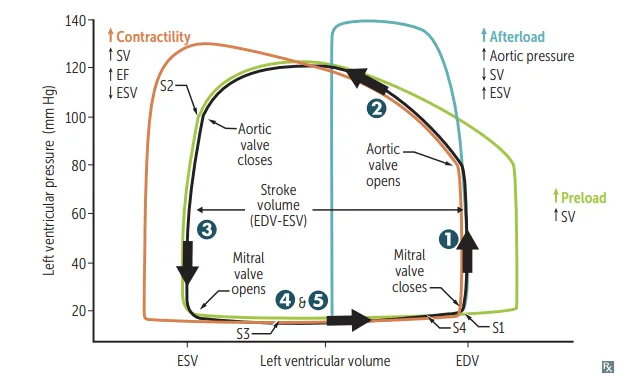
What this shows
Isovolumetric contraction (systole)
between mitral closure and aortic opening. The period of highest oxygen consumption, because the ventricle generates maximal pressure while doing no external work.Systolic ejection (systole)
between aortic opening and aortic closure.Isovolumetric relaxation (diastole)
between aortic closure and mitral opening.Rapid filling (diastole)
just after mitral opening.Reduced filling (diastole)
just before mitral closure.Dicrotic notch
slight ↑ of aortic pressure in the early diastole that corresponds to closure of the aortic valve.Coronary blood flow
peaks during early diastole.| Phase | Begins with | Ends with |
|---|---|---|
| Isovolumetric contraction | Mitral closes (S1) | Aortic opens |
| Systolic ejection | Aortic opens | Aortic closes (S2) |
| Isovolumetric relaxation | Aortic closes (S2) | Mitral opens |
| Rapid filling | Mitral opens | Reduced filling begins |
The jugular venous pulse
Reading the waveform
the normal JVP is the reference; all five patterns sit side by side below.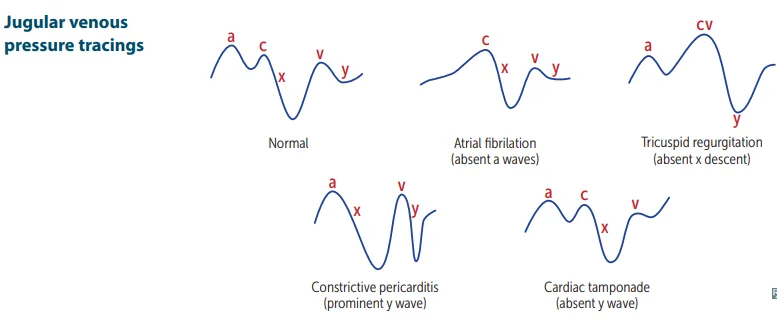
What this shows
Atrial fibrillation gives absent a waves
because there is no organized atrial contraction to produce one.Tricuspid regurgitation gives an absent x descent
because the atrium never truly relaxes against a competent valve; c and v fuse into a single tall cv wave.Constrictive pericarditis gives a prominent y descent
the RA empties fast, then the ventricle hits the rigid pericardium.Cardiac tamponade gives an absent y descent
because the RV cannot fill at all.| Wave | Represents | Abnormalities |
|---|---|---|
| a wave | Atrial contraction | Prominent (cannon a wave) in AV dissociation and raised RV end-diastolic pressure. Absent in atrial fibrillation |
| c wave | RV contraction, the closed tricuspid bulging into the atrium | |
| x descent | Atrial relaxation plus downward pull of the closed tricuspid valve | Reduced or absent in tricuspid regurgitation and right heart failure |
| v wave | Rising RA pressure as it fills against a closed tricuspid valve (venous return) | Tall in tricuspid or mitral regurgitation |
| y descent | RA emptying into the RV | Prominent in constrictive pericarditis; absent in cardiac tamponade |
| Tracing abnormality | Diagnosis |
|---|---|
| Absent a waves | Atrial fibrillation |
| Cannon a waves | AV dissociation (third-degree block) |
| Absent x descent | Tricuspid regurgitation |
| Prominent y descent | Constrictive pericarditis |
| Absent y descent | Cardiac tamponade |
| Tall v wave | Mitral or tricuspid regurgitation |
Pressure-volume loops in valvular disease
Aortic stenosis
on the aortic stenosis loop: LV pressure exceeds aortic pressure, ESV rises and SV falls, EDV is unchanged if mild, and hypertrophy lowers compliance so end-diastolic pressure is higher for a given EDV.Aortic regurgitation
on the aortic regurgitation loop: EDV rises, ESV falls, SV rises, there is no true isovolumetric phase, the pulse pressure is wide, and the dicrotic notch is lost.Mitral stenosis
on the mitral stenosis loop: LA pressure far exceeds LV pressure through diastole, EDV falls because filling is obstructed, and SV falls with it.Mitral regurgitation
on the mitral regurgitation loop: LA pressure rises (tall v wave), there is no true isovolumetric phase, ESV falls because blood escapes backward into the low-resistance atrium during systole, and EDV rises as that volume returns.| Lesion | EDV | ESV | SV | Isovolumetric phases | Signature |
|---|---|---|---|---|---|
| Aortic stenosis | Unchanged if mild | Raised | Reduced | Preserved | LV pressure > aortic pressure; raised EDP for a given EDV |
| Aortic regurgitation | Raised | Reduced | Raised | Lost | Wide pulse pressure; loss of dicrotic notch |
| Mitral stenosis | Reduced | Reduced | Reduced | Preserved | LA pressure far above LV in diastole |
| Mitral regurgitation | Raised | Reduced | Total raised, forward reduced | Lost | Tall v wave |
| Lesion | Which valve leaks | Consequence |
|---|---|---|
| Aortic regurgitation | Aortic valve never fully closes | Blood enters the LV during "isovolumetric relaxation", so the volume is not constant |
| Mitral regurgitation | Mitral valve never fully closes | Blood leaves the LV during "isovolumetric contraction", so the volume is not constant |
Which phase of the cardiac cycle uses the most oxygen, and why?
Isovolumetric contraction. The ventricle generates maximal pressure while doing no external work.
How it's tested
Isovolumetric contraction is the period of highest myocardial oxygen consumption, because the ventricle generates maximal pressure while performing no external work, and that reasoning is what the question is checking. Every phase boundary is a valve event, so a stem naming a valve opening or closing is really asking which phase begins.
A prominent y descent means constrictive pericarditis and an absent y descent means tamponade. The two look similar at the bedside, so the waveform is what separates them: in constriction the ventricle fills fast and then stops abruptly against the rigid pericardium, while in tamponade it never fills at all. The regurgitant lesions lose their isovolumetric phases for a purely mechanical reason, which is that a leaking valve makes constant volume impossible, and reasoning it out beats memorising the table.
Go deeper
First Aid 2026 — CV/Physiology (p.291-292) · B&B — Cardiac cycle & PV loops; JVP waveforms · Mehlman — HY Cardio (Wiggers, a/c/v waves, constriction vs tamponade)
High-yield images8
Flashcards for this page
Card 1 of 5 · try-out only, nothing is saved
(...)
You just read one page of 944
The rest of Step 1, written exactly like this.
Rapid Review is the reading layer of a full Step 1 platform: a schedule fitted to your exam date, flashcards for every page, and a mentor a message away.
Every Step 1 system
Written the same way: what to know, how it’s tested, where to go deeper.
A plan built to your exam date
Tell us when you sit, and the schedule fits the whole library and your question bank to it.
Flashcards for every page
Ready-made spaced-repetition decks linked to each topic, so nothing you read gets forgotten.
