Rapid Review·Cardiovascular
Select any text to highlight it or add a note.
EMBRYOLOGY
T1Must knowHeart Tube, Looping & Outflow Tract Formation
FA P284-285
Videos
2 to play here
Play 2 here
Focus on
The first organ to function, the loop that sets left from right, and the neural crest cells that divide the outflow tract.
Key takeaways
The heart tube and its loop
The heart is the FIRST functional organ in vertebrate embryos
beating spontaneously by weeks 4 to 5, and detectable on transvaginal ultrasound by week 6.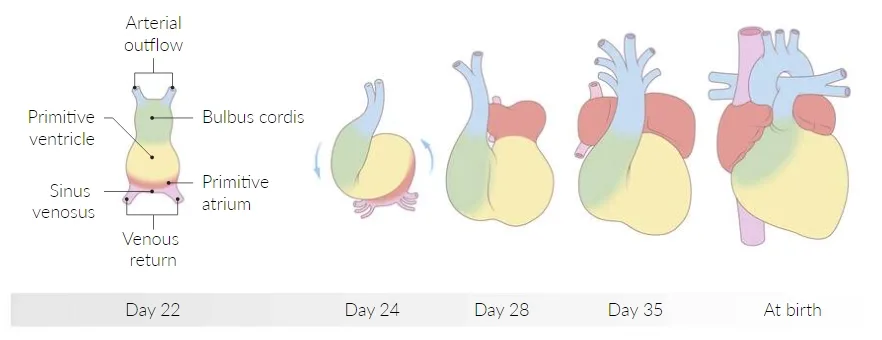
What this shows
Cardiac looping establishes LEFT-RIGHT polarity, beginning in week 4
the primary heart tube bends so that the structures destined to be right-sided and left-sided end up on the correct side of the midline.- A defect in left-right dynein, the motor protein that drives the ciliary movement setting left-right asymmetry, causes dextrocardia, as in Kartagener syndrome.
Outflow tract formation
Outflow tract division is driven by NEURAL CREST cell migration
the migrating cells build the truncal and bulbar ridges, which spiral and fuse into the aorticopulmonary septum, dividing the outflow tract into the ascending aorta and the pulmonary trunk.The spiral is the whole reason the pulmonary trunk ends up ANTERIOR to the aorta
trace the four stages and each failure mode becomes obvious.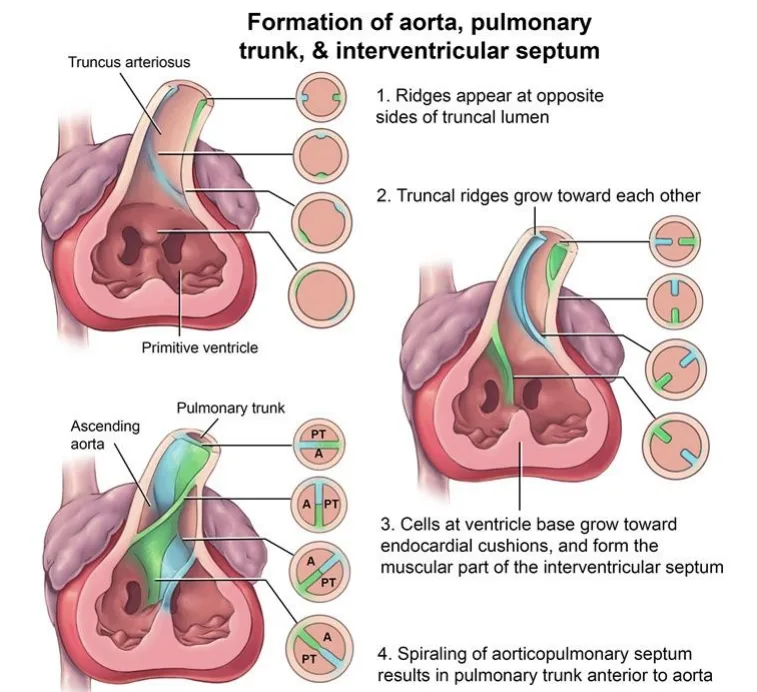
What this shows
Conotruncal abnormalities all trace back to failed neural crest migration
which is why they cluster together in question stems and why they share the 22q11 deletion association.| Defect | Why neural crest matters |
|---|---|
| Transposition of the great arteries | Aorticopulmonary septum fails to spiral |
| Tetralogy of Fallot | Anterosuperior displacement of the infundibular septum |
| Persistent truncus arteriosus | Aorticopulmonary septum fails to form at all |
Valve development
Semilunar valves from the outflow tract cushions, AV valves from the AV canal cushions
- Aortic and pulmonary valves from the endocardial cushions of the outflow tract.
- Mitral and tricuspid valves from the fused endocardial cushions of the AV canal.
- Anomalies may be stenotic, regurgitant, atretic (tricuspid atresia), or displaced (Ebstein anomaly).
| Valve | Derived from |
|---|---|
| Aortic / Pulmonary | Endocardial cushions of the outflow tract |
| Mitral / Tricuspid | Fused endocardial cushions of the AV canal |
A newborn is cyanotic from the first minutes of life. Echocardiography shows the aorta arising anteriorly from the right ventricle and the pulmonary trunk arising posteriorly from the left ventricle, running parallel rather than crossing. What embryologic step failed, what keeps this infant alive, and how would the picture differ if the same cells had failed completely?
This is transposition of the great arteries, and the failed step is the spiraling of the aorticopulmonary septum. Normally the septum, built by migrating neural crest cells forming the truncal and bulbar ridges, twists as it divides the outflow tract, which is what leaves the pulmonary trunk anterior to the aorta and makes each vessel connect to the correct ventricle. Without the spiral the septum still divides the tract but straight down, so the two circulations run in parallel instead of in series, and that parallel arrangement is fatal unless the blood can mix. What keeps the infant alive is a shunt: a patent foramen ovale, a VSD, or the ductus arteriosus, which is why prostaglandin E1 is given immediately to keep the duct open until surgery; see Fetal Circulation & Postnatal Derivatives. Had the same neural crest cells failed completely, no septum would form at all and the outflow tract would remain a single vessel, which is persistent truncus arteriosus. Note that both lesions, plus tetralogy of Fallot, carry the association with 22q11 deletion, because the same cells build the thymus and parathyroids.
How it's tested
Dextrocardia in a patient with recurrent sinusitis and infertility is Kartagener syndrome. The defect is in left-right dynein, which is exactly what fails during cardiac looping in week 4, so the embryology and the clinical triad are the same question. The outflow tract is tested through its neural crest dependence: if a stem describes the great vessels arising in parallel, the failure was the spiral of the aorticopulmonary septum, giving transposition, and if the septum never forms at all the answer is persistent truncus arteriosus.
Go deeper
First Aid 2026 — CV/Embryology (p.284-285) · B&B — Heart embryology; outflow tract & neural crest · Mehlman — HY Cardio (conotruncal anomalies, transposition)
High-yield images2
Flashcards for this page
Card 1 of 5 · try-out only, nothing is saved
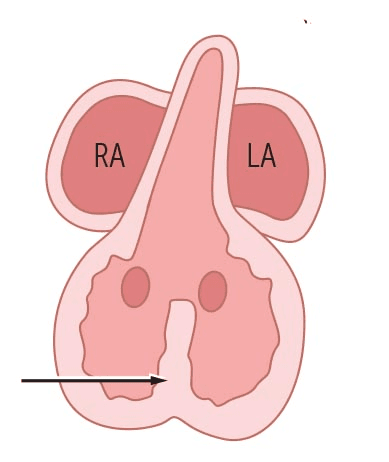
(...)
You just read one page of 944
The rest of Step 1, written exactly like this.
Rapid Review is the reading layer of a full Step 1 platform: a schedule fitted to your exam date, flashcards for every page, and a mentor a message away.
Every Step 1 system
Written the same way: what to know, how it’s tested, where to go deeper.
A plan built to your exam date
Tell us when you sit, and the schedule fits the whole library and your question bank to it.
Flashcards for every page
Ready-made spaced-repetition decks linked to each topic, so nothing you read gets forgotten.
