
Rapid Review·Cardiovascular
Select any text to highlight it or add a note.
PHARMACOLOGY
T2High yieldLipid-Lowering Agents
FA P324-325
Focus on
Six drugs sorted by what they move, and the point on the cholesterol pathway where each one intervenes.
Key takeaways
The seven drugs
Statins
inhibit HMG-CoA reductase, so cholesterol synthesis falls, intrahepatic cholesterol falls, LDL receptor recycling rises, and LDL catabolism increases; VLDL synthesis falls too. They reduce mortality in coronary artery disease. Adverse: hepatotoxicity with raised LFTs, and myopathy, especially with fibrates or niacin.Bile acid resins (cholestyramine, colesevelam, colestipol)
disrupt enterohepatic bile acid circulation, so the liver converts more cholesterol into bile, intrahepatic cholesterol falls, and LDL receptor recycling rises. The liver also switches on HMG-CoA reductase to make up the loss, which a statin blocks, so the two are synergistic. Adverse: GI upset, and reduced absorption of other drugs and fat-soluble vitamins.Ezetimibe
blocks cholesterol absorption at the small intestinal brush border. Adverse: rare raised LFTs, diarrhea.Fibrates (fenofibrate, gemfibrozil)
activate PPAR-alpha (thiazolidinediones act on PPAR-gamma), upregulating lipoprotein lipase to clear triglycerides and lower VLDL production, and also raise HDL synthesis. Adverse: myopathy, worse with statins, and cholesterol gallstones via inhibition of cholesterol 7-alpha-hydroxylase.Niacin
inhibits lipolysis in adipose tissue through hormone-sensitive lipase, and reduces hepatic VLDL synthesis. Adverse: facial flushing, which is prostaglandin-mediated and blunted by aspirin or by long-term use, plus hyperglycemia and hyperuricemia.PCSK9 inhibitors (alirocumab, evolocumab)
block LDL receptor degradation in the lysosome, so more receptors recycle to the hepatocyte surface and hepatic LDL uptake rises. No CYP metabolism, so minimal drug interactions. Adverse: myalgias, and neurocognitive effects (delirium, dementia).Fish oil and marine omega-3 fatty acids
reduce free fatty acid delivery to the liver and triglyceride-synthesising enzyme activity, lowering VLDL production and inhibiting ApoB synthesis. Adverse: nausea and a fishlike taste.Every one of these sits at a distinct point on the pathway
laid out on the lipid pathway drug map.| Drug | LDL | HDL | TG | Mechanism | Adverse effects |
|---|---|---|---|---|---|
| Statins | Falls most | Rises | Falls | Inhibit HMG-CoA reductase, raising LDL receptor recycling | Hepatotoxicity, myopathy (worse with fibrates or niacin) |
| Bile acid resins | Falls | Slight rise | Slight rise | Disrupt enterohepatic bile acid circulation | GI upset, reduced absorption of drugs and fat-soluble vitamins |
| Ezetimibe | Falls | Little change | Little change | Blocks cholesterol absorption at the brush border | Rare raised LFTs, diarrhea |
| Fibrates | Falls | Rises | Falls most | PPAR-alpha raises lipoprotein lipase | Myopathy with statins, cholesterol gallstones |
| Niacin | Falls | Rises most | Falls | Inhibits lipolysis; lowers hepatic VLDL synthesis | Flushing (prostaglandin-mediated), hyperglycemia, hyperuricemia |
| PCSK9 inhibitors | Falls most | Rises | Falls | Block LDL receptor degradation | No CYP metabolism; myalgias, neurocognitive effects |
| Fish oil (omega-3) | Slight rise | Slight rise | Falls at high doses | Lower VLDL production, inhibit ApoB | Nausea, fishlike taste |
| Drug | Why it matters |
|---|---|
| Fibrates, especially gemfibrozil | Markedly raises myopathy risk with a statin |
| Niacin | Raises myopathy risk with a statin |
Where each one acts on the pathway
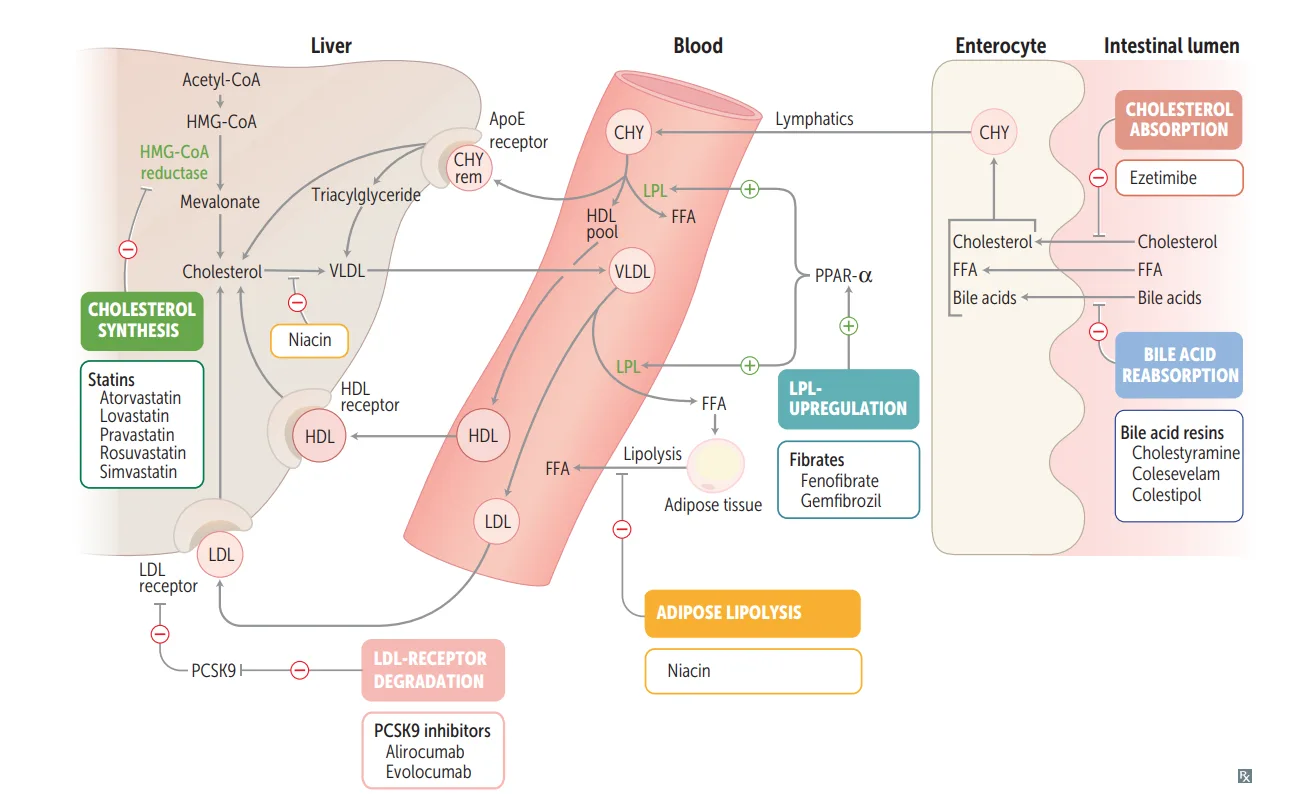
What this shows
Cholesterol synthesis in the liver
acetyl-CoA to HMG-CoA to mevalonate by HMG-CoA reductase, then on to cholesterol. Statins block HMG-CoA reductase, the rate-limiting step. Trace the whole route on the figure.PCSK9
normally binds the LDL receptor and tags it for degradation, so blocking PCSK9 lets more receptors recycle to the surface and hepatic LDL uptake rises.Intestinal lumen
ezetimibe blocks cholesterol absorption at the brush border, and bile acid resins block bile acid reabsorption.Chylomicrons
carry dietary lipid through the lymphatics; lipoprotein lipase liberates free fatty acids at the capillary bed; chylomicron remnants return to the liver via the ApoE receptor.Adipose lipolysis
inhibited by niacin through hormone-sensitive lipase, so less free fatty acid reaches the liver and VLDL synthesis falls.Lipoprotein lipase upregulation
the fibrate mechanism, acting through PPAR-alpha, which clears triglyceride from VLDL and chylomicrons.| Site | Drug | Molecular target |
|---|---|---|
| Hepatic cholesterol synthesis | Statins | HMG-CoA reductase, the rate-limiting step |
| LDL receptor degradation | PCSK9 inhibitors (alirocumab, evolocumab) | PCSK9 |
| Intestinal cholesterol absorption | Ezetimibe | The brush border transporter |
| Bile acid reabsorption | Bile acid resins | Enterohepatic circulation |
| Adipose lipolysis | Niacin | Hormone-sensitive lipase |
| Lipoprotein lipase upregulation | Fibrates | PPAR-alpha |
The LDL receptor loop, the unifying theme
Three routes, one endpoint
statins, bile acid resins, and PCSK9 inhibitors all end at the same place, more LDL receptors on the hepatocyte.- Statins: less synthesis, so less intrahepatic cholesterol.
- Bile acid resins: cholesterol diverted into bile, so less intrahepatic cholesterol.
- PCSK9 inhibitors: less receptor destruction.
| Drug | How it raises LDL receptors |
|---|---|
| Statins | Less cholesterol synthesis, so less intrahepatic cholesterol and more receptor recycling |
| Bile acid resins | More cholesterol converted to bile, so less intrahepatic cholesterol and more receptor recycling |
| PCSK9 inhibitors | Less receptor degradation, so more receptor recycling |
Two side effects with a mechanism
Why fibrates cause gallstones
they inhibit cholesterol 7-alpha-hydroxylase, the rate-limiting enzyme of bile acid synthesis, so less cholesterol becomes bile acid and the bile becomes supersaturated with cholesterol.Why bile acid resins raise triglycerides slightly
diverting cholesterol into bile acid synthesis drives compensatory hepatic VLDL production.| Enzyme | Pathway | Inhibited by | Consequence |
|---|---|---|---|
| HMG-CoA reductase | Cholesterol synthesis | Statins | LDL falls |
| Cholesterol 7-alpha-hydroxylase | Bile acid synthesis | Fibrates | Cholesterol gallstones |
A patient flushes after every dose of niacin. What is the mechanism, and what do you tell them to take beforehand?
The flush is prostaglandin-mediated, so aspirin taken beforehand prevents it (and it fades with long-term use).
How it's tested
Niacin's flushing is prostaglandin-mediated, which is why aspirin taken beforehand prevents it, and that mechanism is the question rather than the side effect itself. For the myopathy question, the drug to name alongside a statin is a fibrate.
Statins, bile acid resins, and PCSK9 inhibitors converge on the same endpoint, more LDL receptors on the hepatocyte surface, but arrive by three different routes, and the question is usually whether you can name the route rather than the endpoint. Fibrates cause gallstones by inhibiting cholesterol 7-alpha-hydroxylase, which blocks conversion of cholesterol into bile acids and leaves the bile supersaturated. Keep that enzyme distinct from HMG-CoA reductase, which is the statin target in a different pathway entirely.
Go deeper
First Aid 2026 — CV/Pharmacology (p.324-325) · B&B — Statins; cholesterol-lowering drugs · Mehlman — HY Cardio (statins, niacin flushing, fibrates, PCSK9); familial dyslipidemias cross-ref Biochemistry
High-yield images2
Flashcards for this page
Card 1 of 5 · try-out only, nothing is saved
Prevents intestinal (...) of bile acids → Liver synthesizes more from (...) stores
You just read one page of 944
The rest of Step 1, written exactly like this.
Rapid Review is the reading layer of a full Step 1 platform: a schedule fitted to your exam date, flashcards for every page, and a mentor a message away.
Every Step 1 system
Written the same way: what to know, how it’s tested, where to go deeper.
A plan built to your exam date
Tell us when you sit, and the schedule fits the whole library and your question bank to it.
Flashcards for every page
Ready-made spaced-repetition decks linked to each topic, so nothing you read gets forgotten.
