Rapid Review·Cardiovascular
Select any text to highlight it or add a note.
PHYSIOLOGY
T2High yieldMyocardial & Pacemaker Action Potentials
P296
Videos
3 to play here
Play 3 here
Focus on
Two different action potentials: one with a plateau, one that depolarizes itself.
Key takeaways
Myocardial (ventricular) action potential
Where
every cardiac myocyte except the SA and AV nodes.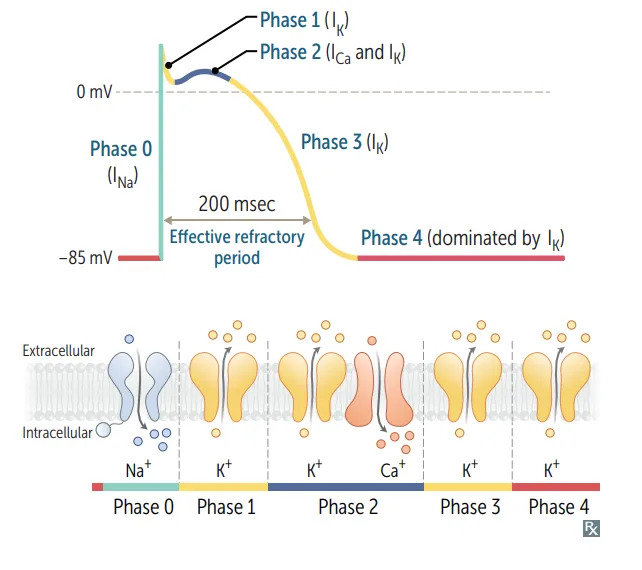
What this shows
Phase 0, rapid upstroke
fast voltage-gated Na+ channels open.Phase 1, early repolarization
Na+ channels inactivate and transient outward K+ channels open.Phase 2, the plateau
("platwo") Ca2+ influx balances K+ efflux. That calcium triggers calcium release from the SR and therefore contraction, which is excitation-contraction coupling.Phase 3, rapid repolarization
K+ efflux through slow delayed-rectifier channels as Ca2+ channels close.Phase 4, resting potential
high K+ permeability.Pacemaker action potential
Where
the SA and AV nodes. Phases 1 and 2 are absent.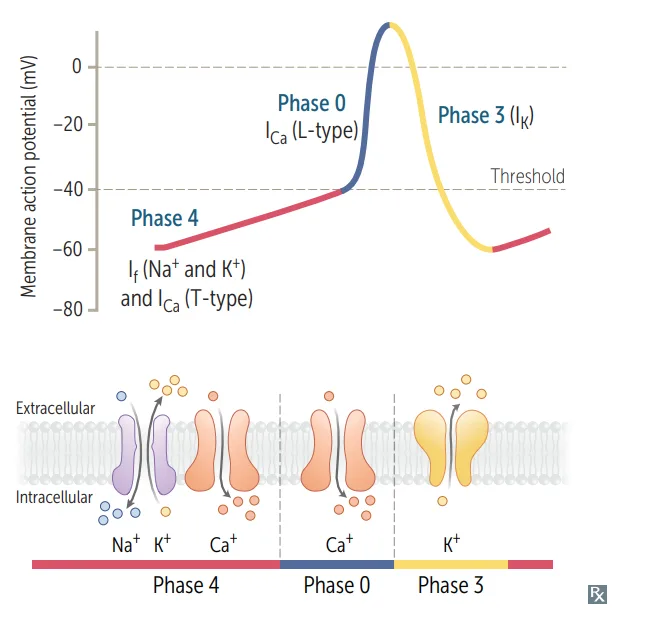
What this shows
What this shows
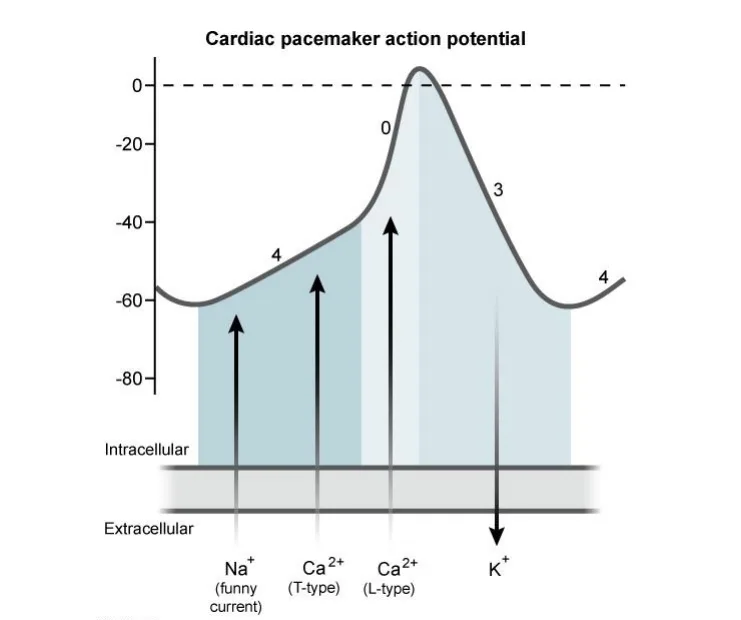
Phase 4, slow spontaneous diastolic depolarization
carried by the funny current (I_f) through HCN channels, a slow mixed Na+/K+ inward current. This is what creates automaticity.Phase 0, the upstroke
comes from voltage-gated Ca2+ channels. Fast Na+ channels are permanently inactivated at this less negative resting potential.Phase 3, repolarization
Ca2+ channels inactivate and K+ channels activate, giving K+ efflux.Side by side
| Feature | Myocardial (ventricular) | Pacemaker (SA/AV node) |
|---|---|---|
| Phase 0 current | Fast voltage-gated Na+ | Voltage-gated Ca2+ |
| Phases 1 and 2 | Present (plateau) | Absent |
| Phase 4 | Resting, high K+ permeability | Slow spontaneous depolarization (I_f, HCN channels) |
| Automaticity | No | Yes |
| Conduction velocity | Fast | Slow (Na+ channels permanently inactivated) |
| Rate determined by | Not applicable | Slope of phase 4 in the SA node |
| Phase | Ion movement | Event |
|---|---|---|
| 0 | Na+ in | Rapid upstroke |
| 1 | Na+ channels inactivate, K+ out | Initial repolarization |
| 2 | Ca2+ in balances K+ out | Plateau; calcium-induced calcium release drives contraction |
| 3 | K+ out | Rapid repolarization |
| 4 | High K+ permeability | Resting |
A drug blocks HCN channels in the SA node. Which phase changes, and what happens to the heart rate?
Phase 4. The funny current carries the slow diastolic depolarization, so blocking it flattens the phase 4 slope and the heart rate falls.
How it's tested
The plateau of phase 2 exists because calcium influx balances potassium efflux, and that same calcium is what triggers release from the sarcoplasmic reticulum. No calcium influx means no contraction, which is exactly why cardiac muscle cannot contract without extracellular calcium while skeletal muscle can. The other reliable point is that the AV node's slow conduction comes from using calcium rather than sodium for phase 0, which is also why calcium channel blockers and adenosine act specifically on the AV node.
Go deeper
First Aid 2026 — CV/Physiology (p.296) · B&B — Cardiac & pacemaker action potentials · Mehlman — HY Cardio (phases, funny current, ivabradine)
High-yield images3
Flashcards for this page
Card 1 of 5 · try-out only, nothing is saved
The resting potential is maintained by high (...) permeability through (...) channels
You just read one page of 944
The rest of Step 1, written exactly like this.
Rapid Review is the reading layer of a full Step 1 platform: a schedule fitted to your exam date, flashcards for every page, and a mentor a message away.
Every Step 1 system
Written the same way: what to know, how it’s tested, where to go deeper.
A plan built to your exam date
Tell us when you sit, and the schedule fits the whole library and your question bank to it.
Flashcards for every page
Ready-made spaced-repetition decks linked to each topic, so nothing you read gets forgotten.
