
Rapid Review·General Pathology
Select any text to highlight it or add a note.
CELLULAR INJURY
T2High yieldCalcification & Psammoma Bodies
P207
Focus on
Calcium deposits in exactly one of two settings: dead tissue with a normal serum calcium, or living tissue with a high one.
Key takeaways
Dystrophic vs metastatic calcification
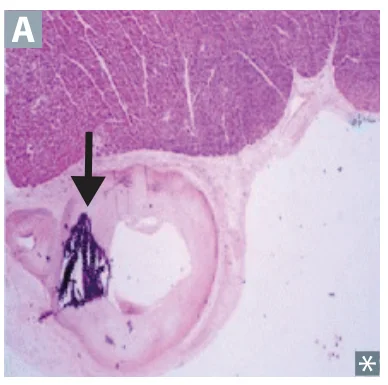
| Feature | Dystrophic Calcification | Metastatic Calcification |
|---|---|---|
| Tissue | Abnormal/dead tissue | Normal/living tissue |
| Serum Ca²⁺/PO₄³⁻ | NORMAL | HIGH (hypercalcemia/hyperphosphatemia) |
| Extent | Localized | Widespread/diffuse |
| Etiology | Secondary to injury or necrosis | Secondary to CKD, primary hyperparathyroidism, sarcoidosis, hypervitaminosis D |
| Sites | TB granulomas, calcific aortic stenosis, atherosclerotic plaque, fat necrosis, thrombi, psammoma bodies, CREST, congenital CMV/toxoplasmosis | Interstitium of kidney, lung, gastric mucosa, all of which lose acid so a high local pH favors deposition |
| Reversibility | Marker of irreversible injury | Marker of a metabolic derangement |
Psammoma bodies
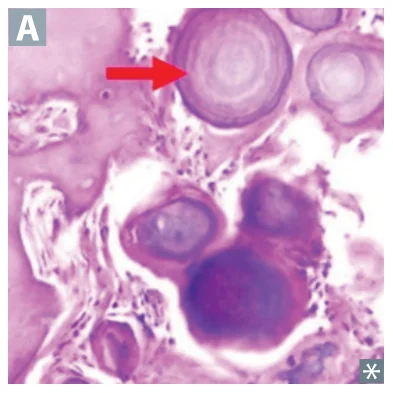
- Mnemonic PSaMMoMa:
- Papillary carcinoma of the thyroid (and kidney)
- Somatostatinoma
- Meningioma
- Mesothelioma
- Ovarian serous papillary cystadenocarcinoma
- Milk, meaning prolactinoma
Fine-needle aspiration of a thyroid nodule shows papillary fronds and concentrically laminated calcified spherules. What are the spherules, which type of calcification are they, and what is the tumor?
Psammoma bodies, a form of dystrophic calcification (serum calcium is normal). The tumor is papillary carcinoma of the thyroid.
How it's tested
The discriminator is always the serum calcium level, never the appearance of the calcium.
An elderly patient with a calcified stenotic aortic valve and a normal serum calcium has dystrophic calcification.
A patient with ESRD or sarcoidosis who has calcium deposits in the renal interstitium, gastric mucosa, and lung, tissues that are histologically normal, has metastatic calcification. Those three organs are picked because they excrete acid, so their local alkaline pH favors precipitation.
Metastatic calcification of the collecting ducts (nephrocalcinosis) can cause nephrogenic diabetes insipidus and renal failure.
Go deeper
First Aid "Calcification" + psammoma bodies; Pathoma Ch. 1. Anchor "Dystrophic = dead tissue, normal serum Ca; Metastatic = live tissue, high serum Ca/phosphate," and the PSaMMOMa list (Papillary thyroid, Serous ovarian, Meningioma, Mesothelioma).
High-yield images2
Flashcards for this page
Card 1 of 5 · try-out only, nothing is saved
(...)
You just read one page of 944
The rest of Step 1, written exactly like this.
Rapid Review is the reading layer of a full Step 1 platform: a schedule fitted to your exam date, flashcards for every page, and a mentor a message away.
Every Step 1 system
Written the same way: what to know, how it’s tested, where to go deeper.
A plan built to your exam date
Tell us when you sit, and the schedule fits the whole library and your question bank to it.
Flashcards for every page
Ready-made spaced-repetition decks linked to each topic, so nothing you read gets forgotten.
