
Rapid Review·General Pathology
Select any text to highlight it or add a note.
CELLULAR INJURY
T3Take a glanceCellular Adaptations
P202
Focus on
How cells change their size, number, or identity to survive a stressor, and the exact point at which that adaptation becomes the first step toward cancer.
Key takeaways
From adaptation to injury
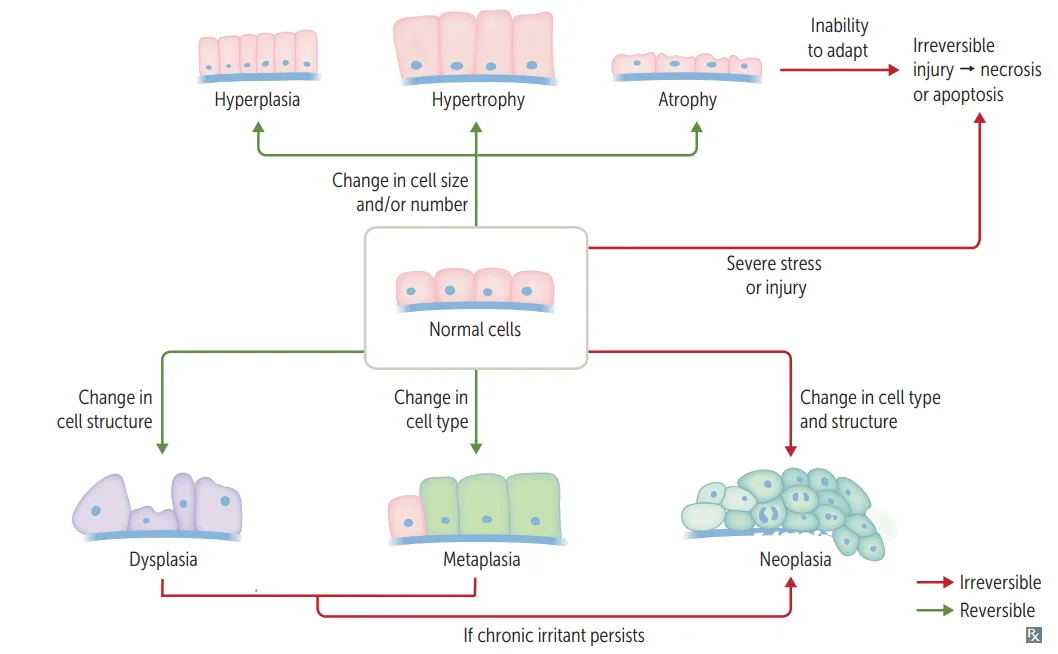
What this shows
Adaptations are reversible
they can be physiologic (uterine enlargement in pregnancy) or pathologic (LV hypertrophy from HTN).- If the stress is excessive or persistent, the adaptation itself progresses to injury (severe LVH → myocardial ischemia → heart failure).
- The whole map runs normal cell → adaptation → irreversible injury, and every question sits somewhere on it.
Growing: more size or more cells
Hypertrophy
↑ cell SIZE via ↑ synthesis of structural proteins and organelles.- The only option for permanent cells (cardiac myocytes, neurons, skeletal muscle), which cannot divide.
- High afterload → concentric hypertrophy; high preload → eccentric hypertrophy.
- Skeletal muscle hypertrophy after resistance training is the physiologic example.
Hyperplasia
↑ cell NUMBER; requires a stem cell population, so it is impossible in permanent tissue.- Physiologic (endometrium in the proliferative phase) or pathologic.
- Highest-yield example: unopposed estrogen → endometrial hyperplasia (anovulatory cycle → no corpus luteum → no progesterone) → dysplasia → adenocarcinoma.
- BPH is the exception: it does NOT raise prostate cancer risk, despite being a lifetime-DHT-driven hyperplasia.
Shrinking
Atrophy
↓ tissue mass via ↓ cell size (ubiquitin-proteasome degradation of the cytoskeleton plus autophagy) and/or ↓ cell number (apoptosis).- Causes: disuse, denervation, diminished blood supply, loss of hormonal stimulation, poor nutrition, aging.
- Loss-of-stimulation examples the NBME reuses: prostate after orchiectomy (↓ testosterone → ↓ DHT), testis on exogenous anabolic steroids (↑ negative feedback → ↓ LH), thyroid follicles on exogenous T3/T4 (↓ TSH).
Changing cell type
Metaplasia
reprogramming of stem cells so one mature cell type is replaced by another better suited to the stressor. Reversible.- Barrett esophagus: squamous → intestinal columnar with goblet cells. Goblet cells are the diagnostic requirement, because the stomach has foveolar/mucous neck cells and no goblet cells.
- Smoker's airway: pseudostratified ciliated columnar → stratified squamous.
- Connective tissue can also undergo metaplasia: myositis ossificans (bone within muscle after trauma).
Dysplasia
disordered, precancerous epithelial growth. NOT a true adaptive response.- Pleomorphism, loss of polarity, ↑ nuclear:cytoplasmic ratio, clumped chromatin.
- Mild and moderate dysplasia regress if the insult is removed; severe dysplasia becomes irreversible → carcinoma in situ.
Words that get confused
Anaplasia is not aplasia.
- Anaplasia = reversion to a primitive, undifferentiated cell → means high grade and worse prognosis.
- Aplasia = the tissue never developed. DiGeorge = aplasia of the 3rd and 4th pharyngeal pouches → no thymus, no parathyroids.
Side by side
| Process | Change | Reversible? | Cancer Risk |
|---|---|---|---|
| Hypertrophy | ↑ cell size | Yes | None |
| Hyperplasia | ↑ cell number | Yes | Yes (except BPH) |
| Atrophy | ↓ cell size/number | Yes | None |
| Metaplasia | One mature cell type → another | Yes | Increased if insult persists |
| Dysplasia | Disordered, pleomorphic growth | Yes (if mild/moderate) | High, precancerous |
| Neoplasia | Monoclonal, uncontrolled growth | No | Definitive |
A woman with anovulatory cycles has heavy, irregular bleeding, and an endometrial biopsy shows crowded glands. What process is this, what drives it, and what does it lead to if unchecked?
Endometrial hyperplasia from unopposed estrogen: with no ovulation there is no corpus luteum and no progesterone. Left unchecked it progresses to dysplasia and then endometrial adenocarcinoma.
How it's tested
The NBME will never ask "is dysplasia reversible?" outright. Instead they give koilocytes in an HPV 16/18 cervical biopsy and ask about the natural history, and the answer is that most low- and even high-grade squamous dysplasia spontaneously regresses.
Also know that a testicular biopsy in a man on exogenous anabolic steroids shows atrophy: negative feedback suppresses LH → loss of testicular stimulation → ↓ cell size, not apoptosis of a whole population. The same logic answers prostate tissue after orchiectomy and thyroid follicles in a patient taking levothyroxine.
Go deeper
First Aid "Cellular adaptations"; Pathoma Ch. 1 "Growth adaptations"; Boards & Beyond Cellular Adaptation. Anchor "permanent cells (heart, muscle) can only hypertrophy, not hyperplasia," and the metaplasia→dysplasia→carcinoma continuum (Barrett, cervical, bronchial squamous).
High-yield images1
Flashcards for this page
Card 1 of 5 · try-out only, nothing is saved
(...) epithelium is replaced by (...) epithelium
You just read one page of 944
The rest of Step 1, written exactly like this.
Rapid Review is the reading layer of a full Step 1 platform: a schedule fitted to your exam date, flashcards for every page, and a mentor a message away.
Every Step 1 system
Written the same way: what to know, how it’s tested, where to go deeper.
A plan built to your exam date
Tell us when you sit, and the schedule fits the whole library and your question bank to it.
Flashcards for every page
Ready-made spaced-repetition decks linked to each topic, so nothing you read gets forgotten.
