
Rapid Review·General Pathology
Select any text to highlight it or add a note.
CELLULAR INJURY
T2High yieldCell Injury: Reversible vs. Irreversible
P203
Focus on
Cellular swelling is the earliest reversible change; membrane rupture is the point of no return.
Key takeaways
Reversible injury: the cell swells
Reversible injury: the hallmark is cellular swelling.
- ↓ ATP → ↓ Na⁺/K⁺-ATPase activity → Na⁺ and water rush in → swelling of cytosol, mitochondria, and ER/Golgi.
- Also: ribosomal/polysomal detachment from RER (↓ protein synthesis), membrane blebbing, blunting of microvilli, loosening of intercellular attachments, nuclear chromatin clumping, fatty change (hepatic steatosis), glycogen accumulation, myelin figures.
- Rapid loss of function precedes cell death. Myocardium is noncontractile after just 1 to 2 minutes of ischemia, long before it is dead.
Irreversible injury: the membranes break
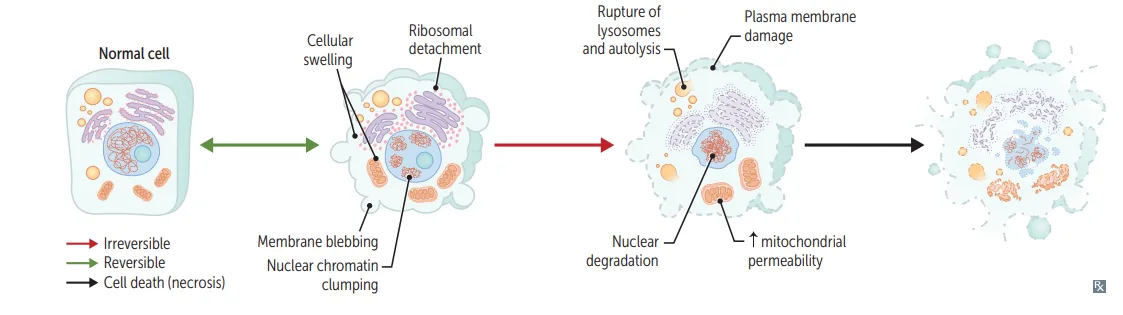
What this shows
Irreversible injury: the hallmark is membrane damage.
- Plasma membrane rupture → cytosolic enzymes (troponin, CK-MB, AST/ALT) leak out; Ca²⁺ floods in and activates degradative enzymes.
- Mitochondrial damage → loss of the electron transport chain → ↓ ATP; amorphous densities appear in mitochondria.
- Lysosomal rupture → autolysis, the cell digesting itself.
- Nuclear degradation sequence: pyknosis (condensation) → karyorrhexis (endonuclease-mediated fragmentation) → karyolysis (dissolution).
Ferroptosis
- Mitochondria shrink with loss of cristae and outer membrane rupture, the opposite of the swelling seen in classic injury.
- Implicated in MASLD/MASH, ischemia-reperfusion injury, and neurodegeneration.
- Preventable with iron chelators (deferiprone, deferoxamine) and lipophilic antioxidants (ferrostatin, liproxstatin).
Reversible vs irreversible
| Feature | Reversible Injury | Irreversible Injury |
|---|---|---|
| Hallmark | Cellular swelling | Membrane rupture |
| ATP | ↓ | ↓↓↓ |
| Ribosomes | Detached from RER | Gone |
| Nucleus | Chromatin clumping | Pyknosis → karyorrhexis → karyolysis |
| Mitochondria | Swollen | Amorphous densities, permeability |
| Ca²⁺ influx | Minimal | Massive, activates degradative enzymes |
| Calcification | Metastatic (from ↑ serum Ca²⁺) | Dystrophic (within the dead tissue) |
Which of these findings means a cell is irreversibly injured: cellular swelling, chromatin clumping, membrane blebbing, or amorphous densities in the mitochondria?
Amorphous densities in the mitochondria, a sign of irreversible mitochondrial damage. Swelling, chromatin clumping and blebbing are all features of reversible injury.
How it's tested
This is the single most repeated cell-injury stem on the NBME: a patient dies of an MI, or a kidney is biopsied after hypotension, and the biopsy shows "hydropic change" or cellular swelling of proximal convoluted tubule cells. They ask why, and the answer is decreased Na⁺/K⁺-ATPase activity. Hypoxia → ↓ ATP → the pump fails → intracellular Na⁺ builds up → water follows → the cell swells.
Note this is still a REVERSIBLE change, and they will ask this mechanism even posthumously in an MI patient, which is what makes the question feel like a trick.
Go deeper
First Aid "Cell injury"; Pathoma Ch. 1 "Cellular injury"; Boards & Beyond. Anchor "swelling = reversible; membrane damage = the point of no return," and the three-step nuclear death sequence (Pyknosis → Karyorrhexis → Karyolysis).
High-yield images1
Flashcards for this page
Card 1 of 5 · try-out only, nothing is saved
(...) cell injury
You just read one page of 944
The rest of Step 1, written exactly like this.
Rapid Review is the reading layer of a full Step 1 platform: a schedule fitted to your exam date, flashcards for every page, and a mentor a message away.
Every Step 1 system
Written the same way: what to know, how it’s tested, where to go deeper.
A plan built to your exam date
Tell us when you sit, and the schedule fits the whole library and your question bank to it.
Flashcards for every page
Ready-made spaced-repetition decks linked to each topic, so nothing you read gets forgotten.
