
Rapid Review·General Pathology
Select any text to highlight it or add a note.
INFLAMMATION
T1Must knowGranulomatous Inflammation
P213
Focus on
A Th1 and IFN-γ dependent wall built around something the macrophage cannot digest.
Key takeaways
What a granuloma is
What a granuloma is
a pattern of chronic inflammation induced by a persistent T-cell response to certain infections, immune-mediated disease, or foreign bodies.- Granulomas wall off a resistant stimulus without eradicating it, so inflammation persists → fibrosis and organ damage.
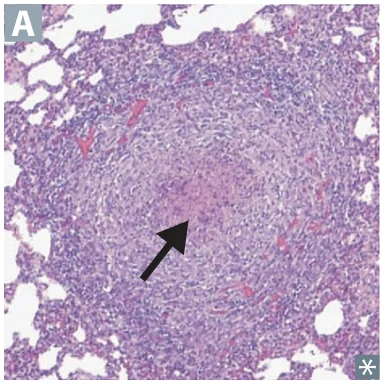
Histology
a focus of epithelioid cells (activated macrophages with abundant pink cytoplasm) surrounded by lymphocytes, with multinucleated giant cells formed by fused activated macrophages.How a granuloma forms
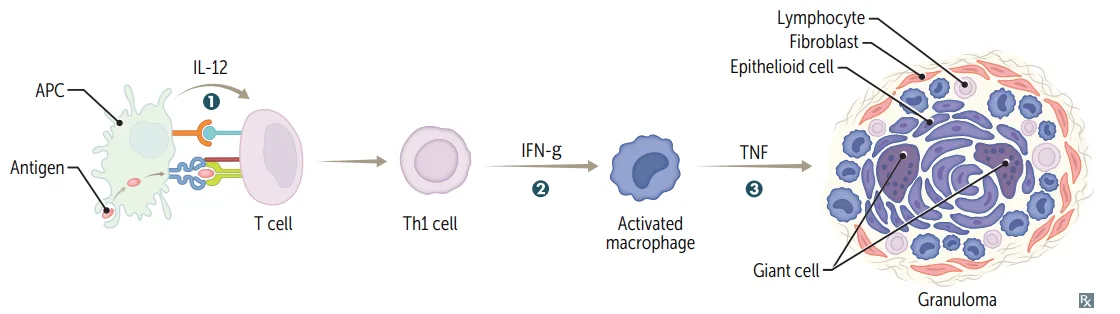
What this shows
Mechanism (know this chain cold)
APC presents antigen to a CD4+ T cell and secretes IL-12 → the CD4+ cell differentiates into Th1 → Th1 secretes IFN-γ → macrophage activation → macrophages secrete TNF → epithelioid macrophages and giant cells form → granuloma.Two consequences worth knowing
Granulomas cause hypercalcemia
activated macrophages autonomously express 1α-hydroxylase → ↑ active vitamin D, independent of PTH.Caseating vs noncaseating
| Feature | Caseating Granuloma | Noncaseating Granuloma |
|---|---|---|
| Central necrosis | Present | Absent |
| Typical cause | Infectious | Noninfectious |
| Bacterial | Mycobacteria (TB, leprosy), Bartonella henselae (cat-scratch, stellate necrotizing), Listeria, T. pallidum (tertiary syphilis) | None |
| Fungal/Parasitic | Endemic mycoses (histoplasmosis), schistosomiasis | None |
| Immune-mediated | None | Sarcoidosis, Crohn disease, primary biliary cholangitis, subacute (de Quervain) thyroiditis |
| Vasculitis | None | GPA, EGPA, giant cell arteritis, Takayasu |
| Foreign body | None | Berylliosis, talcosis, hypersensitivity pneumonitis |
| Other | Catalase-positive organisms in chronic granulomatous disease | None |
A patient with sarcoidosis has a serum calcium of 12 mg/dL with a low PTH. What is the mechanism?
Activated macrophages in the granulomas express 1α-hydroxylase on their own, making active vitamin D independent of PTH. The vitamin D raises calcium absorption, and PTH is appropriately suppressed.
How it's tested
Two guaranteed angles.
(1) Hypercalcemia in sarcoidosis. The epithelioid macrophages within the noncaseating granulomas autonomously express 1α-hydroxylase, producing excess calcitriol independent of PTH, so calcium is high with a suppressed serum PTH.
(2) A patient with RA started on infliximab develops miliary TB. The mechanism is that TNF-α is required to maintain granuloma architecture, so blocking it dissolves the wall around latent bacilli and lets them disseminate. This is why a PPD or IGRA is mandatory before starting any anti-TNF agent.
Go deeper
First Aid "Granulomatous diseases" list; Pathoma Ch. 2 "Granulomatous inflammation"; SketchyImmuno Th1. Anchor the IL-12 → Th1 → IFN-γ → macrophage-activation loop (why anti-TNF biologics reactivate latent TB) and caseating (TB/fungi) vs non-caseating (sarcoid/Crohn/beryllium).
High-yield images2
Flashcards for this page
Card 1 of 5 · try-out only, nothing is saved
Tuberculosis involves (...) granulomas
Sarcoidosis presents with (...) granulomas
You just read one page of 944
The rest of Step 1, written exactly like this.
Rapid Review is the reading layer of a full Step 1 platform: a schedule fitted to your exam date, flashcards for every page, and a mentor a message away.
Every Step 1 system
Written the same way: what to know, how it’s tested, where to go deeper.
A plan built to your exam date
Tell us when you sit, and the schedule fits the whole library and your question bank to it.
Flashcards for every page
Ready-made spaced-repetition decks linked to each topic, so nothing you read gets forgotten.
