
Rapid Review·General Pathology
Select any text to highlight it or add a note.
INFLAMMATION
T1Must knowLeukocyte Extravasation
P211
Focus on
The four-step molecular handshake that gets a neutrophil out of a postcapillary venule, and the two deficiencies that break steps one and two.
Key takeaways
Four steps at the postcapillary venule
Where it happens
extravasation occurs predominantly at postcapillary venules, the same vessels that leak exudate in acute inflammation.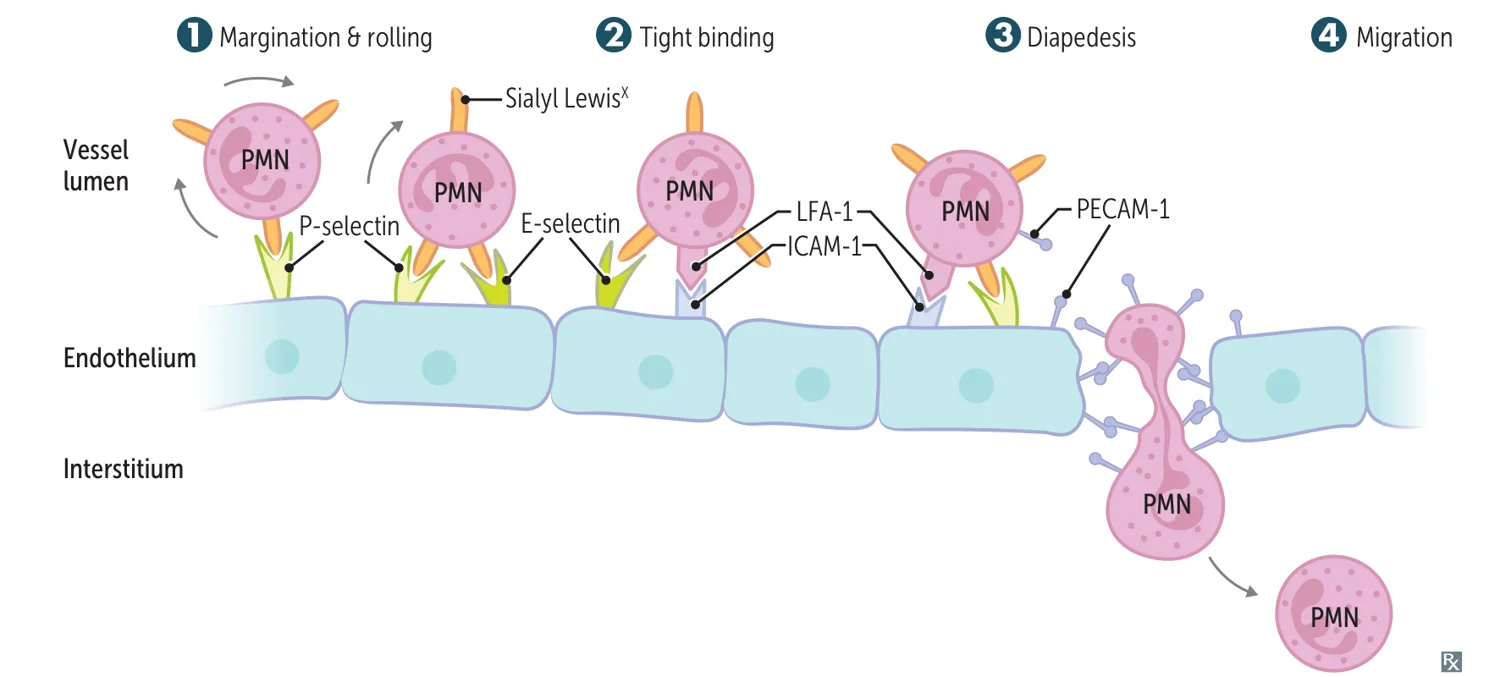
What this shows
| Step | Endothelial/Stromal Marker | Leukocyte Marker |
|---|---|---|
| 1. Margination and rolling | E-selectin (released from endothelium, upregulated by TNF and IL-1); P-selectin (translocated from Weibel-Palade bodies); GlyCAM-1, CD34 | Sialyl Lewis^X; L-selectin |
| 2. Tight binding (adhesion) | ICAM-1 (CD54), VCAM-1 (CD106) | CD11/18 integrins (LFA-1, Mac-1); VLA-4 |
| 3. Diapedesis (transmigration) | PECAM-1 (CD31) | PECAM-1 (CD31) |
| 4. Migration (chemotaxis) | Chemotactic factors: C5a, IL-8, LTB4, 5-HETE, kallikrein, PAF, N-formylmethionyl peptides (CLIK P5) | Various receptors |
When a step fails: leukocyte adhesion deficiency
Leukocyte adhesion deficiency type 1
a defect in the CD18 (β2-integrin) subunit, so step 2, tight binding, fails.Leukocyte adhesion deficiency type 2
a defect in Sialyl Lewis^X fucosylation, so step 1, rolling, fails.- Recurrent bacterial infections with NO PUS, because no neutrophil ever reaches the tissue.
- Delayed umbilical cord separation, beyond 30 days.
- Poor wound healing.
- A paradoxically high peripheral neutrophil count, because the neutrophils are trapped in the bloodstream.
| Feature | LAD Type 1 | LAD Type 2 |
|---|---|---|
| Defect | CD18 / β2-integrin (LFA-1, Mac-1) | Sialyl Lewis^X (fucosylation defect) |
| Step blocked | Step 2, tight binding | Step 1, rolling |
| Delayed cord separation | Yes, classic | Less prominent |
| Neutrophil count | ↑↑ | ↑↑ |
| Pus formation | Absent | Absent |
A 5-week-old still has the umbilical cord attached. There is redness at the stump without pus, and the WBC count is very high. Which molecule is defective, and which step fails?
CD18 (β2-integrin): leukocyte adhesion deficiency type 1. Step 2, tight binding, fails, so neutrophils stay trapped in the blood (high count) and never reach the tissue (no pus).
How it's tested
A neonate whose umbilical cord hasn't separated by 6 weeks, who has recurrent skin infections that form no pus, and whose CBC shows a neutrophil count of 40,000 has LAD type 1.
The apparent contradiction is the whole question: the neutrophils are elevated in the blood precisely because a CD18/β2-integrin defect prevents them from binding ICAM-1 and leaving the vessel. They can roll, but they cannot arrest, transmigrate, or reach the tissue to form pus.
Go deeper
First Aid "Leukocyte extravasation" 4-step figure; Pathoma Ch. 2 "Inflammation"; SketchyImmuno LAD. Anchor the sequence (roll = selectins/Sialyl-Lewis X → tight bind = integrins/ICAM → diapedesis = PECAM-1 → chemotaxis) and the disease hooks (LAD-1 = CD18 integrin defect, no pus, delayed cord separation).
High-yield images1
Flashcards for this page
Card 1 of 5 · try-out only, nothing is saved
(...)
You just read one page of 944
The rest of Step 1, written exactly like this.
Rapid Review is the reading layer of a full Step 1 platform: a schedule fitted to your exam date, flashcards for every page, and a mentor a message away.
Every Step 1 system
Written the same way: what to know, how it’s tested, where to go deeper.
A plan built to your exam date
Tell us when you sit, and the schedule fits the whole library and your question bank to it.
Flashcards for every page
Ready-made spaced-repetition decks linked to each topic, so nothing you read gets forgotten.
