
Rapid Review·General Pathology
Select any text to highlight it or add a note.
NEOPLASIA
T1Must knowOncogenes & Tumor Suppressor Genes
P220
Focus on
Gas pedals stuck on versus brakes cut, and one damaged allele versus two.
Key takeaways
One hit or two
Oncogenes
gain of function, in which a proto-oncogene becomes an oncogene. Only ONE allele needs to be damaged, so they are dominant at the cellular level.Tumor suppressors
loss of function, in which BOTH alleles must be lost. This is the Knudson two-hit hypothesis.| Feature | Oncogenes | Tumor Suppressor Genes |
|---|---|---|
| Normal function | Promote growth | Inhibit the cell cycle or repair DNA |
| Mutation type | Gain of function | Loss of function |
| Alleles required | 1 | 2, the two-hit hypothesis |
| Inheritance of the syndrome | Dominant | Appears dominant, because the second hit is near-certain |
Oncogenes
Kinases and receptors
| Gene | Product | Associated Neoplasm |
|---|---|---|
| ALK | Receptor tyrosine kinase | Lung adenocarcinoma |
| EGFR (ERBB1) | Receptor tyrosine kinase | Lung adenocarcinoma, glioblastoma (erlotinib) |
| HER2 (ERBB2) | Receptor tyrosine kinase | Breast and gastric carcinoma (trastuzumab, cardiotoxic) |
| RET | REceptor Tyrosine kinase | MEN2A and 2B, medullary and papillary thyroid carcinoma, pheochromocytoma |
| BCR-ABL | Non-receptor tyrosine kinase, a fusion protein | CML, t(9;22) Philadelphia (imatinib), also ALL |
| JAK2 | Non-receptor tyrosine kinase | Myeloproliferative neoplasms: polycythemia vera, essential thrombocythemia, myelofibrosis |
| BRAF | Serine/threonine kinase | Melanoma, non-Hodgkin lymphoma, colorectal, papillary thyroid, hairy cell leukemia |
| c-KIT | CytoKIne receptor (CD117) | GIST, mastocytosis |
Transcription factors, RAS and BCL-2
| Gene | Product | Associated Neoplasm |
|---|---|---|
| MYCC (c-myc) | Transcription factor | Burkitt lymphoma, t(8;14) |
| MYCN (N-myc) | Transcription factor | Neuroblastoma |
| KRAS | RAS GTPase, constitutively active once mutated | Pancreatic, colorectal, lung, endometrial |
| BCL-2 | Antiapoptotic molecule | Follicular and diffuse large B-cell lymphoma, t(14;18) |
Tumor suppressor genes
Cell cycle brakes
| Gene | Product | Associated Condition |
|---|---|---|
| CDKN2A | p16, blocks G1 → S | Melanoma, lung, pancreatic |
| RB1 | Inhibits E2F, blocks G1 → S | Retinoblastoma, osteosarcoma |
| TP53 | p53 → activates p21 → blocks G1 → S | Most cancers; Li-Fraumeni, SBLA: Sarcoma, Breast/Brain, Lung/Leukemia, Adrenal |
Signaling brakes
| Gene | Product | Associated Condition |
|---|---|---|
| APC | Negative regulator of β-catenin/WNT | FAP and colorectal cancer (chromosome 5, AD) |
| NF1 | Neurofibromin, a Ras GTPase-activating protein | Neurofibromatosis type 1 (chromosome 17) |
| NF2 | Merlin (schwannomin) | Neurofibromatosis type 2 (chromosome 22), bilateral acoustic schwannomas |
| PTEN | Negative regulator of PI3K/AKT | Prostate, breaST, ENdometrial |
| TSC1 / TSC2 | Hamartin and Tuberin ("2berin") | Tuberous sclerosis complex |
| VHL | Inhibits HIF-1α | von Hippel-Lindau: RCC plus hemangioblastomas |
DNA repair
| Gene | Product | Associated Condition |
|---|---|---|
| BRCA1/BRCA2 | Recombinational double-strand DNA repair | BReast, Ovarian, prostate, pancreatic CAncers |
| MSH2/6, MLH1, PMS2 | Mismatch repair | Lynch/HNPCC → microsatellite instability |
Named by the tumor or syndrome
| Gene | Product | Associated Condition |
|---|---|---|
| DCC | Deleted in Colorectal Cancer | Colorectal cancer |
| SMAD4 (DPC4) | Deleted in Pancreatic Cancer | Pancreatic, colorectal |
| MEN1 | MENin | MEN1, the 3 Ps: Pituitary, Parathyroid, Pancreas (gastrinoma) |
| WT1 | Urogenital transcription factor | Wilms tumor (nephroblastoma) |
Syndrome variants
Syndrome variants the exam expects you to name
- FAP plus soft tissue or bone tumors = Gardner syndrome; FAP plus CNS tumors = Turcot syndrome.
- WT1 appears beyond isolated Wilms tumor: WAGR (Wilms, Aniridia, Genitourinary anomalies, Retardation), Denys-Drash (gonadal dysgenesis plus Wilms), and Beckwith-Wiedemann (macrosomia, macroglossia, hemihypertrophy, hypoglycemia, Wilms).
Rb and the colon cancer sequence
Rb mechanism
Rb normally binds and represses E2F, blocking G1 → S. CDK/cyclin complexes phosphorylate Rb → Rb releases E2F → E2F transcribes S-phase genes.- Therefore decreased Rb phosphorylation is a WRONG answer for what happens in cancer. Cancer has more phosphorylation, or loses Rb entirely.
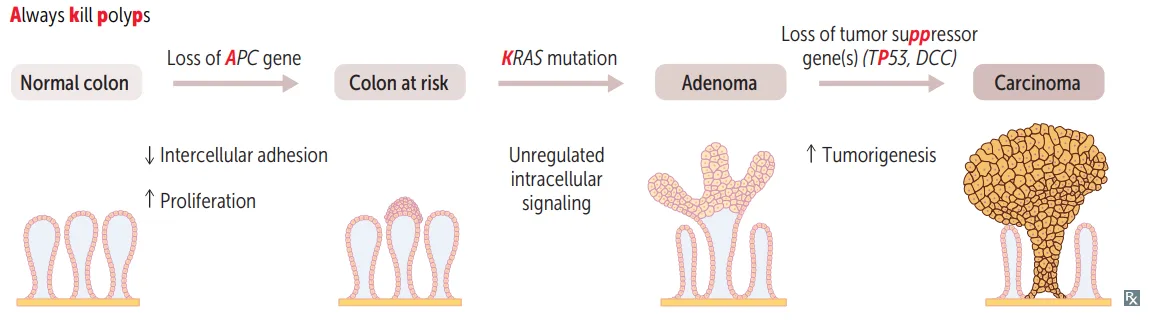
- APC loss reduces intercellular adhesion and raises proliferation: the colon mucosa is now at risk.
- KRAS mutation gives unregulated signalling, and the adenoma grows.
- Loss of P53 (TP53) and DCC completes tumorigenesis: carcinoma.
- A polyp with no invasion of the stalk points to KRAS; a colon cancer that has metastasized points to TP53.
A child treated for bilateral retinoblastoma develops osteosarcoma as a teenager. Which gene is involved, and why does this child get two tumors?
RB1, a tumor suppressor. The child inherited one mutated allele in every cell (the first hit), so a single further mutation (the second hit) is enough to cause a tumor. That is why the retinoblastoma was bilateral and why a second cancer, osteosarcoma, followed.
How it's tested
The two-hit hypothesis in FAP: the patient inherits one mutated APC allele in every cell, so thousands of polyps appear, but each polyp only becomes neoplastic when the remaining wild-type allele is somatically lost. Because a second hit is statistically inevitable across millions of colonocytes, the syndrome is inherited as autosomal dominant even though the gene is recessive at the cellular level.
For Li-Fraumeni, the NBME wants "failure of regulation of apoptosis." "Defective DNA repair enzymes" is a wrong answer, because p53 arrests the cycle and triggers apoptosis but does not itself repair DNA. TP53 is also the textbook example of pleiotropy, since one mutated gene produces many unrelated cancers.
Go deeper
First Aid "Oncogenes" + "Tumor suppressor genes" tables; Pathoma Ch. 3; SketchyPath translocations. Anchor "oncogene = 1 hit (dominant), tumor suppressor = 2 hits (Knudson)," the signature translocations (t(9;22) CML, t(14;18) follicular, t(8;14) Burkitt), and RB/p53 as the G1→S gatekeepers.
Flashcards for this page
Card 1 of 5 · try-out only, nothing is saved
(...) cancer
(...) cancer
(...) cancer
You just read one page of 944
The rest of Step 1, written exactly like this.
Rapid Review is the reading layer of a full Step 1 platform: a schedule fitted to your exam date, flashcards for every page, and a mentor a message away.
Every Step 1 system
Written the same way: what to know, how it’s tested, where to go deeper.
A plan built to your exam date
Tell us when you sit, and the schedule fits the whole library and your question bank to it.
Flashcards for every page
Ready-made spaced-repetition decks linked to each topic, so nothing you read gets forgotten.
