
Rapid Review·General Pathology
Select any text to highlight it or add a note.
NEOPLASIA
T2High yieldTumor Nomenclature & Grade vs. Stage
P216
Focus on
Naming a tumor by its tissue of origin and its behavior, and the fact that where it has spread always beats how ugly it looks.
Key takeaways
Naming tumors
The two root words
carcinoma means epithelial origin, sarcoma means mesenchymal origin. Both terms imply malignancy on their own.- Adeno- is a prefix meaning glandular, so adenocarcinoma is a carcinoma of glandular epithelium.
- Blastoma: malignancy of cells that never fully matured (neuroblastoma, hemangioblastoma, glioblastoma, retinoblastoma, nephroblastoma).
- Glioma: malignancy of glial cells (astrocytoma, oligodendroglioma; glioblastoma multiforme is formally a grade IV fibrillary astrocytoma).
- Myeloma = plasma cells. Melanoma = melanocytes. Lymphoma = lymphatic system. Leukemia = leukocytes.
- "-oma" alone usually means benign, which is exactly why melanoma, lymphoma, mesothelioma, myeloma, and seminoma are the exceptions worth memorizing.
Benign vs malignant
Benign tumors
well differentiated, well demarcated, low mitotic activity, no metastasis, no necrosis.Malignant tumors
poor differentiation, erratic growth, local invasion, metastasis, ↓ apoptosis.| Cell Type | Benign | Malignant |
|---|---|---|
| Epithelium | Adenoma, papilloma | Adenocarcinoma, papillary carcinoma |
| Blood cells | None | Leukemia, lymphoma |
| Blood vessels | Hemangioma | Angiosarcoma |
| Smooth muscle | Leiomyoma | Leiomyosarcoma |
| Striated muscle | Rhabdomyoma | Rhabdomyosarcoma |
| Connective tissue | Fibroma | Fibrosarcoma |
| Bone | Osteoma | Osteosarcoma |
| Fat | Lipoma | Liposarcoma |
| Melanocyte | Nevus/mole | Melanoma |
Look-alikes that are not tumors
Non-neoplastic malformations that get mistaken for tumors
- Hamartoma: disorganized overgrowth of tissues in their native location (Peutz-Jeghers polyps, pulmonary hamartoma).
- Choristoma: normal tissue in a FOREIGN location (gastric tissue in the distal ileum, as in a Meckel diverticulum).
Grade vs stage
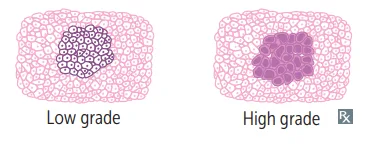
What this shows
Grade
the degree of differentiation plus mitotic activity on histology.- Runs from low grade (well differentiated) to high grade (poorly differentiated or anaplastic).
- Markers of high grade: ↑ Ki-67, prominent nucleoli, a 1:1 nuclear:cytoplasmic ratio, ↑ mitoses.
- Determined by the pathologist at the microscope.
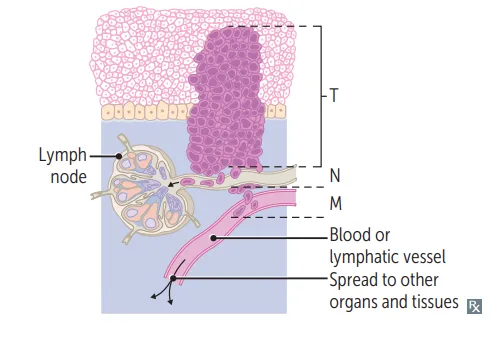
Stage
the degree of invasion and spread.- TNM, where the importance runs M > N > T.
- Based on clinical (c) or pathologic (p) findings.
| Feature | Grade | Stage |
|---|---|---|
| Measures | How abnormal the cells look (differentiation, mitoses) | How far the tumor has spread |
| Determined by | Pathologist at the microscope | Clinical and surgical workup (TNM) |
| Scale | Low grade → high grade (anaplastic) | T (size), N (nodes), M (metastasis) |
| Prognostic value | Lower | Higher, stage determines survival |
| Modifiable by treatment | No | Stage at diagnosis is fixed |
Two patients have the same cancer. One is low grade with liver metastases; the other is high grade and confined to the organ. Who has the worse prognosis, and why?
The patient with liver metastases. Stage (how far it has spread) predicts survival better than grade (how abnormal the cells look), and within stage M outweighs N and T.
How it's tested
This is one of the most prevalent principles on the NBME: stage always beats grade. They ask which finding indicates the worst prognosis, or the need for radical surgery, and the correct answer sounds deceptively mild, something like "well-differentiated, slowly dividing tumor cells present in a sentinel lymph node." Every other option describes a high-grade in situ lesion, which sounds more sinister but is stage 0.
A high-stage, low-grade tumor is worse than a low-stage, high-grade tumor, because spread rather than appearance determines survival.
Go deeper
First Aid "Tumor nomenclature" + "Grade vs stage"; Pathoma Ch. 3. Anchor the "-oma" malignant exceptions (melanoma, lymphoma, mesothelioma, seminoma) and "Stage (spread) beats Grade (differentiation) for prognosis."
High-yield images2
Flashcards for this page
Card 1 of 5 · try-out only, nothing is saved
(...) resemblance to cells of origin
You just read one page of 944
The rest of Step 1, written exactly like this.
Rapid Review is the reading layer of a full Step 1 platform: a schedule fitted to your exam date, flashcards for every page, and a mentor a message away.
Every Step 1 system
Written the same way: what to know, how it’s tested, where to go deeper.
A plan built to your exam date
Tell us when you sit, and the schedule fits the whole library and your question bank to it.
Flashcards for every page
Ready-made spaced-repetition decks linked to each topic, so nothing you read gets forgotten.
