
Rapid Review·General Pathology
Select any text to highlight it or add a note.
NEOPLASIA
T1Must knowNeoplasia & Neoplastic Progression
P215
Focus on
The stepwise march from a normal polarized epithelium to a cell sitting in a distant capillary bed, defined by one structure: the basement membrane.
Key takeaways
What a neoplasm is
Neoplasia = uncontrolled, usually MONOCLONAL proliferation.
- Every neoplasm has two components: parenchyma, the neoplastic cells, and supporting stroma, which is non-neoplastic blood vessels and connective tissue recruited by the tumor.
From normal to metastasis
The progression sequence, one bright line at a time
- Normal: epithelium with intact basal-to-apical polarity.
- Dysplasia: pleomorphism, loss of tissue orientation, ↑ nuclear:cytoplasmic ratio. Often reversible.
- Carcinoma in situ: irreversible severe dysplasia involving the ENTIRE thickness of the epithelium, but the basement membrane is INTACT.
- Invasive carcinoma: cells have breached the basement membrane using collagenases and hydrolases (metalloproteinases). Cell-to-cell contacts are lost by inactivation of E-cadherin.
- Metastasis: spread to distant organs via lymphatics or blood.
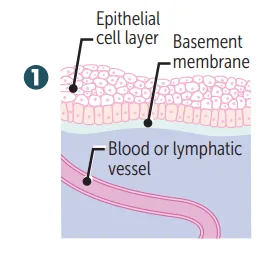
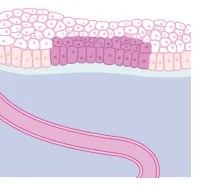
What this shows
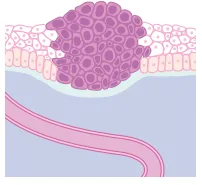
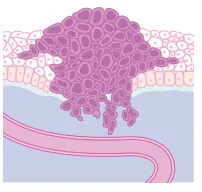
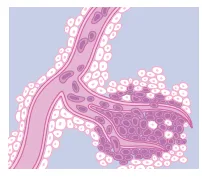
The basement membrane decides everything
| Stage | Basement membrane | Reversible? | Metastatic potential |
|---|---|---|---|
| Dysplasia | Intact | Often yes if the insult is removed | None |
| Carcinoma in situ | Intact | No, but it is stage 0 | None |
| Invasive carcinoma | Breached | No | Yes |
| Metastasis | Already crossed, plus vessel walls | No | Established |
A cervical biopsy shows atypical cells through the full thickness of the epithelium, with an intact basement membrane. What is the diagnosis, and can it metastasize?
Carcinoma in situ: irreversible full-thickness dysplasia, but the basement membrane is intact, so there is no metastatic potential yet (stage 0). Once cells cross the membrane, even as microinvasion, it becomes invasive carcinoma.
How it's tested
The basement membrane is the entire question. A cervical biopsy showing full-thickness atypia with an intact basement membrane is carcinoma in situ: irreversible, but stage 0 and curable by excision. The moment metalloproteinases digest that membrane it is invasive carcinoma, and the loss of E-cadherin is the molecular event that lets the cells detach and start moving.
Note the exception the NBME loves for melanoma: prognosis tracks the depth of invasion (Breslow depth into the subcutaneous tissue), not merely whether the basement membrane was crossed.
Go deeper
First Aid "Neoplastic progression"; Pathoma Ch. 3 "Neoplasia — basic principles"; Boards & Beyond. Anchor the continuum and its one bright line: dysplasia/CIS keep an INTACT basement membrane; invasion (penetrating it) is what makes it cancer capable of metastasis.
High-yield images5
Flashcards for this page
Card 1 of 5 · try-out only, nothing is saved
Replacement of a (...) area of normal cells by (...) cells due to widespread carcinogen exposure
You just read one page of 944
The rest of Step 1, written exactly like this.
Rapid Review is the reading layer of a full Step 1 platform: a schedule fitted to your exam date, flashcards for every page, and a mentor a message away.
Every Step 1 system
Written the same way: what to know, how it’s tested, where to go deeper.
A plan built to your exam date
Tell us when you sit, and the schedule fits the whole library and your question bank to it.
Flashcards for every page
Ready-made spaced-repetition decks linked to each topic, so nothing you read gets forgotten.
