A one-page recap of nutrition: fat- and water-soluble vitamins, minerals, malnutrition, inborn errors treated by diet, eating disorders, obesity and GLP-1 agents, TPN and enteral feeding, post-bariatric deficiencies, and dietary counselling, each linked to its full page.
Key takeaways
Five questions that place almost any nutrition vignette
1.
Who is the patient
the host predicts the deficiency before you read the symptoms. Alcohol use means thiamine and folate, a gastric bypass means B12, iron, and calcium, long-term TPN means zinc and selenium, and fat malabsorption means A, D, E, and K together.
2.
Is there steatorrhea
fat malabsorption takes out all four fat-soluble vitamins at once, and the exam picks whichever deficiency it wants to show you.
3.
Is there neurology with the anemia
B12 (raised methylmalonic acid), copper (a B12 mimic with neutropenia), and vitamin E (hemolytic, not megaloblastic) all damage the dorsal columns. Folate never does.
4.
Is it too much rather than too little
vitamin A (raised intracranial pressure), vitamin D (hypercalcemia), vitamin C (oxalate stones, iron overload), niacin (flushing), and zinc (copper deficiency) all cause disease in excess.
5.
Is the feeding itself the danger
glucose before thiamine precipitates Wernicke encephalopathy, and fast refeeding of a starved patient drops the phosphate.
all four need bile, pancreatic lipase, and an intact ileum, so they fail together. They are stored in fat, which is why toxicity is common here and rare with the water-soluble vitamins.
A, D, E, K in one table
Vitamin
Job
Deficiency
Excess
Exam hook
A (retinol)
Visual pigment, epithelial differentiation
Night blindness, Bitot spots, keratomalacia, dry skin, immunosuppression
Isotretinoin needs two contraceptives and a negative pregnancy test; given in measles; ATRA treats APL
D (calciferol)
Raises gut calcium and phosphate absorption
Rickets (bowed legs, rachitic rosary), osteomalacia; low calcium and phosphate, high PTH, high ALP
Hypercalcemia, hypercalciuria
Measure 25-OH-D for stores; sarcoidosis makes calcitriol in granulomas and suppresses PTH
E (tocopherol)
Membrane antioxidant
Hemolytic anemia with acanthocytes, dorsal column and spinocerebellar demyelination
Antagonises vitamin K, so bleeding
Looks like B12 deficiency but methylmalonic acid is normal
K
Gamma-carboxylates II, VII, IX, X, protein C and S
Prolonged PT and PTT, NORMAL bleeding time
Rare
Newborns have sterile guts, so all get IM vitamin K at birth; broad-spectrum antibiotics kill the gut source
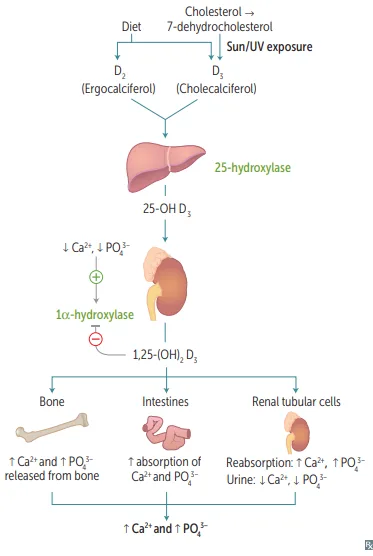
Vitamin D activation
skin (D3 from 7-dehydrocholesterol under UV), then liver 25-hydroxylase (25-OH-D, the storage form), then kidney 1-alpha-hydroxylase (calcitriol, the active form, switched on by PTH and low phosphate).
What this shows
Vitamin D activation. Dietary D2 and skin-derived D3 are hydroxylated in the liver to 25-OH D3, the storage form, then in the kidney by 1-alpha-hydroxylase (stimulated by PTH and low phosphate) to active 1,25-(OH)2 D3.
Full pages
Vitamins Overview, Fat-Soluble Vitamins: A, D, E & K, and Osteopetrosis, Osteomalacia/Rickets, Paget Disease
Water-soluble vitamins
Storage rule
they wash out, so toxicity is rare, except B12 (stored about 3 to 4 years) and folate (about 3 to 4 months). That gap is why folate deficiency appears within months of poor intake and B12 deficiency takes years.
the B vitamins and C, by cofactor and deficiency
Vitamin
Cofactor and job
Deficiency
Classic setting
B1 thiamine
TPP for PDH, alpha-KG dehydrogenase, transketolase, branched-chain dehydrogenase ("Be APT")
Microcytic anemia, high RDW, low ferritin, high TIBC; pica, Plummer-Vinson webs
Hemochromatosis (HFE, low hepcidin; treat with phlebotomy). Acute poisoning in children: GI bleeding, radiopaque pills, acidosis; treat with deferoxamine
Absorbed as Fe2+ in the duodenum; vitamin C helps
Zinc
Poor wound healing, hypogonadism, dysgeusia and anosmia, alopecia, acrodermatitis enteropathica (periorificial and acral rash)
Wilson (ATP7B, autosomal recessive): cirrhosis, parkinsonism, Kayser-Fleischer rings, low ceruloplasmin
Cofactor for lysyl oxidase; treat Wilson with penicillamine or trientine plus zinc
Selenium
Dilated cardiomyopathy (Keshan disease), myopathy
Garlic breath, hair and nail loss
Long-term TPN
Iodine
Goiter, hypothyroidism, cretinism in the fetus
Wolff-Chaikoff hypothyroidism or Jod-Basedow hyperthyroidism
Pregnancy, non-iodized salt
Chromium
Glucose intolerance
Rare
TPN
Manganese
Rare
Parkinsonism, bright globus pallidus on T1 MRI
TPN with cholestasis, welding
Magnesium
Hypokalemia and hypocalcemia that will not correct until magnesium is replaced (low magnesium blocks PTH release)
Loss of reflexes, respiratory depression
Alcohol, PPIs, diuretics, diarrhea
Fluoride
Dental caries
Fluorosis, mottled teeth
Unfluoridated water
Full pages
Zinc & Copper, Inherited Metabolic Liver Disease: Wilson, Hemochromatosis & α1-Antitrypsin, Microcytic Anemias: Iron Deficiency & α-Thalassemia, and Heme Synthesis, Porphyrias, Lead & Iron Poisoning
Malnutrition
Assessment
unintentional weight loss of more than 5% in 1 month or 10% in 6 months, or a BMI below 18.5. Albumin tracks inflammation and fluid status more than intake, so it is a poor marker on its own.
kwashiorkor vs marasmus, decided by edema
Feature
Kwashiorkor
Marasmus
Deficit
Protein, with calories adequate
Total calories
Edema
Present, from low albumin and low oncotic pressure
Absent
Liver
Fatty, because low apolipoprotein synthesis traps fat
Parotid swelling with raised amylase, enamel erosion, Russell sign
Raised diabetes risk
Labs
Hypokalemia if purging; low LH and FSH (central amenorrhea); low albumin causes edema
Hypokalemic, hypochloremic metabolic alkalosis
Not characteristic
Treatment
Nutritional rehabilitation, psychotherapy, olanzapine; admit if BMI below 15
Psychotherapy, fluoxetine
Psychotherapy; SSRIs; lisdexamfetamine
Avoid
Bupropion (seizures)
Bupropion (seizures)
None specific
Leading killer in anorexia
ventricular fibrillation from hypokalemia, and again during treatment from refeeding hypophosphatemia.
Pica
non-food craving for more than 1 month, common in children and pregnancy, and a pointer to iron deficiency.
Full pages
Eating Disorders and Psychiatry at a Glance: Disorders Side by Side
Obesity and GLP-1 agents
BMI cutoffs
Category
Adults (kg/m²)
Children and adolescents (BMI percentile for age and sex)
Underweight
Below 18.5
Below the 5th
Normal
18.5 to 24.9
5th to 84th
Overweight
25 to 29.9
85th to 94th
Obesity class I
30 to 34.9
95th or above
Obesity class II
35 to 39.9
Severe obesity: 120% of the 95th percentile or above
Obesity class III
40 or above
Same
Central obesity
waist over 102 cm (40 in) in men or 88 cm (35 in) in women adds risk at any BMI. Asian American adults get diabetes screening from a BMI of 23.
what to screen for once obesity is found
Complication
How to screen
Prediabetes and type 2 diabetes
HbA1c or fasting glucose, in adults 35 to 70 with overweight or obesity
Hypertension
Blood pressure at every visit
Dyslipidemia
Fasting lipid panel
Fatty liver (MASLD)
ALT, then a fibrosis score such as FIB-4
Obstructive sleep apnea
Snoring, witnessed apneas, daytime sleepiness, then polysomnography
Obesity hypoventilation
Raised PaCO2 while AWAKE with a BMI of 30 or more
PCOS, osteoarthritis, GERD, depression
History and examination
Secondary causes
TSH (hypothyroidism), Cushing features, and the drug list: antipsychotics, insulin, sulfonylureas, pioglitazone, glucocorticoids, mirtazapine, valproate
the treatment ladder
Step
Who
Lifestyle (calorie deficit of about 500 to 750 kcal/day, 150 minutes of activity a week)
Everyone with overweight or obesity
Add a drug
BMI 30 or more, or 27 or more with a weight-related illness (diabetes, hypertension, dyslipidemia, sleep apnea)
Bariatric surgery
Classic teaching: BMI 40 or more, or 35 or more with a comorbidity. Current guidelines: 35 or more, or 30 or more with type 2 diabetes
the GLP-1 agents
Drug
Receptor
Dosing
Semaglutide
GLP-1 receptor agonist
Weekly injection (an oral daily form exists for diabetes)
Liraglutide
GLP-1 receptor agonist
Daily injection
Tirzepatide
Dual GIP and GLP-1 receptor agonist
Weekly injection; the most weight loss of the group
Mechanism
GLP-1 receptors are Gs-coupled (raise cAMP), so the drugs give glucose-dependent insulin release, lower glucagon, slow gastric emptying, and act on the hypothalamus to raise satiety. Because insulin release depends on glucose, they rarely cause hypoglycemia on their own.
Indications
type 2 diabetes, preferred when there is established cardiovascular disease or chronic kidney disease (they cut cardiovascular events), and chronic weight management at the BMI thresholds above. Semaglutide also reduces cardiovascular events in obesity with established heart disease, and tirzepatide is approved for obstructive sleep apnea with obesity.
GLP-1 side effects and what each one means
Side effect
What to know
Nausea, vomiting, diarrhea, constipation
The most common; dose-related, so titrate slowly
Pancreatitis
Stop the drug if abdominal pain comes with a raised lipase; avoid after prior pancreatitis
Gallbladder disease
Gallstones from rapid weight loss
Thyroid C-cell tumours (in rodents)
Boxed warning: contraindicated with a personal or family history of medullary thyroid carcinoma or MEN 2
Hypoglycemia
Only when combined with insulin or a sulfonylurea, so lower their dose
Slow gastric emptying
Food retained at endoscopy and aspiration risk under anesthesia
Worsening diabetic retinopathy
With a rapid fall in HbA1c on semaglutide
Weight regain
Most of the weight returns after stopping
Pregnancy
Stop before conception; tirzepatide lowers oral contraceptive absorption, so add a barrier method after starting and after each dose increase
the other weight-loss drugs
Drug
Mechanism
Watch for
Orlistat
Blocks pancreatic lipase
Oily stools, steatorrhea, fat-soluble vitamin deficiency, so add a multivitamin
Phentermine
Sympathomimetic
Raised blood pressure and heart rate; avoid in cardiovascular disease
Seizures, so avoid in eating disorders and seizure disorders; precipitates withdrawal on opioids
Full pages
Diabetes Drugs (Oral and Non-Insulin), Appetite Regulation: Ghrelin & Leptin, and Sleep Apnea & Obesity Hypoventilation
TPN and enteral nutrition
The rule
if the gut works, use it. Enteral feeding keeps the mucosa alive, causes fewer infections, and is cheaper; parenteral feeding is for a gut that cannot be used.
enteral vs parenteral nutrition
Feature
Enteral
Parenteral (TPN)
Needs
A working, reachable gut
A non-working gut: short bowel, high-output fistula, obstruction, prolonged ileus, severe malabsorption
Timing in ICU
Within 24 to 48 hours if stable
Day 7 if previously well nourished, earlier if malnourished
Access
Nasogastric (short term); post-pyloric for aspiration, gastroparesis, or pancreatitis; PEG if needed beyond 4 to 6 weeks
Central line (PICC or tunneled catheter), because the solution is highly concentrated
Main risks
Aspiration (head of bed 30 to 45 degrees), diarrhea, tube problems
Line sepsis, hyperglycemia, liver disease, gallstones, trace element loss
TPN complications and their mechanism
Complication
Mechanism or clue
Catheter bloodstream infection
The most common serious one; staphylococci, gram-negatives, Candida
Hyperglycemia
Concentrated dextrose; hypoglycemia if the infusion is stopped abruptly
Refeeding syndrome
Hypophosphatemia when a starved patient is fed fast
Liver disease
Steatosis in adults, cholestasis in infants
Gallstones and acalculous cholecystitis
No fat in the duodenum means no CCK, so the gallbladder never empties
a Roux-en-Y gastric bypass skips the duodenum and proximal jejunum, and the small pouch makes little acid or intrinsic factor. Every nutrient absorbed up there falls, so all patients get lifelong supplements and yearly labs.
what falls after a gastric bypass and why
Nutrient
Why it falls
What you see
Replace with
B12
Little acid and intrinsic factor from the pouch
Macrocytic anemia, neuropathy after years
Lifelong B12 (injection, sublingual, or high-dose oral)
Iron
Duodenum bypassed, and little acid to keep iron as Fe2+
Microcytic anemia
Oral iron with vitamin C; IV if it fails
Calcium and vitamin D
Duodenum bypassed; calcium carbonate needs acid
Secondary hyperparathyroidism, osteoporosis
Calcium citrate (does not need acid) plus vitamin D
Thiamine
Small stores plus early postoperative vomiting
Wernicke within weeks of surgery
Thiamine, urgently if vomiting
Folate
Low intake, proximal bypass
Macrocytic anemia without neurology
Folate in the multivitamin
Copper
Duodenum bypassed
Anemia that fails iron, neutropenia, B12-like myelopathy
Copper
A, D, E, K
Fat malabsorption, worst after duodenal switch
Night blindness, bleeding
Fat-soluble vitamins
the other complications after bariatric surgery
Complication
Timing and cause
Fix
Early dumping
15 to 30 minutes after eating; hyperosmolar food pulls fluid into the bowel: cramps, diarrhea, tachycardia, flushing
Small frequent meals, fewer simple sugars, liquids apart from solids
Late dumping
1 to 3 hours after eating; an insulin surge causes hypoglycemia
Same diet; add protein and fibre
Gallstones
Rapid weight loss
Ursodiol prophylaxis
Marginal ulcer
At the gastrojejunal join; smoking and NSAIDs
PPI, stop NSAIDs and smoking
Internal hernia
Bowel obstruction months to years later
Surgery
Sleeve gastrectomy
fewer deficiencies because the duodenum stays in the circuit, but B12 still falls and reflux often worsens.
Absorption sites
"Ironfist, Bro": iron in the duodenum, folate in the jejunum, B12 in the terminal ileum.
Full pages
Carbohydrate, Vitamin & Mineral Absorption and Vitamin B12 (cobalamin) & Vitamin C
Dietary counselling
which diet for which patient
Diet
What it looks like
Use it for
Mediterranean
Olive oil, vegetables, fruit, legumes, whole grains, nuts, fish; little red or processed meat
Cardiovascular prevention (fewer heart attacks and strokes), fatty liver, type 2 diabetes
DASH
Fruit, vegetables, low-fat dairy, whole grains; low sodium, saturated fat, and sweets; rich in potassium, calcium, magnesium
Hypertension: lowers systolic pressure by about 11 mmHg
Low sodium
Under 2.3 g/day (ideally 1.5 g)
Hypertension, heart failure, calcium stones
Calcium oxalate stone diet
High fluid, normal calcium, low sodium, less animal protein, fewer high-oxalate foods
Recurrent calcium oxalate stones
Low phenylalanine
Protein-restricted medical formula, tyrosine added, no aspartame
PKU, for life
Gluten-free
No wheat, barley, or rye
Celiac disease
Low purine
Less red meat, seafood, beer, and sugary fructose drinks
Gout
Blood pressure payoff
weight loss lowers systolic pressure about 1 mmHg per kg lost, DASH about 11 mmHg, and sodium restriction about 5 to 6 mmHg. Weight loss and DASH are the two biggest lifestyle levers.
Low-oxalate counselling for calcium stones
1.
Drink more
enough to pass more than 2 to 2.5 L of urine a day. This is the single most effective step for every stone type.
2.
Keep calcium normal
about 1,000 to 1,200 mg a day. Restricting calcium RAISES stone risk, because less calcium in the gut leaves more oxalate free to be absorbed.
3.
Cut sodium and animal protein
sodium raises urine calcium, and animal protein raises urine calcium and lowers citrate.
4.
Limit high-oxalate foods
spinach, rhubarb, nuts, beets, chocolate, and tea, and stop vitamin C supplements, which are metabolized to oxalate.
5.
Treat fat malabsorption
in Crohn disease or after bypass, fat binds calcium in the gut and frees oxalate (enteric hyperoxaluria), so give a low-fat diet with calcium at meals.
6.
Add drugs if needed
a thiazide for high urine calcium and potassium citrate for low urine citrate.
PKU restrictions
Lifelong diet
low phenylalanine, with tyrosine added because it becomes an essential amino acid, and no aspartame, which is a phenylalanine source. Some patients respond to sapropterin (a BH4 analog).
Maternal PKU
a woman with PKU must bring her phenylalanine under strict control before conception, because her high phenylalanine causes microcephaly, heart defects, and growth restriction in a fetus who does not have PKU.
Screening adolescents for eating disorders
At every routine visit
use the HEEADSSS psychosocial interview, which includes Eating, and plot the BMI percentile over time. A fall across percentiles is an early sign even when the BMI still looks normal.
Quick screen, "SCOFF"
Sick (make yourself sick because you feel full), lost Control over eating, lost more than One stone (6 kg) in 3 months, believe you are Fat when others say you are thin, Food dominates your life. Two or more "yes" answers suggests an eating disorder.
Higher-risk groups
athletes in weight-class or aesthetic sports (gymnastics, ballet, wrestling), and adolescents with type 1 diabetes, who may skip insulin to lose weight.
How to counsel
talk about healthy eating and activity, not weight or dieting, since weight-focused talk can trigger disordered eating. Family-based treatment is first line for an adolescent with anorexia.
Admit if
heart rate below 50 while awake, systolic pressure below 90, temperature below 35.6 °C (96 °F), orthostatic changes, less than 75% of median BMI for age and sex, electrolyte disturbance (hypokalemia, hypophosphatemia), arrhythmia, or refusal to eat.
Full pages
Kidney Stones, Amino Acid Disorders, Hypertension, and Eating Disorders
Rapid fire: clue to answer
one line each
Clue
Answer
Alcoholic becomes confused and ataxic after IV dextrose
Wernicke: thiamine should have gone first
Cystic fibrosis with night blindness and bruising
Fat malabsorption: vitamins A and K
Macrocytic anemia, normal methylmalonic acid, no neurology
Folate deficiency
Macrocytic anemia with numb feet in a strict vegan
B12 deficiency
Anemia that fails iron, neutropenia, and a B12-like gait after bypass
Diarrhea, dementia, and a sun-exposed rash with carcinoid
Pellagra: niacin
Isoniazid with neuropathy and ringed sideroblasts
B6 deficiency
Periorificial rash and poor wound healing on TPN
Zinc deficiency
Dilated cardiomyopathy on long-term TPN
Selenium deficiency
Starved patient fed quickly, arrhythmia on day 2
Refeeding: hypophosphatemia
Child with edema, swollen belly, and fatty liver
Kwashiorkor
Infant with vomiting and hypoglycemia after the first fruit juice
Hereditary fructose intolerance: aldolase B
Musty-smelling fair infant who missed screening
PKU: avoid aspartame, add tyrosine
Hypercalcemia with suppressed PTH and hilar nodes
Sarcoidosis making calcitriol
Patient on semaglutide with epigastric pain radiating to the back
Pancreatitis: stop the drug
Family history of MEN 2 in a patient wanting weight-loss therapy
Avoid GLP-1 agonists
Oily stools and night blindness on a weight-loss drug
Orlistat
Calcium oxalate stones: should she cut dairy?
No: keep calcium normal, cut sodium, oxalate, and animal protein
Hypertensive patient asks which diet
DASH
How it's tested
Most nutrition questions are decided by the host (alcohol, bypass, TPN, vegan, fat malabsorption) or by one discriminating lab such as methylmalonic acid. Read the five questions at the top, then jump to the table that owns the clue.
Rapid Review is the reading layer of a full Step 1 platform: a schedule fitted to your exam date, flashcards for every page, and a mentor a message away.
Every Step 1 system
Written the same way: what to know, how it’s tested, where to go deeper.
A plan built to your exam date
Tell us when you sit, and the schedule fits the whole library and your question bank to it.
Flashcards for every page
Ready-made spaced-repetition decks linked to each topic, so nothing you read gets forgotten.