Place any psychiatric vignette in seconds: 33 comparison tables covering the psychotic, mood, anxiety, trauma, somatic, personality, eating, dissociative, childhood, cognitive, substance, and emergency disorders, sorted by the feature that actually separates them.
Key takeaways
Four questions that place almost any vignette
1.
Is there psychosis
if yes, ask whether it stands alone or only appears during mood episodes. Psychosis alone for more than 2 weeks makes it a psychotic disorder, not a mood disorder.
2.
Is there a mood episode, and which pole
mania and hypomania move the patient into the bipolar spectrum no matter how much depression is in the history.
3.
How long has it lasted
most "which diagnosis" questions in psychiatry are duration questions in disguise, so the duration chart below answers them directly.
4.
Does the patient mind
ego-dystonic (distressed by the symptom) separates OCD from OCPD and avoidant from schizoid personality disorder.
5.
Could a drug or a medical illness explain it
anxiety with hyperthyroidism, depression on propranolol, psychosis on stimulants, and confusion from a urinary tract infection are all answered by treating the cause.
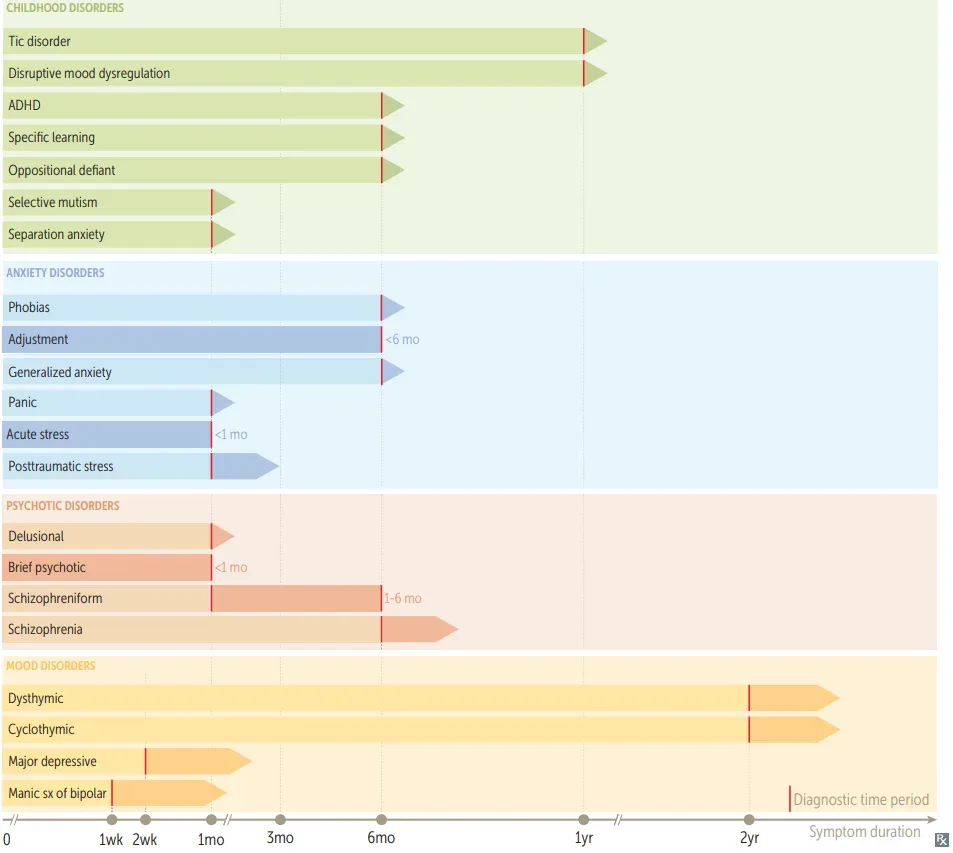
The master duration chart
diagnostic duration, the single highest-yield table in psychiatry
Category
Disorder
Diagnostic duration
Psychotic
Brief psychotic
Under 1 month
Schizophreniform
1 to 6 months
Schizophrenia
More than 6 months
Delusional
More than 1 month
Schizoaffective
Over 2 weeks of psychosis without mood symptoms
Mood
Major depressive episode
2 weeks or more
Manic episode
1 week or more
Hypomanic episode
4 days or more
Persistent depressive (dysthymia)
2 years or more
Cyclothymic
2 years or more
Anxiety and trauma
Panic disorder
1 month or more of worry after an attack
Acute stress
3 days to 1 month
PTSD
More than 1 month
Adjustment
Under 6 months after the stressor ends
Phobias
6 months or more
GAD
6 months or more
Childhood
Selective mutism
1 month or more
Separation anxiety
4 weeks or more
Oppositional defiant
6 months or more
Specific learning disorder
6 months or more
Tic disorder (Tourette)
More than 1 year
Sleep and elimination
Narcolepsy
3 months or more
Enuresis
3 months or more, at least twice weekly
Encopresis
3 months or more, at least monthly
Full page
Diagnostic Criteria by Symptom Duration
Psychotic disorders
the psychotic spectrum, sorted by duration
Disorder
Duration
Defining detail
Brief psychotic disorder
1 day to 1 month
1 or more positive symptoms, usually stress-related
Schizophreniform disorder
1 to 6 months
2 or more symptoms
Schizophrenia
More than 6 months
At least 1 month of active symptoms; needs 2 or more symptoms including one of delusions, hallucinations, or disorganized speech
Delusional disorder
More than 1 month
One fixed, non-bizarre delusion; functioning otherwise intact
Schizoaffective disorder
Psychosis alone for more than 2 weeks
Mood episodes sit on top of a psychotic baseline
Schizotypal personality disorder
Lifelong pattern
Magical thinking and brief, milder psychotic episodes that never meet criteria
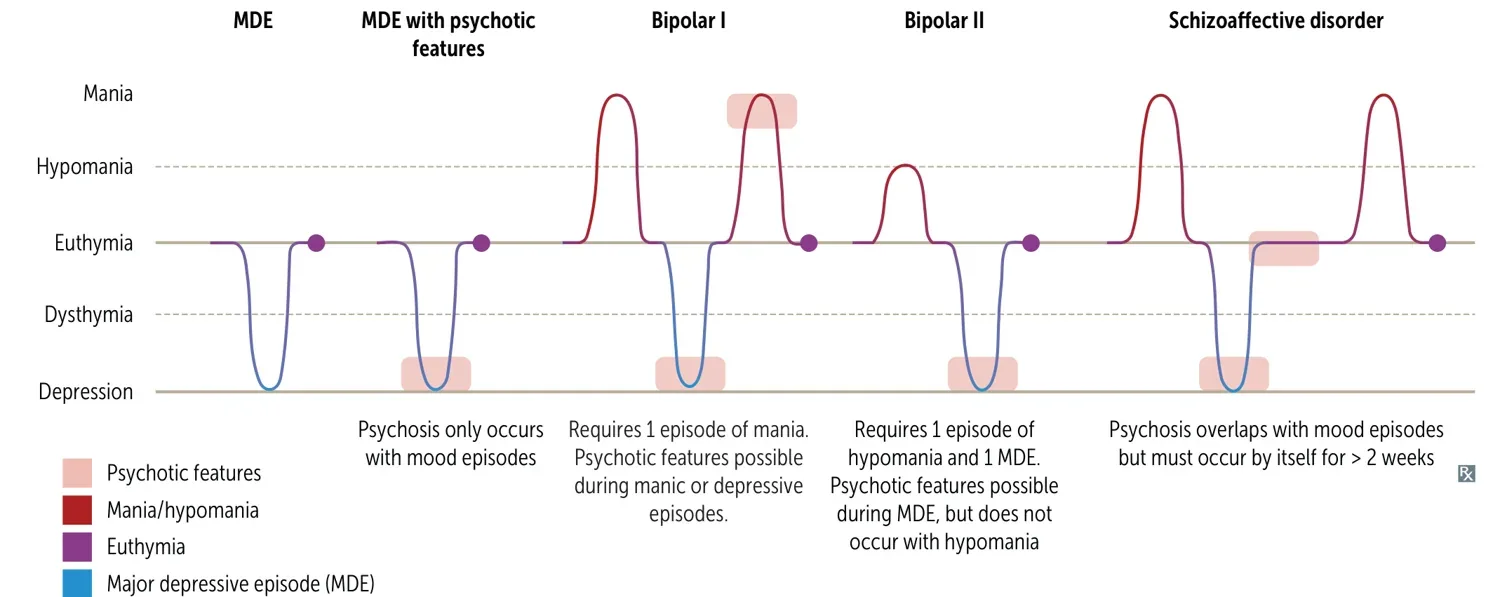
where psychosis sits relative to mood
Diagnosis
Relationship of psychosis to mood episodes
Major depressive episode with psychotic features
Psychosis occurs only with mood episodes; depression is the baseline
Bipolar I
Requires 1 or more manic episodes; psychosis possible during mania or depression
Bipolar II
Hypomania plus a major depressive episode; psychosis possible in depression but never with hypomania
Schizoaffective disorder
Psychosis must also occur alone for more than 2 weeks, so psychosis is the baseline
Schizophrenia
Psychosis without a mood disorder driving it
the two "suspicious patient" diagnoses
Feature
Delusional disorder
Paranoid personality disorder
Content
One specific false belief
No specific delusion, broad general suspicion
Scope of life affected
Narrow, for example only work
Many areas, relationships and work
Example
"My coworkers are stealing from me," everything else normal
Rigidity WITHOUT fever, hours to days after an antipsychotic
Acute dystonia
Benztropine or diphenhydramine
Rigidity WITH fever, autonomic instability, raised creatine kinase
Neuroleptic malignant syndrome
Dantrolene, bromocriptine
Clonus and hyperreflexia with fever and diarrhea
Serotonin syndrome
Cyproheptadine
Full page
Psychiatric Emergencies
First-line treatment in one line each
what to give, by diagnosis
Diagnosis
First line
Notable alternative or caution
Major depressive disorder
CBT and an SSRI
SNRI, mirtazapine, bupropion; ECT or ketamine if severe or refractory
MDD with psychotic features
Antidepressant plus an atypical antipsychotic
ECT
Bipolar disorder
Lithium or valproate
Atypical antipsychotic, lamotrigine; antidepressants alone can trigger mania
Schizophrenia
Atypical antipsychotic (risperidone)
Haloperidol decanoate if adherence is poor
Panic disorder
SSRI plus CBT
Benzodiazepine for the acute attack
GAD
CBT and an SSRI
Buspirone; benzodiazepines second line
Social anxiety (performance type)
Beta-blocker
Benzodiazepine if asthmatic
OCD
CBT plus an SSRI
Clomipramine
PTSD
CBT, SSRI, or venlafaxine
Prazosin for nightmares
Acute stress and adjustment disorder
CBT
Medication usually not indicated
Borderline personality disorder
Dialectical behavioral therapy
Treat comorbid mood or substance disorder
Anorexia nervosa
Nutritional rehabilitation and psychotherapy, olanzapine
Mirtazapine if depressed; admit if BMI under 15
Bulimia nervosa
Psychotherapy plus fluoxetine
Bupropion contraindicated
Binge-eating disorder
Psychotherapy
SSRI, lisdexamfetamine
Postpartum psychosis
Hospitalization plus an atypical antipsychotic
ECT if insufficient
Delirium
Treat the underlying cause
Antipsychotic only for dangerous agitation
Alcohol withdrawal
Benzodiazepine
Thiamine before glucose
Opioid overdose
Naloxone
Methadone or buprenorphine for withdrawal and maintenance
How it's tested
Most "which diagnosis" items are decided by one variable: duration, whether psychosis stands alone, whether the patient is distressed by the symptom, or whether a drug explains it. Read the four questions at the top, then jump to the table that owns that variable.
Rapid Review is the reading layer of a full Step 1 platform: a schedule fitted to your exam date, flashcards for every page, and a mentor a message away.
Every Step 1 system
Written the same way: what to know, how it’s tested, where to go deeper.
A plan built to your exam date
Tell us when you sit, and the schedule fits the whole library and your question bank to it.
Flashcards for every page
Ready-made spaced-repetition decks linked to each topic, so nothing you read gets forgotten.