
Rapid Review·Cardiovascular
Select any text to highlight it or add a note.
Cardiovascular Pharmacology
T1Must knowAntianginal & Vasodilator Drugs
Focus on
Nitrates work on the veins (less preload, less wall stress) and are forbidden with PDE-5 inhibitors, in RV infarction and in HOCM; hydralazine and nitroprusside work on the arteries (hydralazine gives lupus and reflex tachycardia, nitroprusside gives cyanide); ranolazine treats angina without touching rate or pressure; sacubitril boosts natriuretic peptides; ivabradine slows the sinus node and lights up the visual field.
Key takeaways
The principle
Supply and demand
angina is relieved by lowering demand (rate, contractility, wall stress) or raising supply.Through the heart
beta blockers and calcium-channel blockers (Antihypertensive Drugs, Antiarrhythmic Drugs).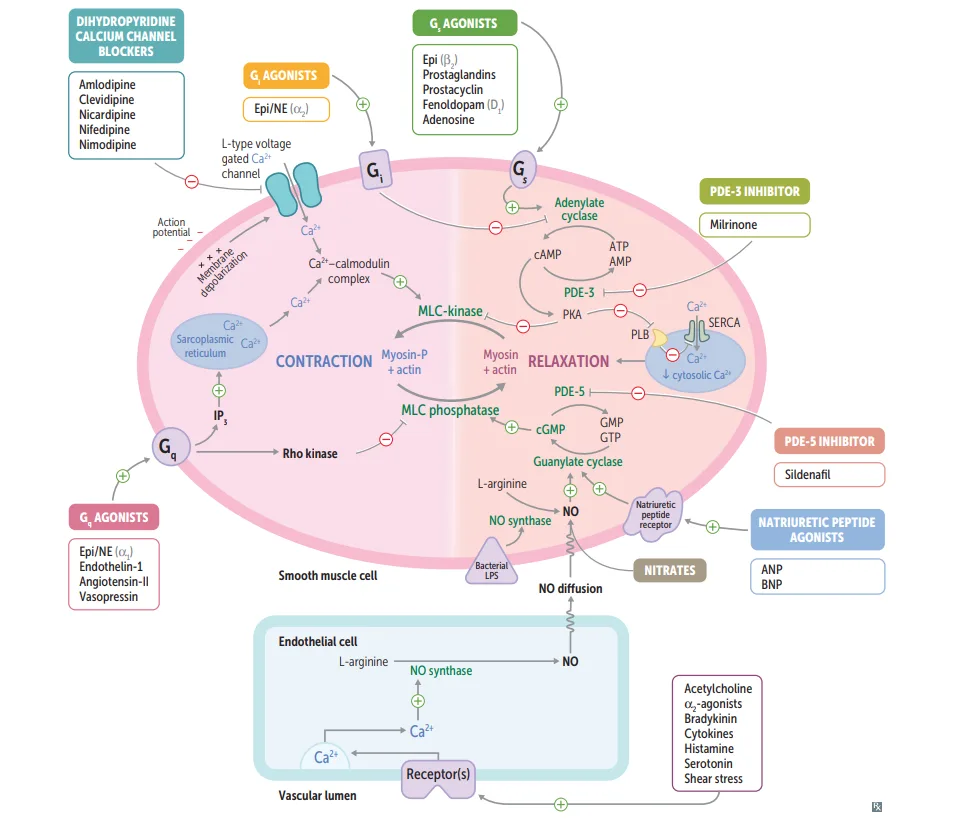
What this shows
Through the vessels or ion currents
the drugs here; venodilators lower preload, arteriolar dilators lower afterload, others act on the myocyte's currents.Nitrates and the direct vasodilators
| Drug | Mechanism | Indication | Side effects and contraindications |
|---|---|---|---|
| Nitroglycerin (sublingual, intravenous, patch), isosorbide mononitrate and dinitrate | Nitric oxide release raises cyclic guanosine monophosphate (GMP); veins far more than arteries, so preload and wall stress fall | Angina (sublingual every 5 minutes, three doses), acute coronary syndrome with ongoing pain or heart failure, acute pulmonary edema, chronic prophylaxis; with hydralazine in heart failure | Flushing, headache, hypotension, reflex tachycardia, methemoglobinemia; tolerance (a nitrate-free interval of 10 to 12 hours daily); contraindicated with phosphodiesterase-5 inhibitors (sildenafil 24 hours, tadalafil 48 hours), in right-ventricular infarction, severe aortic stenosis and obstructive hypertrophic cardiomyopathy |
| Hydralazine | Direct arteriolar dilation | Hypertension in pregnancy, hypertensive emergency (intravenous), heart failure with isosorbide dinitrate | Headache, edema, reflex tachycardia and sodium retention (pair with a beta blocker and diuretic), drug-induced lupus |
| Nitroprusside (intravenous) | Nitric oxide donor; balanced arterial and venous dilation, seconds-long half-life | Hypertensive emergency (after a beta blocker in dissection), acute heart failure needing afterload reduction | Cyanide toxicity (lactic acidosis, confusion, "not improving"; prolonged infusion, high doses, renal failure; hydroxocobalamin or thiosulfate), methemoglobinemia, thiocyanate accumulation; needs an arterial line |
| Minoxidil | Arteriolar potassium-channel opener | Refractory hypertension (with a beta blocker and loop diuretic) | Marked reflex tachycardia and fluid retention, hirsutism, pericardial effusion |
| Dihydropyridine calcium-channel blockers (amlodipine, nifedipine) | Arteriolar L-type calcium block | Angina add-on (especially with bradycardia or vasospasm), hypertension, Raynaud | Peripheral edema, headache, flushing; short-acting nifedipine causes reflex tachycardia (avoid in acute coronary syndrome) |
The metabolic and rate-modulating agents
| Drug | Mechanism | Indication | Side effects and notes |
|---|---|---|---|
| Ranolazine | Inhibits the late inward sodium current, reducing calcium overload, diastolic wall tension and oxygen consumption; no effect on rate or pressure | Refractory chronic angina when beta blockers, calcium-channel blockers and nitrates are maximal or limited by bradycardia or hypotension | QT prolongation (avoid with other QT drugs), constipation, dizziness; CYP3A4 interactions; no mortality benefit |
| Ivabradine | Inhibits the funny current in the sinus node, slowing the sinus rate only | Reduced-ejection-fraction heart failure in sinus rhythm with a rate of 70 or more despite a maximal beta blocker (fewer hospitalizations) | Bradycardia, visual phosphenes (luminous phenomena), atrial fibrillation; useless in atrial fibrillation |
| Sacubitril (with valsartan) | Neprilysin inhibitor: raises natriuretic peptides and bradykinin (natriuresis, vasodilation, anti-remodeling); valsartan blocks the angiotensin II that would otherwise rise | Reduced-ejection-fraction heart failure (mortality benefit over enalapril) | Hypotension, hyperkalemia, kidney injury, angioedema (never with an angiotensin-converting-enzyme inhibitor; 36-hour washout); raises B-type natriuretic peptide (BNP), so follow the N-terminal fragment instead; teratogenic |
| Adenosine | Activates potassium channels, hyperpolarizing nodal cells; transient atrioventricular block (half-life under 10 seconds) | Supraventricular tachycardia termination and diagnosis; vasodilator stress testing | Flushing, chest pain, dyspnea, sense of impending doom, transient asystole, bronchospasm; blunted by caffeine and theophylline, potentiated by dipyridamole; avoid in pre-excited fibrillation and transplanted hearts |
| Atropine | Muscarinic antagonist; removes vagal tone from the nodes | Symptomatic bradycardia, nodal block, organophosphate poisoning | Dry mouth, constipation, urinary retention, blurred vision, confusion; ineffective in infranodal block and transplanted hearts |
| Digoxin | Sodium-potassium pump inhibition: inotropy and vagal tone | Reduced-ejection-fraction heart failure, atrial fibrillation rate control | Digoxin Toxicity |
Putting the antianginals together
Acute attack
sublingual nitroglycerin; pain persisting after three doses over 15 minutes is treated as an acute coronary syndrome.Prevention
step up in order.- A beta blocker first: or a non-dihydropyridine calcium-channel blocker.
- Add a long-acting nitrate or a dihydropyridine.
- Then ranolazine: when rate or pressure will not allow more of the others.
Vasospastic angina
a calcium-channel blocker with or without a nitrate, no beta blocker (Stable Angina, Vasospastic Angina).What changes survival
only aspirin, statins, risk-factor control and revascularization of left main or three-vessel disease; every drug here relieves symptoms, except sacubitril-valsartan and ivabradine in heart failure.The nitrate rules
Phosphodiesterase-5 inhibitors
never within 24 hours of sildenafil or 48 hours of tadalafil.Other contraindications
right-ventricular infarction (inferior infarction with hypotension and clear lungs), hypotension, severe aortic stenosis or obstructive cardiomyopathy, tamponade.Tolerance
long-acting nitrates need a nitrate-free overnight interval; patches come off at night.A man with an inferior infarction has hypotension, clear lungs and distended neck veins; the resident wants to give nitroglycerin for his pain. Why is that wrong, and what other situation also forbids nitrates?
This is a right-ventricular infarction: it is preload-dependent, so a venodilator causes profound hypotension (give fluids instead). Nitrates are also forbidden within 24 hours of sildenafil or 48 hours of tadalafil (and in severe aortic stenosis, obstructive cardiomyopathy and tamponade).
How it's tested
Chest pain relieved by sublingual nitroglycerin — what did the drug do: venodilation → less preload and wall stress → less oxygen demand (not mainly coronary dilation); note that esophageal spasm also responds.
Inferior STEMI with BP 88/50, JVD and clear lungs given nitroglycerin collapses: RV infarction — nitrates removed the preload it depended on; fluids.
A man took sildenafil last night and nitroglycerin this morning for chest pain; BP 60/30: nitrate–PDE-5 interaction — fluids and vasopressors, no more nitrates.
Angina persisting on metoprolol and isosorbide with a heart rate of 55 and BP 105/65: add ranolazine — it does not lower rate or pressure; watch the QT.
Hypertensive emergency treated with nitroprusside for three days in a patient with CKD, now confused with a lactate of 8: cyanide toxicity — stop the infusion, hydroxocobalamin or sodium thiosulfate.
HFrEF, EF 30%, sinus 78 on maximal carvedilol, still symptomatic: add ivabradine; he later reports flashes of light — phosphenes, a known effect.
Arthralgias, pleuritic pain and a positive anti-histone antibody on long-term hydralazine: drug-induced lupus — stop the drug.
Go deeper
Guidelines: 2023 AHA/ACC Chronic Coronary Disease Guideline · 2022 AHA/ACC/HFSA Heart Failure Guideline
Related Step 2 pages: Approach to Cardiac Drug Adverse Effects, Stable Angina, Acute Coronary Syndrome, Heart Failure, Hypertension, Antihypertensive Drugs, Hemodynamics: Preload, Afterload & Contractility
High-yield images1
You just read one page of 236
The rest of Step 2 CK, written exactly like this.
Rapid Review is the reading layer of a full Step 1 platform: a schedule fitted to your exam date, flashcards for every page, and a mentor a message away.
Every Step 1 system
Written the same way: what to know, how it’s tested, where to go deeper.
A plan built to your exam date
Tell us when you sit, and the schedule fits the whole library and your question bank to it.
Flashcards for every page
Ready-made spaced-repetition decks linked to each topic, so nothing you read gets forgotten.
