
Rapid Review·Cardiovascular
Select any text to highlight it or add a note.
Cardiovascular Pharmacology
T1Must knowVasopressors & Inotropes
Focus on
Match the infusion to the hemodynamic problem: norepinephrine for low resistance (septic and most undifferentiated shock), epinephrine for anaphylaxis and arrest, vasopressin as the second pressor in sepsis, phenylephrine for pure vasodilation with tachycardia, dobutamine or milrinone for a failing pump with an acceptable pressure, and dopamine almost never. Know which receptor each hits and what that does to heart rate, resistance and output.
Key takeaways
The principle
Two jobs
vasopressors raise vascular resistance (alpha-1) to restore perfusion pressure; inotropes raise contractility (beta-1, or phosphodiesterase-3 inhibition) to restore output; several drugs do both.Match the shock
distributive shock needs resistance, cardiogenic shock needs contractility (often both), and hypovolemia needs volume first (Approach to Shock).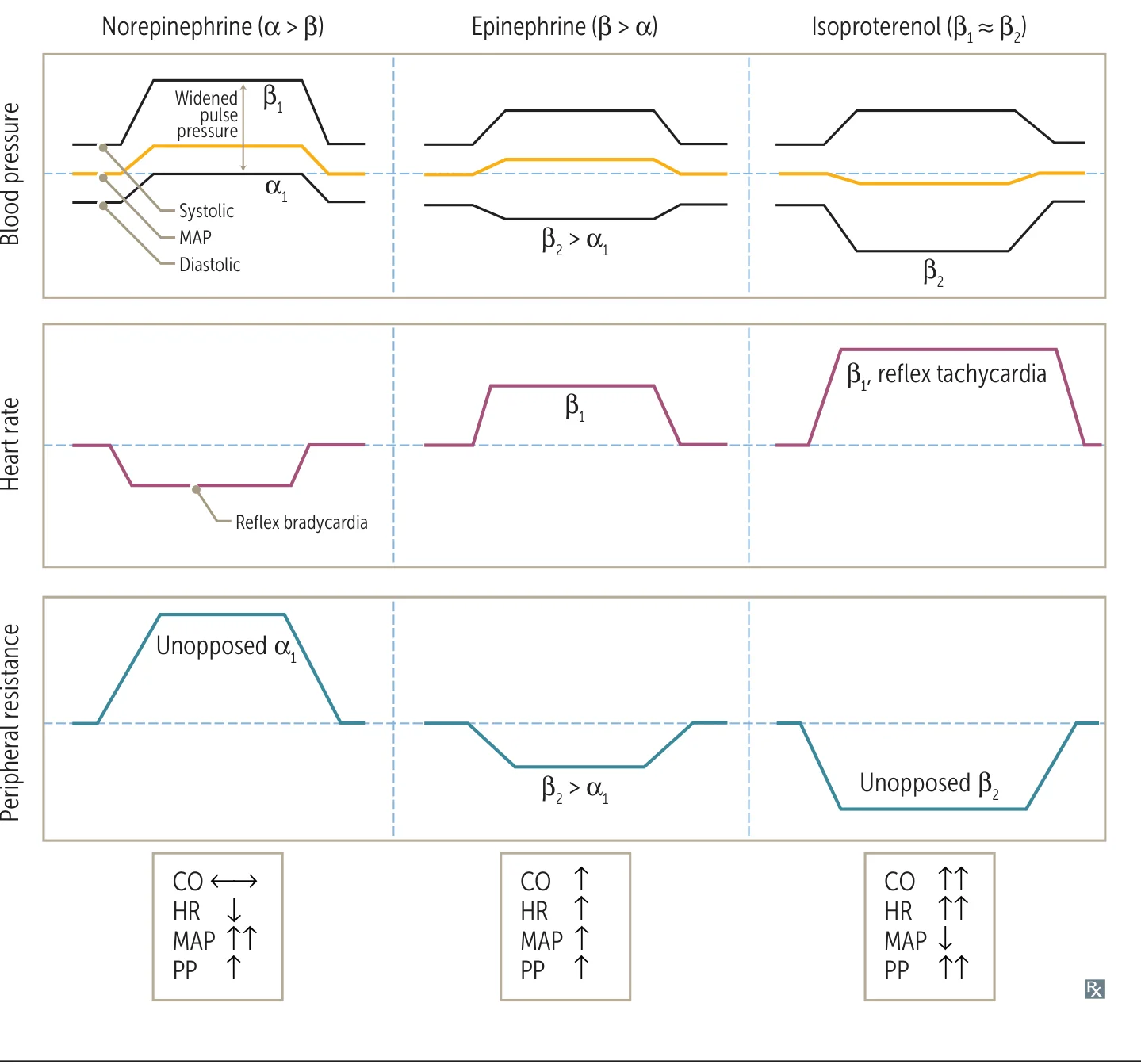
What this shows
How to give them
through a central line when possible (peripheral norepinephrine is acceptable short-term), with an arterial line, titrated to a mean arterial pressure of 65 and perfusion markers.| Receptor | Location | Effect |
|---|---|---|
| Alpha-1 | Vascular smooth muscle | Vasoconstriction: higher resistance and pressure; reflex bradycardia if pure |
| Beta-1 | Heart | Higher contractility, rate and conduction: more output (and oxygen demand, arrhythmia) |
| Beta-2 | Bronchial and vascular smooth muscle | Bronchodilation, vasodilation in muscle beds |
| Vasopressin V1 | Vascular smooth muscle | Vasoconstriction independent of catecholamine receptors; works in acidosis |
| Phosphodiesterase-3 inhibition | Myocardium and vessels | Inotropy plus vasodilation (an "inodilator") |
The drugs
| Drug | Receptors | Hemodynamic effect | Main indications | Cautions |
|---|---|---|---|---|
| Norepinephrine | Alpha-1 far more than beta-1 | Strong vasoconstriction, mild inotropy, little rate change | First line in septic, cardiogenic and undifferentiated shock | Peripheral and mesenteric ischemia; extravasation necrosis (local phentolamine) |
| Epinephrine | Beta-1 and beta-2 at low dose, alpha-1 at high dose | Higher rate and contractility; vasoconstriction at high dose | Anaphylaxis (intramuscular), cardiac arrest, second or third line in septic shock, low output after cardiac surgery | Tachyarrhythmias, lactic acidosis (a beta-2 effect that confounds lactate trends), hyperglycemia, ischemia |
| Vasopressin | V1 | Vasoconstriction without inotropy or tachycardia | Second agent in septic shock, vasodilatory shock after bypass | Digital and mesenteric ischemia, hyponatremia; fixed dose, not titrated |
| Phenylephrine | Pure alpha-1 | Vasoconstriction with reflex bradycardia; may lower output | Vasodilatory hypotension with tachyarrhythmia, anesthesia-induced hypotension, obstructive hypertrophic cardiomyopathy or aortic stenosis with hypotension | Lowers output in cardiogenic shock (avoid) |
| Dopamine | Dopamine, then beta-1, then alpha-1 with rising dose | Renal vasodilation, then inotropy, then vasoconstriction | Symptomatic bradycardia refractory to atropine (second line to pacing) | More arrhythmias and higher mortality than norepinephrine in shock; "renal-dose" dopamine does not protect the kidneys |
| Dobutamine | Beta-1 more than beta-2 | Higher contractility and rate with mild vasodilation; pressure may fall | Cardiogenic shock and low-output heart failure with adequate pressure (add to norepinephrine when hypotensive); stress echocardiography | Tachyarrhythmias, hypotension, ischemia; less effective on beta blockers |
| Milrinone | Phosphodiesterase-3 inhibitor | Higher contractility with systemic and pulmonary vasodilation, little rate change | Low output on chronic beta blockers or with pulmonary hypertension and right-ventricular failure | Hypotension, arrhythmias, renally cleared (accumulates in kidney injury), long half-life |
| Isoproterenol | Pure beta-1 and beta-2 | Higher rate and contractility, vasodilation | Bradycardia-dependent torsades, bradycardia in a transplanted (denervated) heart | Tachyarrhythmia, hypotension |
Choosing by the type of shock
Septic or distributive
30 mL/kg crystalloid, then norepinephrine, add vasopressin, then epinephrine; dobutamine if output stays low; hydrocortisone for escalating requirements (Distributive Shock).Anaphylaxis
intramuscular epinephrine, then an infusion; glucagon if beta-blocked (Anaphylactic Shock).Cardiogenic
norepinephrine for a systolic under 90 (dopamine increases mortality) plus dobutamine or milrinone for output once the pressure allows; no phenylephrine (Cardiogenic Shock).Right-ventricular failure
milrinone or dobutamine, avoid hypoxia and acidosis (they raise pulmonary resistance), vasopressin for pressure.Hypovolemic or hemorrhagic
volume and blood first; pressors only as a bridge (Hypovolemic & Hemorrhagic Shock).Obstructive
fluids and the definitive procedure, norepinephrine meanwhile (Obstructive Shock).Neurogenic
fluids, then norepinephrine (covers the bradycardia).Bradycardia
atropine, then transcutaneous pacing, then a dopamine or epinephrine infusion, then transvenous pacing (Sinus Bradycardia).Cardiac arrest
epinephrine 1 mg every 3 to 5 minutes (Cardiac Arrest & ACLS).Practical points
Titrate to perfusion
mentation, urine output, lactate, capillary refill, not a fixed dose; reassess volume repeatedly.Extravasation
a catecholamine causes local necrosis; stop the infusion and infiltrate phentolamine.Ischemia at high doses
digital and mesenteric; add a second agent rather than escalating one.Weaning
wean the last-added agent first.A patient in septic shock remains hypotensive on moderate-dose norepinephrine after 30 mL/kg of fluid. What is the next agent, and which drug is added if the cardiac output stays low?
Add vasopressin (then epinephrine if needed), with hydrocortisone for escalating requirements. Add dobutamine if the output stays low. Dopamine is not used.
How it's tested
Septic shock with MAP 55 after 30 mL/kg of crystalloid: norepinephrine, titrated to MAP 65; add vasopressin if the norepinephrine dose climbs.
Cardiogenic shock after an anterior MI, BP 75/50, cool and congested: norepinephrine for pressure plus dobutamine for output; not dopamine, not phenylephrine, and no fluid bolus.
Which pressor is wrong in a patient with hypertrophic obstructive cardiomyopathy and hypotension after sedation: dobutamine or epinephrine (inotropy worsens the obstruction) — give fluids and phenylephrine.
Low-output heart failure in a patient on long-term carvedilol who needs an inotrope: milrinone — it bypasses the blocked beta receptor.
Norepinephrine infusing through a hand IV; the hand becomes pale, cold and blistered: extravasation — stop, aspirate, local phentolamine.
Why not "renal-dose" dopamine for oliguria: it does not protect the kidney and causes arrhythmias — treat the perfusion, not the diuresis.
Go deeper
Guidelines: 2026 Surviving Sepsis Campaign Adult Guidelines · 2025 AHA Adult Advanced Life Support Guidance
Related Step 2 pages: Approach to Shock, Cardiogenic Shock, Distributive Shock, Anaphylactic Shock, Cardiac Arrest & ACLS, Hemodynamics: Preload, Afterload & Contractility, Approach to Cardiac Drug Adverse Effects
High-yield images1
You just read one page of 236
The rest of Step 2 CK, written exactly like this.
Rapid Review is the reading layer of a full Step 1 platform: a schedule fitted to your exam date, flashcards for every page, and a mentor a message away.
Every Step 1 system
Written the same way: what to know, how it’s tested, where to go deeper.
A plan built to your exam date
Tell us when you sit, and the schedule fits the whole library and your question bank to it.
Flashcards for every page
Ready-made spaced-repetition decks linked to each topic, so nothing you read gets forgotten.
