
Rapid Review·Cardiovascular
Select any text to highlight it or add a note.
Arrhythmias: Supraventricular
T1Must knowAtrial Fibrillation
Focus on
Irregularly irregular with no P waves. Three decisions in order: unstable → cardiovert now; stable → rate control (beta blocker or diltiazem) and find the cause (TSH, echo); then stroke prevention by CHA2DS2-VASc with a DOAC (warfarin only for mechanical valves and rheumatic mitral stenosis). Cardioversion of AF older than 48 hours needs 3 weeks of anticoagulation or a TEE first.
Key takeaways
What it is
Atrial fibrillation (AF)
an ectopic atrial rhythm, usually arising near the pulmonary veins, so fast (about 400 per minute) that no P waves are visible.- Variable atrioventricular (AV) nodal conduction gives a ventricular rate of about 75 to 125.
Three types by duration
paroxysmal resolves within 7 days, persistent lasts over 7 days, permanent lasts over a year.- All three need anticoagulation when valvular or when the stroke score says so.
Risk factors and clinical features
Hypertension
the most common and most significant risk factor.Other risk factors
diabetes, smoking, age over 80, coronary disease, obstructive sleep apnea, hyperthyroidism, pulmonary disease (chronic obstructive pulmonary disease (COPD), pulmonary embolism, pneumonia).Atrial stretch and triggers
atrial enlargement from heart failure or valve disease (mitral stenosis), pre-excitation (Wolff-Parkinson-White), stress or the post-surgical state (especially after cardiac surgery), alcohol and catecholamine surges (infection, surgery, pain)."Holiday heart"
an alcohol binge triggers paroxysmal AF that resolves within 7 days without treatment; the patient should abstain.Symptoms
often asymptomatic; otherwise an irregularly irregular pulse with palpitations, presyncope or syncope, dyspnea.Instability
with a rapid ventricular response or acute heart failure.Thromboembolism
stroke or transient ischemic attack (TIA), renal or splenic infarct, intestinal ischemia, acute limb ischemia.Diagnosis and acute management
Resting electrocardiogram (ECG) in every patient
an irregularly irregular rhythm with no distinct P waves, as in the AF with rapid ventricular response ECG.- Holter monitoring if the ECG is non-diagnostic but suspicion is high.
Every new AF
thyroid function tests (thyroid-stimulating hormone (TSH) and free thyroxine (T4)) and a transthoracic echocardiogram to check function and exclude structural disease, especially mitral stenosis.Rapid ventricular response, stable
intravenous beta blocker.Rapid ventricular response, unstable
emergency synchronized cardioversion.Rate or rhythm control
Outcomes are roughly equivalent
choose by duration of AF and patient preference.AF that began over 48 hours ago
exclude a left atrial thrombus before restoring rhythm, or cardioversion can dislodge the clot.- Either a transesophageal echocardiogram, or 3 or more weeks of anticoagulation.
| Rate control (preferred for most) | Rhythm control | |
|---|---|---|
| Who | Most patients | Young (under 65) or severely symptomatic patients who need sinus rhythm |
| Tools | Beta blocker or non-dihydropyridine calcium-channel blocker first line, digoxin second, amiodarone third | Electrical cardioversion; flecainide or propafenone (sotalol if coronary disease, amiodarone if reduced ejection fraction); catheter ablation |
| Target | Heart rate under 85 if symptomatic, under 110 if asymptomatic | Sinus rhythm, only if AF under 48 hours or a clean transesophageal echo |
| Anticoagulation | Usually indicated | Often indicated |
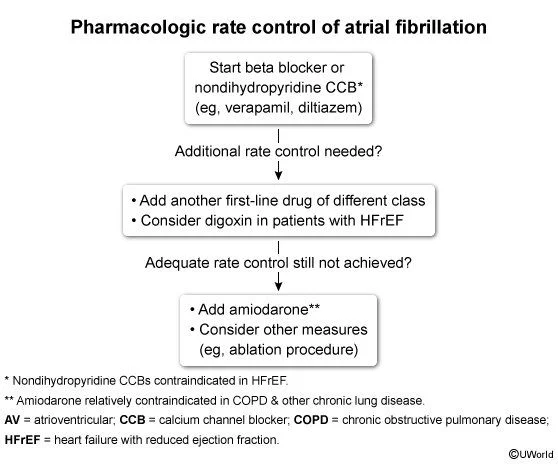
What this shows
Stepping up rate control
add drugs in order until the target is reached.Anticoagulation and complications
Direct oral anticoagulants (dabigatran, rivaroxaban, apixaban)
for non-valvular AF; contraindicated in renal insufficiency.Warfarin (international normalized ratio (INR) 2 to 3)
for valvular AF and end-stage renal disease.Start anticoagulation
for a CHA2DS2-VA score of 2 or more.| Item | Points |
|---|---|
| Heart failure | 1 |
| Hypertension | 1 |
| Age 75 or more | 2 |
| Diabetes | 1 |
| Prior stroke or TIA | 2 |
| Vascular disease | 1 |
| Age 65 to 74 | 1 |
Female sex was removed from the score
it is a risk modifier, not a risk factor.Occasional paroxysmal AF
with a qualifying score still needs anticoagulation.Pulmonary vein isolation
for severe or refractory cases.Complications
tachycardia-induced (dilated) cardiomyopathy, and embolic events (stroke, mesenteric or limb ischemia).A 70-year-old man with hypertension and diabetes has palpitations for 3 days; the ECG shows an irregularly irregular rhythm with no P waves at a rate of 105, and he is stable. What must be done before rhythm control, and does he need anticoagulation?
Atrial fibrillation of over 48 hours: exclude a left atrial thrombus first, with a transesophageal echocardiogram or 3 or more weeks of anticoagulation. His CHA2DS2-VA score is 3 (hypertension, diabetes, age 65 to 74), so he needs anticoagulation (a direct oral anticoagulant if the valves and kidneys are normal).
How it's tested
Irregularly irregular tachycardia at 150 with BP 82/50 and chest pain: synchronized cardioversion now.
Same rhythm, BP 130/80, symptoms for two days: IV metoprolol or diltiazem; TSH and echo; heparin.
New AF in a 68-year-old woman with hypertension and diabetes (score 4): a DOAC — long-term.
AF in a woman with rheumatic mitral stenosis: warfarin, regardless of her score.
AF of unknown duration in a stable patient who wants cardioversion: TEE first, or three weeks of anticoagulation; then four weeks after.
AF with rapid rate in decompensated HFrEF: digoxin (or cautious beta blocker) — diltiazem is contraindicated.
Heavy drinking over a holiday weekend, then palpitations with AF that resolves in two days: holiday heart — abstinence; no long-term antiarrhythmic.
Go deeper
Guidelines: 2023 ACC/AHA/ACCP/HRS Atrial Fibrillation Guideline
Related Step 2 pages: Atrial Flutter, Multifocal Atrial Tachycardia, Wolff-Parkinson-White Syndrome, Mitral Stenosis, Sick Sinus Syndrome, Antiarrhythmic Drugs, Approach to Tachyarrhythmias
High-yield images2
Flashcards for this page
Card 1 of 5 · try-out only, nothing is saved
You just read one page of 236
The rest of Step 2 CK, written exactly like this.
Rapid Review is the reading layer of a full Step 1 platform: a schedule fitted to your exam date, flashcards for every page, and a mentor a message away.
Every Step 1 system
Written the same way: what to know, how it’s tested, where to go deeper.
A plan built to your exam date
Tell us when you sit, and the schedule fits the whole library and your question bank to it.
Flashcards for every page
Ready-made spaced-repetition decks linked to each topic, so nothing you read gets forgotten.
