
Rapid Review·Cardiovascular
Select any text to highlight it or add a note.
Arrhythmias: Supraventricular
T2High yieldAtrial Flutter
Focus on
A regular narrow tachycardia at exactly 150 with a sawtooth baseline in II, III and aVF is flutter with 2:1 block. It is managed like atrial fibrillation for stroke prevention, but rate control is harder and catheter ablation of the cavotricuspid isthmus is curative.
Key takeaways
What it is
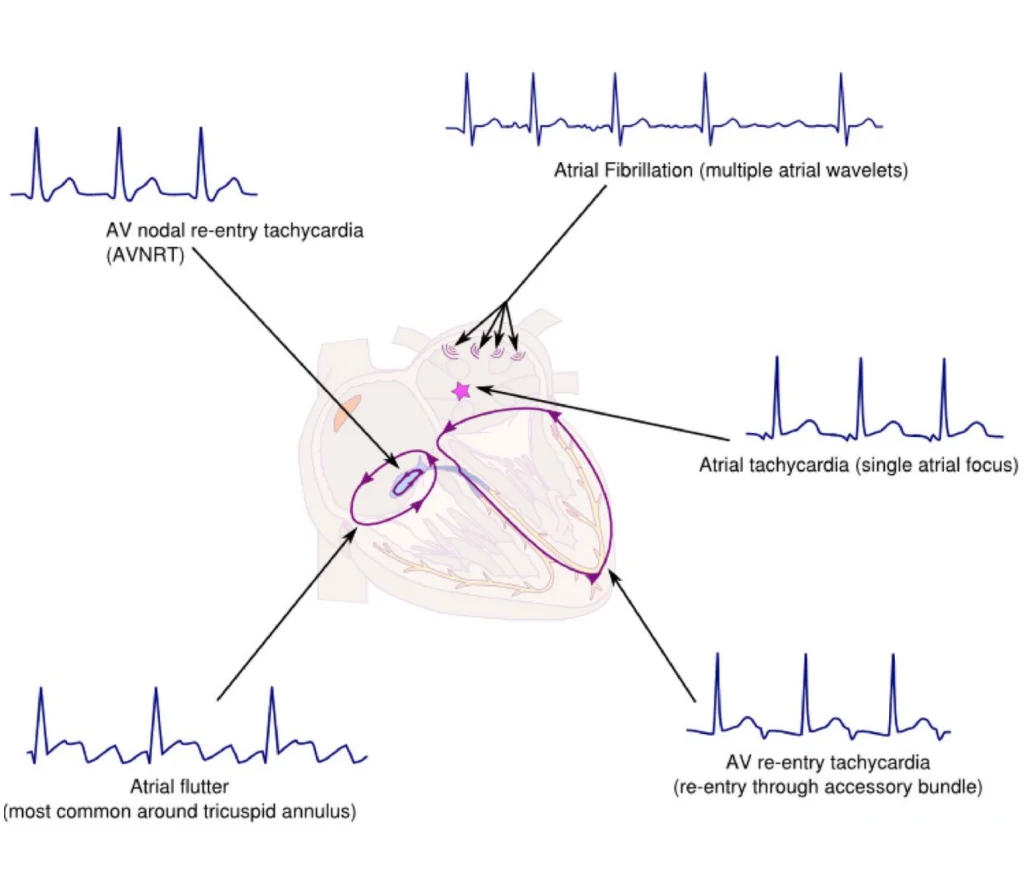
What this shows
Atrial flutter
a re-entrant circuit, usually around the tricuspid annulus or atrial scar, fires the atria regularly at about 300 per minute.Ventricular rate
with the usual 2:1 block the ventricles run at about 150 (about 100 with 3:1 block, 75 with 4:1).Like atrial fibrillation
the causes are the same, and the thrombus risk is the same.Clinical features and diagnosis
Most patients are asymptomatic
otherwise palpitations, dyspnea, fatigue, dizziness, presyncope.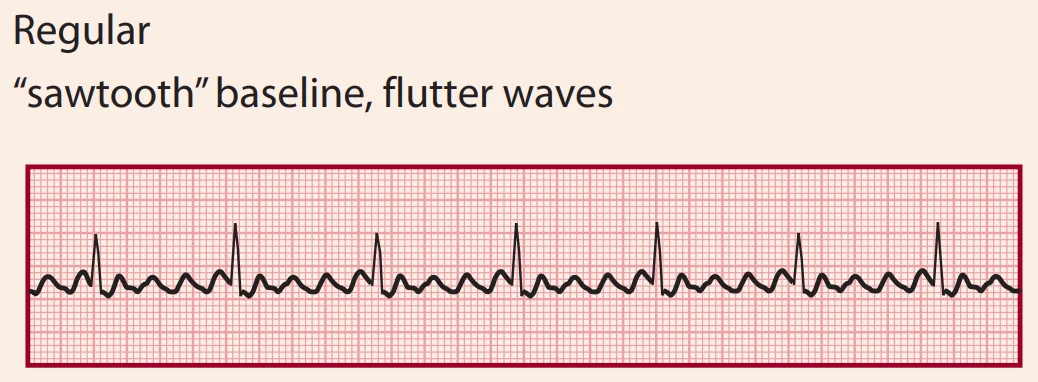
Electrocardiogram (ECG)
saw-tooth flutter (F) waves at about 300 per minute with variable atrioventricular (AV) conduction, most often 2:1, giving a ventricular rate near 150.Usually regular
but a variable block can make it regularly or irregularly irregular.- Regularly irregular when the block alternates in a fixed pattern (2:1 then 4:1); irregularly irregular when it varies at random.
Management
Acute, stable
rate control with a beta blocker.Acute, unstable
synchronized cardioversion.Chronic
a beta blocker (first) or non-dihydropyridine calcium-channel blocker for rate, and anticoagulation by the same rules as atrial fibrillation (Atrial Fibrillation).Ablation is definitive
rate control is harder to achieve than in fibrillation, so rhythm control does better; radiofrequency catheter ablation of the circuit is the definitive and most effective therapy.A patient has a regular narrow-complex tachycardia at exactly 150 with a saw-tooth baseline in the inferior leads. What is the rhythm, what is the atrial rate, and what is the definitive treatment?
Atrial flutter with 2:1 block: the atria fire at about 300, and every second impulse reaches the ventricles. Anticoagulate by the atrial fibrillation rules; radiofrequency catheter ablation of the circuit is definitive.
How it's tested
Regular narrow tachycardia at 150 that does not slow with vagal maneuvers; adenosine briefly reveals a sawtooth baseline: atrial flutter with 2:1 conduction — rate control, anticoagulation, and referral for ablation.
Flutter with 2:1 block, BP 75/40: synchronized cardioversion.
A patient with recurrent typical flutter asks for a permanent solution: cavotricuspid isthmus ablation — curative.
Flutter given flecainide alone develops a wide-complex tachycardia at 220: 1:1 conduction of a slowed flutter — always pair a IC drug with AV-nodal blockade.
Does flutter need anticoagulation like AF: yes — same scoring, same drugs, same cardioversion rules.
Go deeper
Guidelines: 2023 ACC/AHA/ACCP/HRS Atrial Fibrillation Guideline · 2015 ACC/AHA/HRS Supraventricular Tachycardia Guideline
Related Step 2 pages: Atrial Fibrillation, Approach to Tachyarrhythmias, AV Nodal Reentrant Tachycardia, Antiarrhythmic Drugs
High-yield images2
You just read one page of 236
The rest of Step 2 CK, written exactly like this.
Rapid Review is the reading layer of a full Step 1 platform: a schedule fitted to your exam date, flashcards for every page, and a mentor a message away.
Every Step 1 system
Written the same way: what to know, how it’s tested, where to go deeper.
A plan built to your exam date
Tell us when you sit, and the schedule fits the whole library and your question bank to it.
Flashcards for every page
Ready-made spaced-repetition decks linked to each topic, so nothing you read gets forgotten.
