
Rapid Review·Cardiovascular
Select any text to highlight it or add a note.
Arrhythmias: Supraventricular
T1Must knowAV Nodal Reentrant Tachycardia
Focus on
The most common paroxysmal SVT: a young adult with abrupt-onset palpitations, a regular narrow tachycardia at 150–220 with no visible P waves, stopped by a Valsalva or by adenosine. Cardiovert if unstable; slow-pathway ablation cures recurrent episodes.
Key takeaways
What it is and how it works
AV nodal re-entrant tachycardia (AVNRT)
the most common paroxysmal supraventricular tachycardia, from a re-entry circuit inside a dysfunctional atrioventricular (AV) node.- AV re-entrant tachycardia (via an accessory pathway) is the second most common.
Who
idiopathic, usually starting in young adulthood.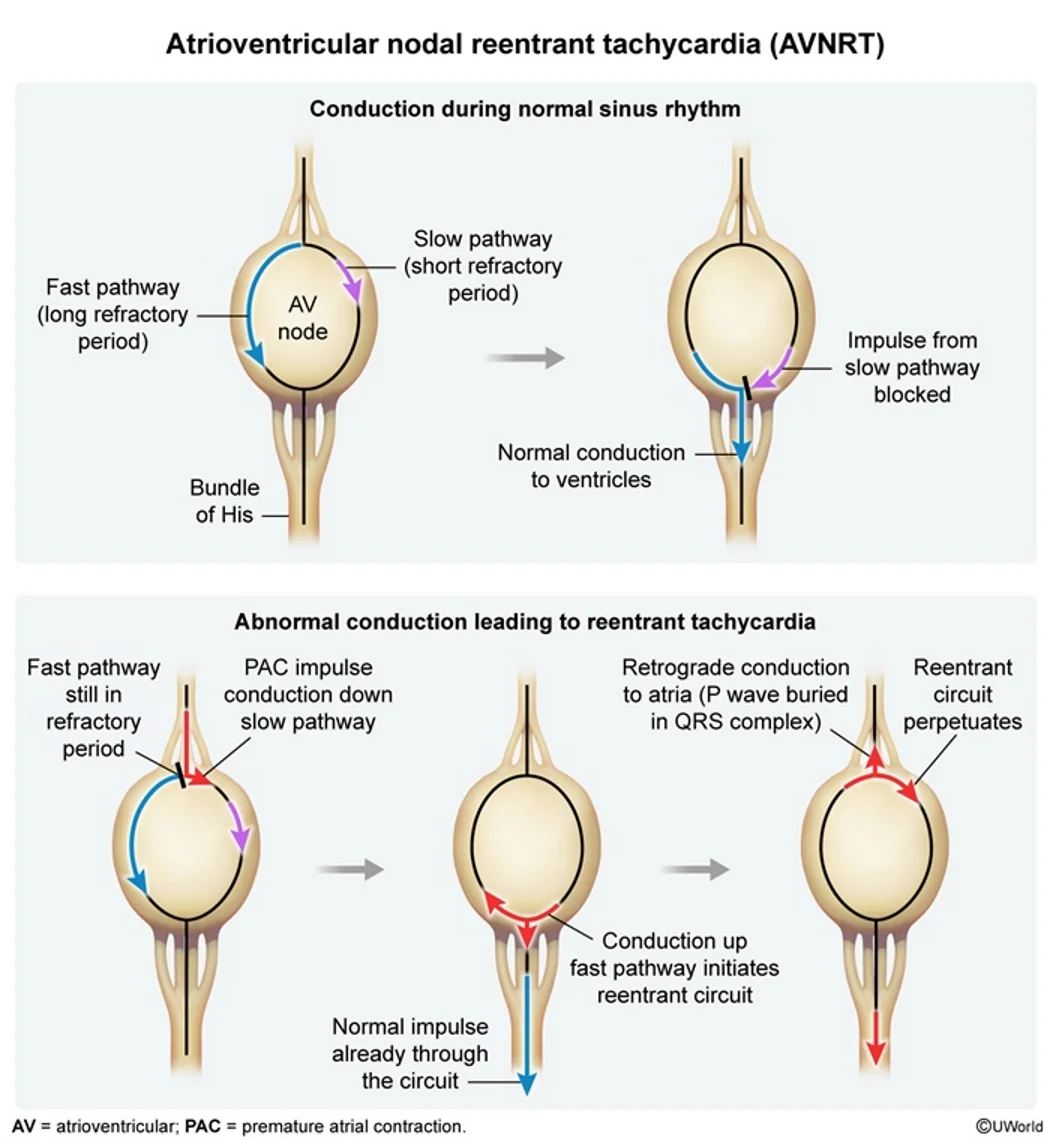
What this shows
Mechanism
a loop between two pathways inside the node.- Two pathways: a fast pathway with a long refractory period and a slow pathway with a short one.
- Normal beats: the fast pathway conducts, and the slow impulse dies against the refractory fast pathway.
- A premature atrial beat: arrives while the fast pathway is still refractory, so it goes down the slow pathway.
- The loop: it returns up the fast pathway, and a re-entrant loop starts.
- The hidden P wave: the atria depolarize retrogradely, almost together with the ventricles, so the P wave hides in the QRS.
Clinical features and diagnosis
Paroxysms with abrupt onset and abrupt end
palpitations, dizziness, presyncope, chest discomfort, diaphoresis, dyspnea.- Syncope is uncommon and mostly in older adults.
Electrocardiogram (ECG)
a regular narrow-complex tachycardia at 150 to 220 with no visible P waves or retrograde P waves, as in the AVNRT ECG pattern.- The ECG may be normal between episodes.
Inconclusive ECG
a Holter or event recorder over 24 to 48 hours.Management
Unstable
immediate synchronized cardioversion.Stable
in order.- Vagal maneuvers: Valsalva, carotid sinus massage, the diving reflex; they raise parasympathetic tone and prolong AV nodal refractoriness.
- Intravenous adenosine: beta blockers and calcium-channel blockers are the alternatives.
Infrequent mild episodes
self-guided vagal maneuvers.Frequent episodes
catheter ablation of the slow pathway first line; a beta blocker, verapamil or diltiazem second line.A 26-year-old woman has sudden palpitations; she is stable, and the ECG shows a regular narrow-complex tachycardia at 190 with no visible P waves. What are the first two steps, and what is the long-term fix if episodes are frequent?
AV nodal re-entrant tachycardia. First vagal maneuvers, then intravenous adenosine. Frequent episodes: catheter ablation of the slow pathway.
How it's tested
A 26-year-old woman with sudden palpitations; ECG shows a regular narrow tachycardia at 190 with no P waves; BP 115/75: AVNRT — modified Valsalva, then adenosine.
Same rhythm with BP 70/40: synchronized cardioversion.
Adenosine transiently slows the rate and sawtooth waves appear before it speeds back up: atrial flutter, not AVNRT.
Third episode this year despite metoprolol: catheter ablation of the slow pathway.
Regular narrow tachycardia in a patient with a known delta wave on his resting ECG: orthodromic AVRT — same acute treatment (vagal, adenosine) because the AV node is part of the circuit.
Go deeper
Guidelines: 2015 ACC/AHA/HRS Supraventricular Tachycardia Guideline · 2025 AHA Adult Advanced Life Support Guidance
Related Step 2 pages: Approach to Tachyarrhythmias, Wolff-Parkinson-White Syndrome, Atrial Flutter, Sinus Tachycardia, Antiarrhythmic Drugs
High-yield images2
You just read one page of 236
The rest of Step 2 CK, written exactly like this.
Rapid Review is the reading layer of a full Step 1 platform: a schedule fitted to your exam date, flashcards for every page, and a mentor a message away.
Every Step 1 system
Written the same way: what to know, how it’s tested, where to go deeper.
A plan built to your exam date
Tell us when you sit, and the schedule fits the whole library and your question bank to it.
Flashcards for every page
Ready-made spaced-repetition decks linked to each topic, so nothing you read gets forgotten.
