
Rapid Review·Cardiovascular
Select any text to highlight it or add a note.
Arrhythmias: Supraventricular
T1Must knowWolff-Parkinson-White Syndrome
Focus on
Short PR, delta wave, wide QRS — an accessory pathway (bundle of Kent) bypassing the AV node. Orthodromic AVRT is a narrow regular tachycardia treated like AVNRT; pre-excited AF is an irregular, very fast wide tachycardia where AV-nodal blockers (adenosine, beta blockers, CCBs, digoxin, amiodarone) can precipitate VF — use procainamide, ibutilide or cardioversion. Ablation cures it.
Key takeaways
What it is
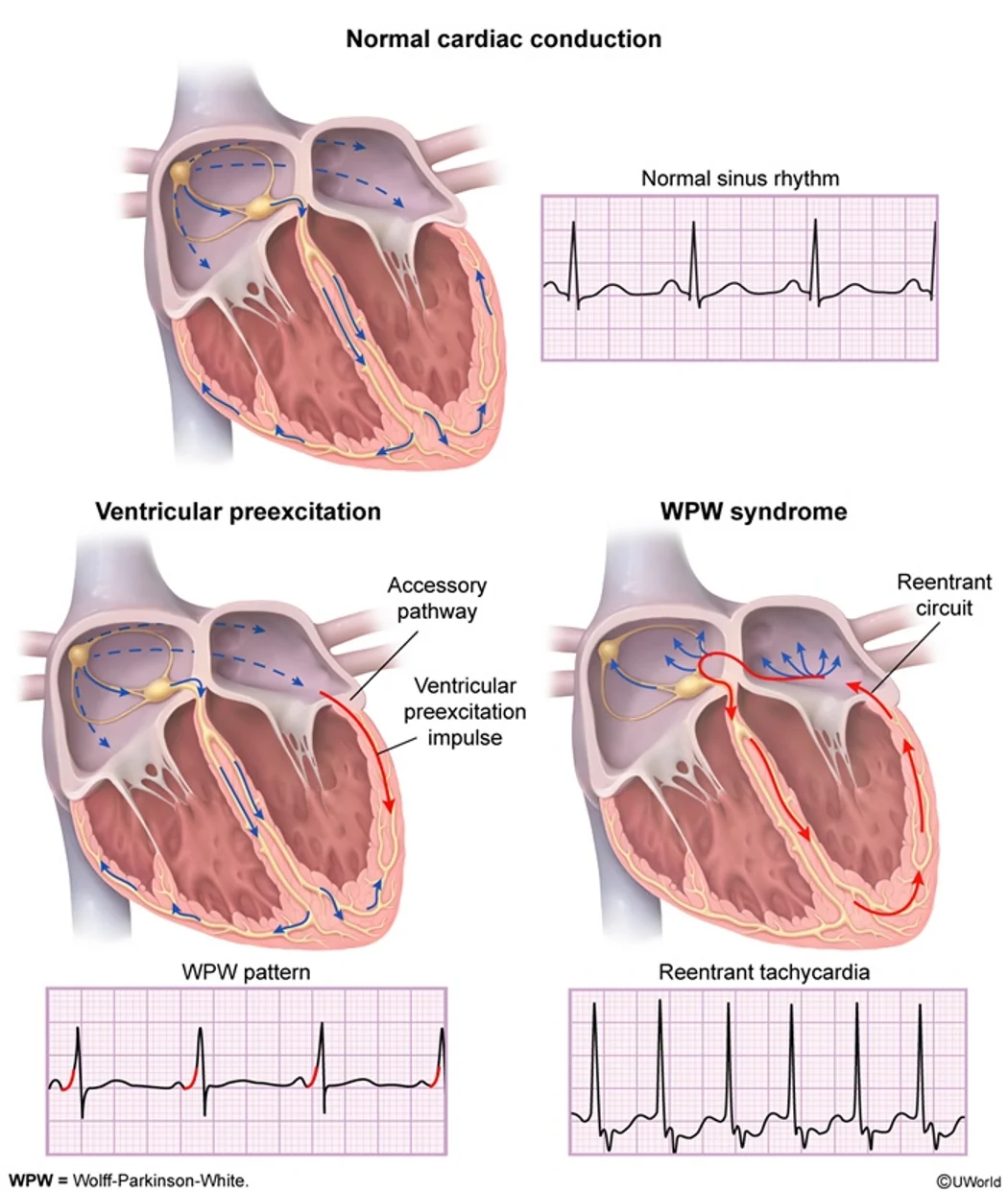
What this shows
An accessory pathway
a congenital accessory pathway (bundle of Kent) connects atrium to ventricle, bypasses the atrioventricular (AV) node, and pre-excites the ventricle.Pattern vs syndrome
Wolff-Parkinson-White (WPW) pattern is the pre-excitation on the electrocardiogram (ECG) without symptoms; WPW syndrome is the pattern plus tachyarrhythmias.The arrhythmias
atrioventricular re-entrant tachycardia (AVRT), the most common, and atrial fibrillation or flutter with pre-excitation.Clinical features
often asymptomatic until an arrhythmia occurs; then palpitations, dizziness, presyncope, chest discomfort, diaphoresis, dyspnea.Diagnosis
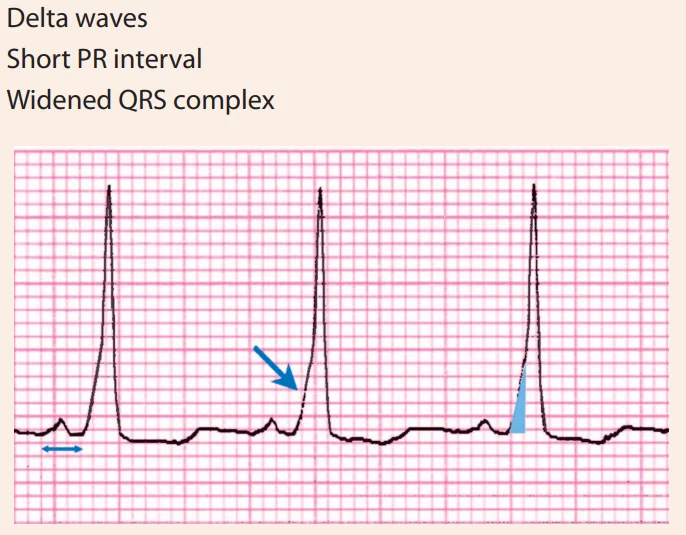
What this shows
WPW pattern in sinus rhythm
short PR interval, a delta wave, and a widened QRS.AVRT
starts abruptly with a regular rhythm at 150 to 250.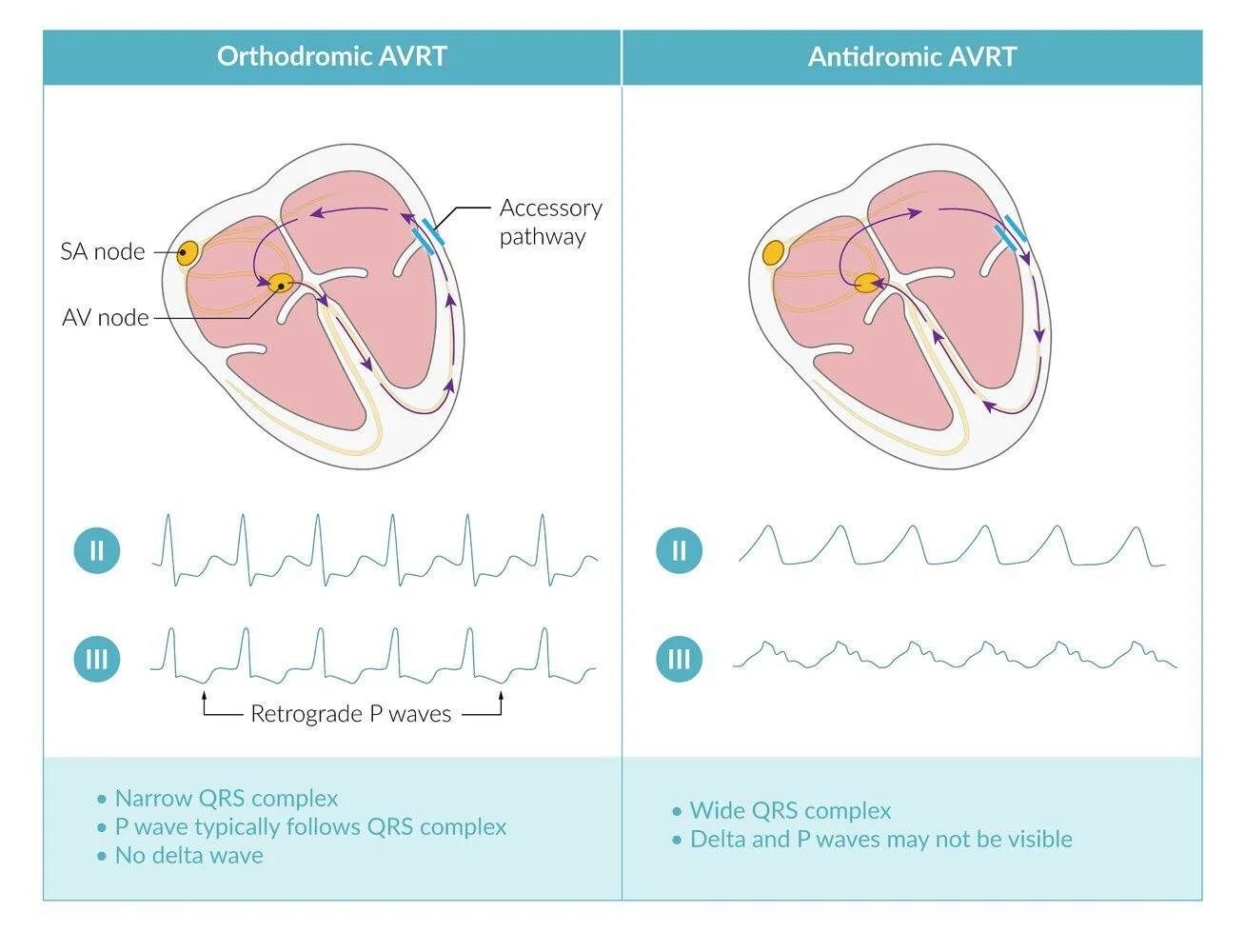
What this shows
Orthodromic AVRT
atrium to AV node to ventricle, back up the pathway.- Narrow QRS, the P wave after the QRS, delta waves absent.
- It can be indistinguishable from AVNRT.
Antidromic AVRT
down the pathway, back up the node.- Wide QRS that looks like ventricular tachycardia, with occasional delta waves.
AVRT vs AVNRT
AVRT uses an accessory pathway; AV nodal re-entrant tachycardia (AVNRT) uses two pathways inside the node.| Pattern | QRS | Delta wave | AV node dependent | Acute treatment |
|---|---|---|---|---|
| WPW in sinus rhythm | Wide | Yes | Yes | None needed |
| Orthodromic AVRT | Usually narrow | No | Yes | Vagal maneuvers or adenosine |
| Antidromic AVRT, or atrial fibrillation (AF) with pre-excitation | Wide | Intermittent | No | Electrical cardioversion, or procainamide (first line) or ibutilide |
Management
Unstable
synchronized cardioversion.Stable orthodromic AVRT (narrow)
vagal maneuvers, then adenosine.Antidromic AVRT or pre-excited atrial fibrillation
electrical cardioversion, or procainamide first line (ibutilide is the alternative).Asymptomatic low-risk patients
no treatment.Catheter ablation of the accessory pathway
definitive, and first line for symptomatic or high-risk patients.- High risk: syncope, associated atrial fibrillation, flutter or atrial tachycardia, or an aborted sudden death.
A stable 22-year-old with a known delta wave has palpitations; the ECG shows an irregular, wide-complex tachycardia at 240. Which drug is first line, which drugs are dangerous, and what is the long-term fix?
Pre-excited atrial fibrillation in WPW. Give procainamide (or electrical cardioversion). AV nodal blockers (adenosine, beta blockers, calcium-channel blockers, digoxin) push conduction down the pathway and are dangerous. Long term: catheter ablation of the accessory pathway.
How it's tested
A 20-year-old with palpitations; resting ECG shows a PR of 100 ms with a slurred QRS upstroke: WPW pattern — refer for risk stratification and, if symptomatic, ablation.
Same patient in a regular narrow tachycardia at 200, BP normal: orthodromic AVRT — vagal maneuvers, then adenosine.
Same patient in an irregular wide-complex tachycardia at 240 with changing QRS shapes, BP 100/60: pre-excited AF — IV procainamide (or cardioversion); adenosine, diltiazem, metoprolol or digoxin could cause VF.
Same rhythm with BP 70/40: synchronized cardioversion.
What is the definitive therapy after a syncopal episode: catheter ablation of the accessory pathway.
Go deeper
Guidelines: 2015 ACC/AHA/HRS Supraventricular Tachycardia Guideline · 2023 ACC/AHA/ACCP/HRS Atrial Fibrillation Guideline
Related Step 2 pages: AV Nodal Reentrant Tachycardia, Atrial Fibrillation, Approach to Tachyarrhythmias, Ventricular Tachycardia, Ebstein Anomaly, Antiarrhythmic Drugs
High-yield images3
Flashcards for this page
Card 1 of 4 · try-out only, nothing is saved
You just read one page of 236
The rest of Step 2 CK, written exactly like this.
Rapid Review is the reading layer of a full Step 1 platform: a schedule fitted to your exam date, flashcards for every page, and a mentor a message away.
Every Step 1 system
Written the same way: what to know, how it’s tested, where to go deeper.
A plan built to your exam date
Tell us when you sit, and the schedule fits the whole library and your question bank to it.
Flashcards for every page
Ready-made spaced-repetition decks linked to each topic, so nothing you read gets forgotten.
