
Rapid Review·Cardiovascular
Select any text to highlight it or add a note.
Vascular: Peripheral
T1Must knowFibromuscular Dysplasia
Focus on
A young woman with severe or early-onset hypertension and an epigastric bruit — or a headache, pulsatile tinnitus and a carotid dissection. Non-inflammatory, non-atherosclerotic wall disease of the renal and carotid arteries with a "string of beads" on angiography. ACE inhibitors and balloon angioplasty without a stent for the kidney; antiplatelets for the neck.
Key takeaways
What it is and where it strikes
Fibromuscular dysplasia (FMD)
a non-inflammatory, non-atherosclerotic proliferation of connective tissue and muscle in the walls of medium-sized arteries, producing stenosis (with ischemia of the organ) and predisposing to aneurysm and dissection.Who
women 8 to 1, young to middle-aged.What it is not
not atherosclerosis (no plaque, distal rather than ostial), not vasculitis (normal inflammatory markers).Renal arteries
75 to 80 percent, often bilateral.Carotid and vertebral arteries
transient ischemic attack, stroke, dissection.Clinical features and screening
Renal FMD
severe secondary hypertension, flank or abdominal pain, chronic kidney disease; an abdominal or costovertebral bruit.Cerebrovascular FMD
headache, neck pain, pulsatile tinnitus, transient ischemic attack, stroke, Horner syndrome, amaurosis fugax, usually through carotid or vertebral dissection (Carotid Artery Dissection); a cervical bruit.Whom to screen
women under 50 with any of these.- Severe or resistant hypertension.
- Hypertension onset before 35.
- A sudden rise from a stable baseline.
- A creatinine rise (over 0.5 to 1 mg/dL) after starting an angiotensin-converting-enzyme (ACE) inhibitor or receptor blocker without a pressure response.
- A systolic-diastolic epigastric bruit.
Diagnosis
Best initial tests
duplex ultrasound or computed tomography (CT) angiography.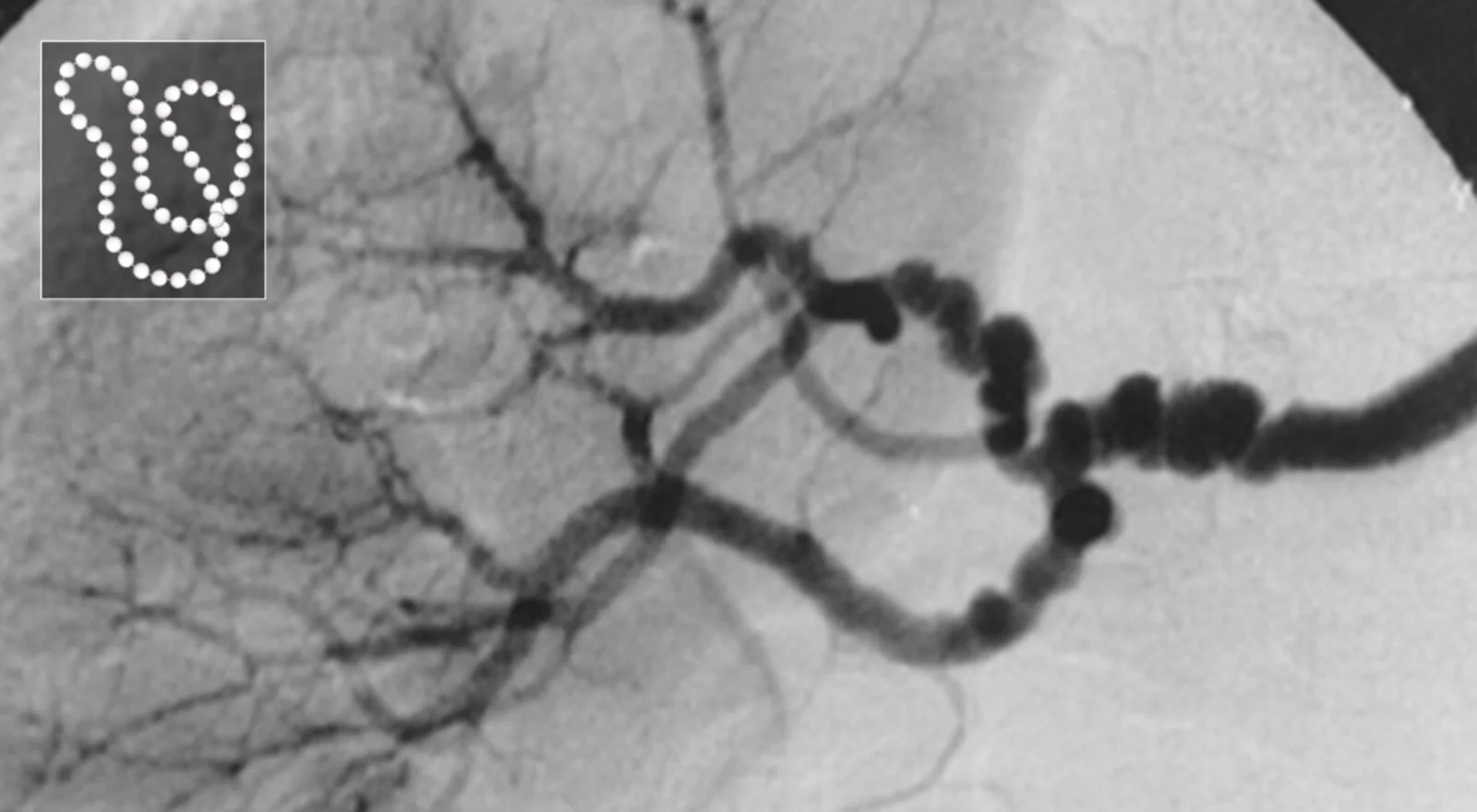
What this shows
Gold standard: digital subtraction angiography
showing the "string of beads" (aneurysmal dilations alternating with stenoses) in the mid-to-distal renal artery.| Fibromuscular dysplasia | Atherosclerotic renal artery stenosis | |
|---|---|---|
| Patient | Woman 30 to 50 | Older, diabetic, diffuse atherosclerosis |
| Lesion | Mid-to-distal renal artery, string of beads, often bilateral | Ostial or proximal plaque |
| Presentation | Early-onset or resistant hypertension, bruit | Late-onset hypertension, flash pulmonary edema, kidney injury on an ACE inhibitor |
| Revascularization | Balloon angioplasty alone cures or improves the pressure in most | Medical therapy first; stenting only for refractory hypertension, flash edema or declining renal function |
Management and complications
Renal FMD
antihypertensives (ACE inhibitors or receptor blockers); the definitive treatment is balloon percutaneous transluminal angioplasty without stenting.- Medically treated patients: blood pressure and creatinine every 3 to 4 months, renal ultrasound every 6 to 12 months.
Cerebrovascular FMD
antiplatelet therapy (low-dose aspirin) for all as stroke prophylaxis; angioplasty for symptomatic patients; avoid neck manipulation.Everyone
smoking cessation (smoking worsens FMD); counsel before pregnancy.Complications
renovascular hypertension and its end-organ damage, renal artery dissection or aneurysm, cervical artery dissection with stroke, subarachnoid hemorrhage from intracranial aneurysms, spontaneous coronary artery dissection.A 31-year-old woman has new severe hypertension and a systolic-diastolic epigastric bruit; her creatinine rose after starting lisinopril. What is the likely cause, the gold-standard test finding, and the definitive treatment?
Renal fibromuscular dysplasia: angiography shows a "string of beads" in the mid-to-distal renal artery. Definitive treatment is balloon angioplasty without stenting.
How it's tested
A 32-year-old woman with BP 180/110 unresponsive to three drugs and a systolic–diastolic bruit in the epigastrium: renal artery fibromuscular dysplasia — CT angiography (string of beads); ACE inhibitor, then balloon angioplasty without a stent.
A 40-year-old woman with pulsatile tinnitus, headache, then a partial Horner syndrome and a TIA: carotid dissection on a background of FMD — CT angiography of the neck, antithrombotic therapy, aspirin long term.
Definitive treatment of renal FMD vs atherosclerotic renal artery stenosis: balloon angioplasty alone for FMD; medical therapy (with stenting reserved for refractory cases) for atherosclerosis.
Creatinine rises from 0.9 to 1.5 two weeks after lisinopril in a young hypertensive woman, with no fall in pressure: bilateral renal artery stenosis — image for FMD.
Go deeper
Guidelines: 2014 AHA Scientific Statement on Fibromuscular Dysplasia
Related Step 2 pages: Secondary Hypertension, Carotid Artery Dissection, Approach to Leg Pain & Ulcers, Hypertension, Vertebrobasilar Insufficiency
High-yield images1
You just read one page of 236
The rest of Step 2 CK, written exactly like this.
Rapid Review is the reading layer of a full Step 1 platform: a schedule fitted to your exam date, flashcards for every page, and a mentor a message away.
Every Step 1 system
Written the same way: what to know, how it’s tested, where to go deeper.
A plan built to your exam date
Tell us when you sit, and the schedule fits the whole library and your question bank to it.
Flashcards for every page
Ready-made spaced-repetition decks linked to each topic, so nothing you read gets forgotten.
