
Rapid Review·Cardiovascular
Select any text to highlight it or add a note.
Vascular: Peripheral
T2High yieldHereditary Hemorrhagic Telangiectasia
Focus on
Lifelong nosebleeds, red spots on the lips and tongue, and an affected parent — Osler-Weber-Rendu. The danger lies in the arteriovenous malformations: pulmonary AVMs let clots and bacteria bypass the lung filter (stroke, brain abscess), GI telangiectasias cause iron deficiency, hepatic shunts cause high-output failure, brain AVMs bleed. Screen and embolize.
Key takeaways
What it is
Hereditary hemorrhagic telangiectasia (HHT)
an autosomal dominant systemic vasculopathy (Osler-Weber-Rendu syndrome; mutations in endoglin or ACVRL1).The lesions
telangiectasias of the skin and mucosa (nose, lips, tongue) and larger arteriovenous malformations (AVMs) in the lungs, liver, brain and gut, all lacking a capillary bed.Clinical features and diagnosis
Recurrent epistaxis
the usual first sign, from childhood.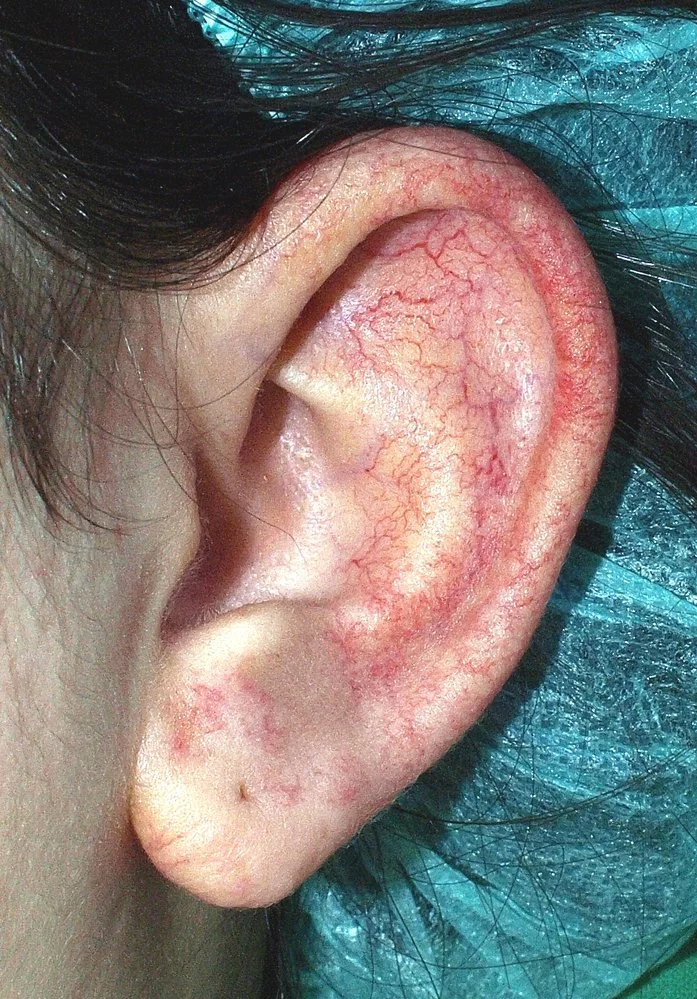
Telangiectasias
small red blanching macules on the lips, tongue, oral mucosa, face and fingertips, increasing with age.Other features
cyanosis with pulmonary shunting; iron-deficiency anemia from nasal and gut blood loss.Curacao criteria
three are definite, two possible.- Epistaxis.
- Telangiectasias of skin and mucous membranes.
- A family history of the disease.
- Visceral involvement (pulmonary, gastrointestinal, cerebral AVMs or telangiectasias).
Genetic testing
confirms uncertain cases and enables screening of relatives.Workup at diagnosis
blood count and iron studies; contrast (bubble) echocardiography to screen for pulmonary AVMs (then chest computed tomography (CT) if positive); brain magnetic resonance imaging (MRI); gut endoscopy for anemia out of proportion to the epistaxis.| Site | Presentation or complication | Treatment |
|---|---|---|
| Nose, mouth, skin | Recurrent epistaxis, visible telangiectasias, iron deficiency | Humidification, tranexamic acid, laser or sclerotherapy; bevacizumab for severe bleeding |
| Lung | Right-to-left shunt: hypoxemia, clubbing; hemoptysis; paradoxical embolization: ischemic stroke and brain abscess; pulmonary hypertension with right heart failure | Transcatheter embolization; antibiotic prophylaxis before dental and other bacteremic procedures; air filters on intravenous lines |
| Gut | Chronic bleeding and anemia, often after 50 | Iron, transfusion, endoscopic coagulation, bevacizumab |
| Liver | Arteriovenous shunting causing high-output heart failure; portal hypertension | Heart-failure therapy, bevacizumab; transplant if refractory (embolization is dangerous here) |
| Brain and spine | Hemorrhagic stroke, seizures, headache | Neurosurgical, endovascular or radiosurgical treatment by lesion |
Management and complications
Treat and prevent bleeding
iron replacement, nasal humidification, tranexamic acid, laser ablation for refractory epistaxis.- Avoid non-steroidal anti-inflammatory drugs and unnecessary antiplatelets.
Prevent the pulmonary AVM complications
embolize treatable AVMs, antibiotic prophylaxis before bacteremic procedures (brain abscess), air filters on all intravenous lines, treat before pregnancy.Bevacizumab (anti-vascular endothelial growth factor)
for severe epistaxis, transfusion-dependent gut bleeding or symptomatic hepatic AVMs.Family
genetic counseling and screening of first-degree relatives.Complications
chronic iron-deficiency anemia, brain abscess and ischemic stroke through pulmonary AVMs, hemorrhagic stroke, hemoptysis, high-output heart failure, pulmonary hypertension, chronic gut bleeding and hematuria.A 24-year-old with lifelong nosebleeds and red spots on her lips, whose father has the same problem, develops a brain abscess. What is the diagnosis, what caused the abscess, and which test screens for it?
Hereditary hemorrhagic telangiectasia (autosomal dominant). The abscess comes from paradoxical embolization through a pulmonary AVM. Screen with contrast (bubble) echocardiography; embolize treatable AVMs and give antibiotic prophylaxis before bacteremic procedures.
How it's tested
A 30-year-old with nosebleeds since childhood, red macules on the lips and tongue, and a mother with the same: hereditary hemorrhagic telangiectasia — check iron studies and screen for pulmonary AVMs with contrast echocardiography and the brain with MRI.
HHT patient with fever, headache and a ring-enhancing brain lesion, or a stroke with a normal carotid study: paradoxical embolism through a pulmonary AVM — bubble echo, CT chest, embolization; antibiotic prophylaxis before dental work.
Dyspnea, bounding pulses, wide pulse pressure and a hepatic bruit in HHT: hepatic arteriovenous shunting with high-output heart failure.
Iron deficiency in a 60-year-old with HHT whose nosebleeds are mild: GI telangiectasias — endoscopy, iron, argon plasma coagulation.
Which mutation and inheritance: endoglin or ACVRL1 (ALK1), autosomal dominant.
Go deeper
Guidelines: International HHT Guidelines — Table of Recommendations
Related Step 2 pages: High Output Heart Failure, Approach to Leg Pain & Ulcers, Patent Foramen Ovale, Infective Endocarditis
High-yield images1
Flashcards for this page
Card 1 of 1 · try-out only, nothing is saved
You just read one page of 236
The rest of Step 2 CK, written exactly like this.
Rapid Review is the reading layer of a full Step 1 platform: a schedule fitted to your exam date, flashcards for every page, and a mentor a message away.
Every Step 1 system
Written the same way: what to know, how it’s tested, where to go deeper.
A plan built to your exam date
Tell us when you sit, and the schedule fits the whole library and your question bank to it.
Flashcards for every page
Ready-made spaced-repetition decks linked to each topic, so nothing you read gets forgotten.
