
Rapid Review·Cardiovascular
Select any text to highlight it or add a note.
Heart Failure
T1Must knowHigh Output Heart Failure
Focus on
Heart failure with warm extremities, bounding pulses and a wide pulse pressure: the output is high but the periphery demands more. Find the driver — obesity, anemia, thyrotoxicosis, an AV fistula, beriberi, Paget disease, sepsis, cirrhosis — and fix it; diuretics only relieve the congestion.
Key takeaways
What it is and what causes it
Heart failure with a raised cardiac output
usually from a chronically expanded volume status or a low peripheral vascular resistance.Morbid obesity
the most common cause in the United States.Other causes
severe anemia, hyperthyroidism, sepsis, pregnancy, and wet beriberi (thiamine deficiency).Arteriovenous shunting
congenital or acquired.- Congenital: patent ductus arteriosus, arteriovenous fistula.
- Acquired: dialysis or traumatic fistula, Paget disease of bone.
Erythroblastosis fetalis
severe fetal anemia.Clinical features
The classic findings of heart failure, plus a hyperdynamic circulation
the circulation is running fast.- Warm extremities (low-output failure gives cold ones).
- A wide pulse pressure, bounding peripheral pulses and a brisk carotid upstroke.
- Pulsatile tinnitus.
Diagnosis
Primarily clinical.
Echocardiography
cardiomegaly with a dilated left ventricle, right ventricle and inferior vena cava, and a raised resting cardiac index.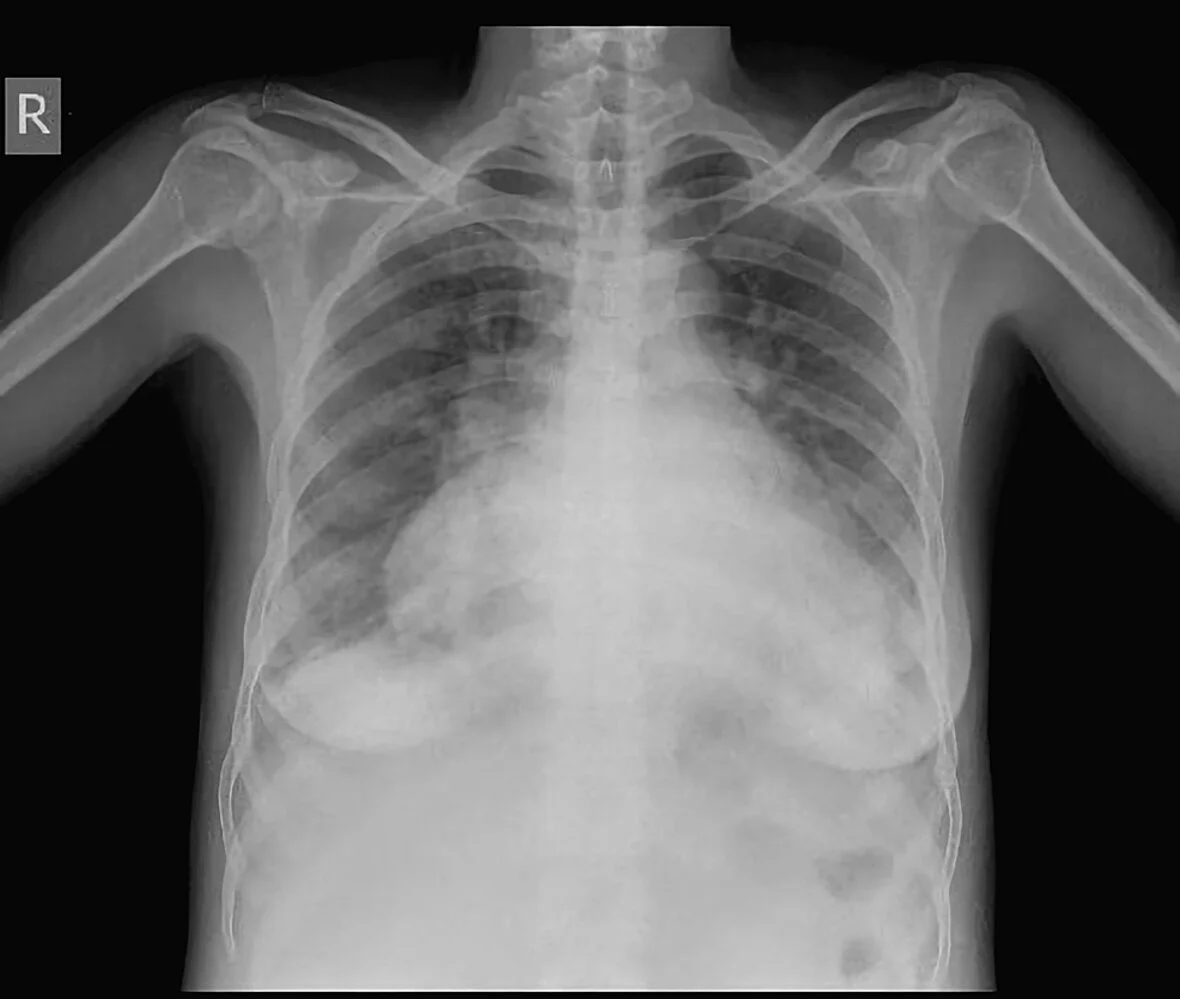
What this shows
The chest radiograph may also show cardiomegaly.
| Parameter | High-output failure | Low-output failure |
|---|---|---|
| Cardiac index | Raised | Reduced |
| Pulmonary capillary wedge pressure | Raised | Raised |
| Systemic vascular resistance | Reduced | Raised |
| Extremities | Warm | Cold |
Management
Treat the underlying condition
the driver has to be fixed.Diuretics for congestion
as in chronic heart failure.How do the cardiac index, wedge pressure and systemic vascular resistance differ between high-output and low-output heart failure?
Cardiac index is raised in high-output failure and reduced in low-output failure. Pulmonary capillary wedge pressure is raised in both. Systemic vascular resistance is reduced in high-output failure (hence warm extremities) and raised in low-output failure (cold extremities).
How it's tested
Two years after a gunshot wound to the thigh, progressive dyspnea, a continuous bruit over the scar, warm legs and a wide pulse pressure: traumatic AV fistula causing high-output failure — duplex/CT angiography and surgical repair.
Thyrotoxic patient with tachycardia, bounding pulses, edema and a cardiac index of 5: high-output failure from low SVR — treat the thyroid; beta blocker for rate.
Chronic alcoholic with edema, dyspnea, warm extremities and a high output on echo: wet beriberi — thiamine before any glucose.
Dialysis patient with a very high-flow fistula and new heart failure symptoms: measure access flow; banding or revision.
Congestion with cold extremities, narrow pulse pressure and a low cardiac index: not high-output — decompensated systolic failure or cardiogenic shock.
Go deeper
Guidelines: 2022 AHA/ACC/HFSA Heart Failure Guideline
Related Step 2 pages: Heart Failure, Femoral Artery Disease, Hemodynamics: Preload, Afterload & Contractility
High-yield images1
Flashcards for this page
Card 1 of 4 · try-out only, nothing is saved
You just read one page of 236
The rest of Step 2 CK, written exactly like this.
Rapid Review is the reading layer of a full Step 1 platform: a schedule fitted to your exam date, flashcards for every page, and a mentor a message away.
Every Step 1 system
Written the same way: what to know, how it’s tested, where to go deeper.
A plan built to your exam date
Tell us when you sit, and the schedule fits the whole library and your question bank to it.
Flashcards for every page
Ready-made spaced-repetition decks linked to each topic, so nothing you read gets forgotten.
