
Rapid Review·Cardiovascular
Select any text to highlight it or add a note.
Heart Failure
T2High yieldCardiorenal Syndrome
Focus on
Kidney function falling because the heart is failing. The driver is venous congestion (high renal venous pressure), not "low flow" — so the answer to a rising creatinine in a congested patient is more diuresis, not less, and a small creatinine bump on GDMT is not a reason to stop it.
Key takeaways
What it is
Cardiorenal syndrome
a progressive decline in renal function caused by severe cardiac dysfunction.How common
it occurs in about 30 percent of patients with acute decompensated heart failure.- It is the major driver of acute kidney injury (AKI) in acute heart failure.
Pathophysiology
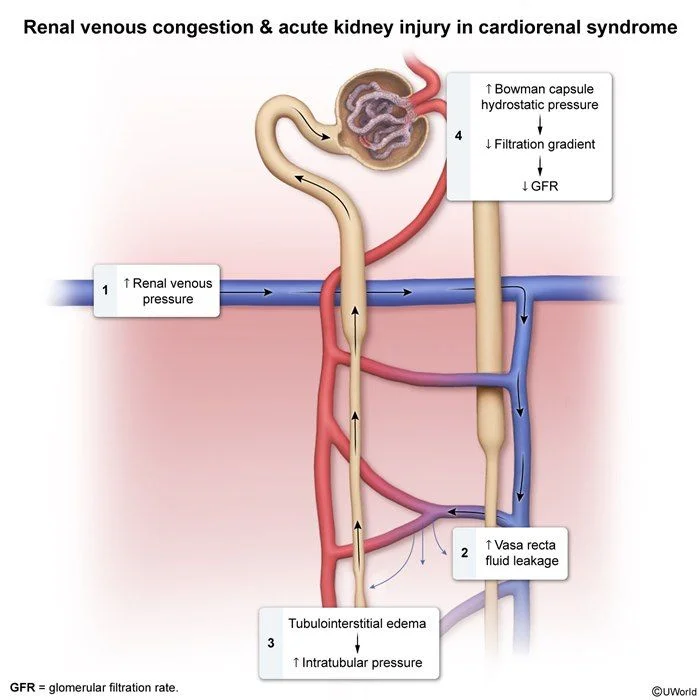
What this shows
The main problem is venous congestion
a high central venous pressure is transmitted to the renal veins.- That lowers the trans-glomerular pressure gradient and the glomerular filtration rate (GFR).
Low forward flow is the smaller contributor
reduced renal perfusion from a low cardiac output also lowers the GFR (prerenal physiology).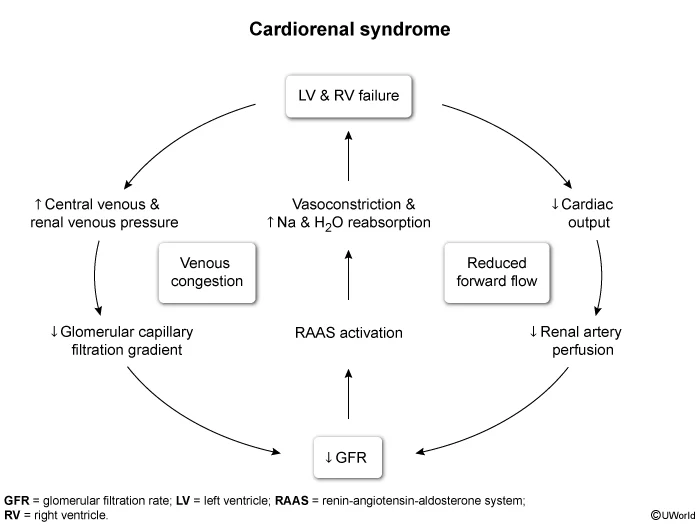
What this shows
Renin-angiotensin-aldosterone activation
causes salt and fluid retention, hypertension, and hypertensive nephropathy.Diagnosis and management
Diagnosis
a falling GFR and rising creatinine that cannot be explained by underlying kidney disease.Treat the heart failure and the renal failure together.
Intravenous diuretics (furosemide)
lower central and renal venous pressure, improve cardiac output, and so raise the GFR.- A congested patient with a rising creatinine needs more diuresis, not less.
Prognosis
heart failure with a reduced GFR and a creatinine over 3 mg/dL carries a poor prognosis.A patient admitted with acute decompensated heart failure is congested and the creatinine rises from 1.4 to 2.1. Should the diuretic be stopped? Explain.
No, diuresis should continue or increase. In cardiorenal syndrome the main driver is venous congestion: high central venous pressure is transmitted to the renal veins and lowers the GFR. IV furosemide lowers that pressure and raises the GFR.
How it's tested
Admitted with decompensated HFrEF, JVD and edema; creatinine rises from 1.4 to 1.9 after two days of IV furosemide while he is still congested: cardiorenal syndrome from venous congestion — continue or increase diuresis; do not stop.
Same patient, now dry with orthostatic hypotension, creatinine 2.4 and BUN 60: over-diuresis — hold the diuretic.
Starting sacubitril/valsartan raised the creatinine 15% with a potassium of 4.9: an expected hemodynamic change — continue and recheck.
Cirrhotic with tense ascites, creatinine 3, urine sodium < 10 and no response to albumin challenge: hepatorenal syndrome — the vasodilation problem, not the congestion problem.
Go deeper
Guidelines: 2022 AHA/ACC/HFSA Heart Failure Guideline
Related Step 2 pages: Heart Failure, Approach to Shock, Approach to Fluid Replacement
High-yield images2
You just read one page of 236
The rest of Step 2 CK, written exactly like this.
Rapid Review is the reading layer of a full Step 1 platform: a schedule fitted to your exam date, flashcards for every page, and a mentor a message away.
Every Step 1 system
Written the same way: what to know, how it’s tested, where to go deeper.
A plan built to your exam date
Tell us when you sit, and the schedule fits the whole library and your question bank to it.
Flashcards for every page
Ready-made spaced-repetition decks linked to each topic, so nothing you read gets forgotten.
