
Rapid Review·Cardiovascular
Select any text to highlight it or add a note.
Shock
T1Must knowHypovolemic & Hemorrhagic Shock
Focus on
Tachycardia comes before hypotension, the hemoglobin lags behind the bleed, and the answer is always the same order: stop the bleeding, replace blood with blood (1:1:1), give tranexamic acid within 3 hours, and keep the patient warm. Permissive hypotension until hemostasis — except with a head injury.
Key takeaways
What it is and what causes it
Hypovolemic shock
loss of intravascular volume lowers preload and stroke volume.- Compensatory tachycardia and vasoconstriction (high resistance, cool skin, narrow pulse pressure) hold the pressure until about 30 percent of the volume is gone.
Two kinds of loss
hemorrhage loses whole blood; non-hemorrhagic hypovolemia (vomiting, diarrhea, burns, third spacing, diabetic ketoacidosis, diuretics) loses plasma and electrolytes.Hemorrhage, the most common type of shock
trauma (chest, abdomen, pelvis and retroperitoneum, long bones, external), gastrointestinal bleeding, ruptured Abdominal Aortic Aneurysm, ruptured ectopic pregnancy, postpartum hemorrhage, post-operative bleeding, anticoagulation.Non-hemorrhagic
gastrointestinal losses, burns, pancreatitis and bowel obstruction (third spacing), heat illness, polyuria (diabetic ketoacidosis, diabetes insipidus), poor intake.| Class | Blood loss | Heart rate | Blood pressure | Pulse pressure | Urine output | Mental status | Fluid |
|---|---|---|---|---|---|---|---|
| I | Under 15 percent (under 750 mL) | Under 100 | Normal | Normal | Over 30 mL/h | Slightly anxious | Crystalloid |
| II | 15 to 30 percent (750 to 1,500 mL) | 100 to 120 | Normal | Narrowed | 20 to 30 | Anxious | Crystalloid, blood if needed |
| III | 30 to 40 percent (1,500 to 2,000 mL) | 120 to 140 | Decreased | Narrowed | 5 to 15 | Confused | Blood products |
| IV | Over 40 percent (over 2 L) | Over 140 | Decreased | Narrowed | Negligible | Lethargic | Massive transfusion |
Clinical features
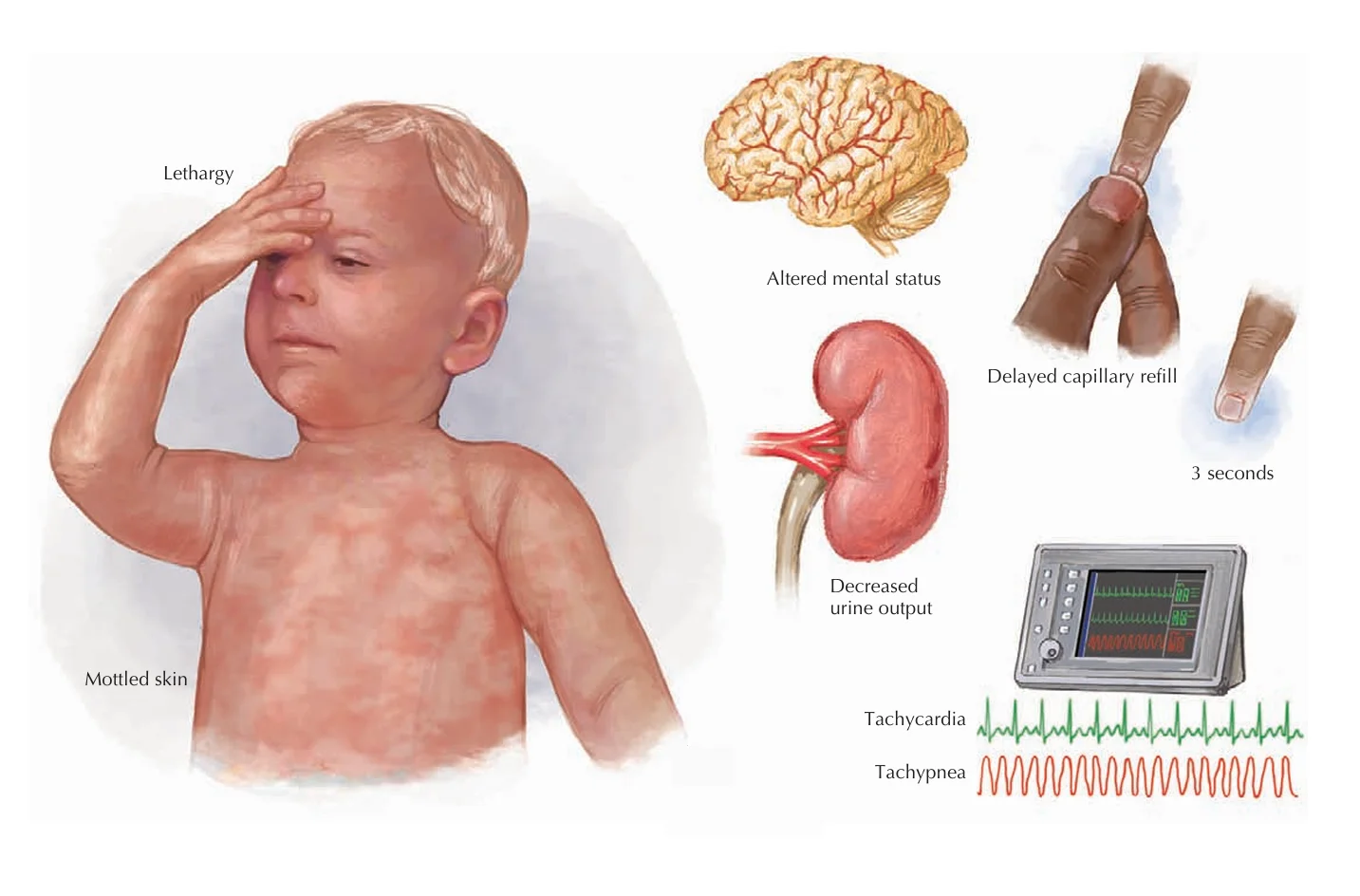
What this shows
The sequence
tachycardia, tachypnea, cool clammy pale skin, delayed capillary refill, flat neck veins, thirst and anxiety, then confusion, oliguria, a narrowed pulse pressure and finally hypotension.The trauma rule
hypotension in a trauma patient without a cervical spine injury is hemorrhagic shock until proven otherwise.The first hemoglobin is normal
whole blood is lost, so it falls only after fluid shifts and resuscitation.Masked or early decompensation
beta blockers, pacemakers and athletic conditioning blunt the tachycardia; the elderly decompensate early.Find the bleeding compartment
Clinical, with labs
lactate and base deficit for severity, hemoglobin trend, coagulation, fibrinogen, type and crossmatch, ionized calcium, pregnancy test.External
direct pressure first; a tourniquet for life-threatening limb bleeding when direct pressure fails.Chest
radiograph; a massive hemothorax (over 1,500 mL from the chest tube, or over 200 mL/h) means thoracotomy.Abdomen
focused assessment with sonography for trauma (FAST) for free fluid; positive with instability means laparotomy.Pelvis
an unstable pelvis with a negative FAST still bleeds massively; binder, angioembolization or preperitoneal packing.Thigh
a femur hides 1 to 2 L.Stable patients
computed tomography.Damage-control resuscitation
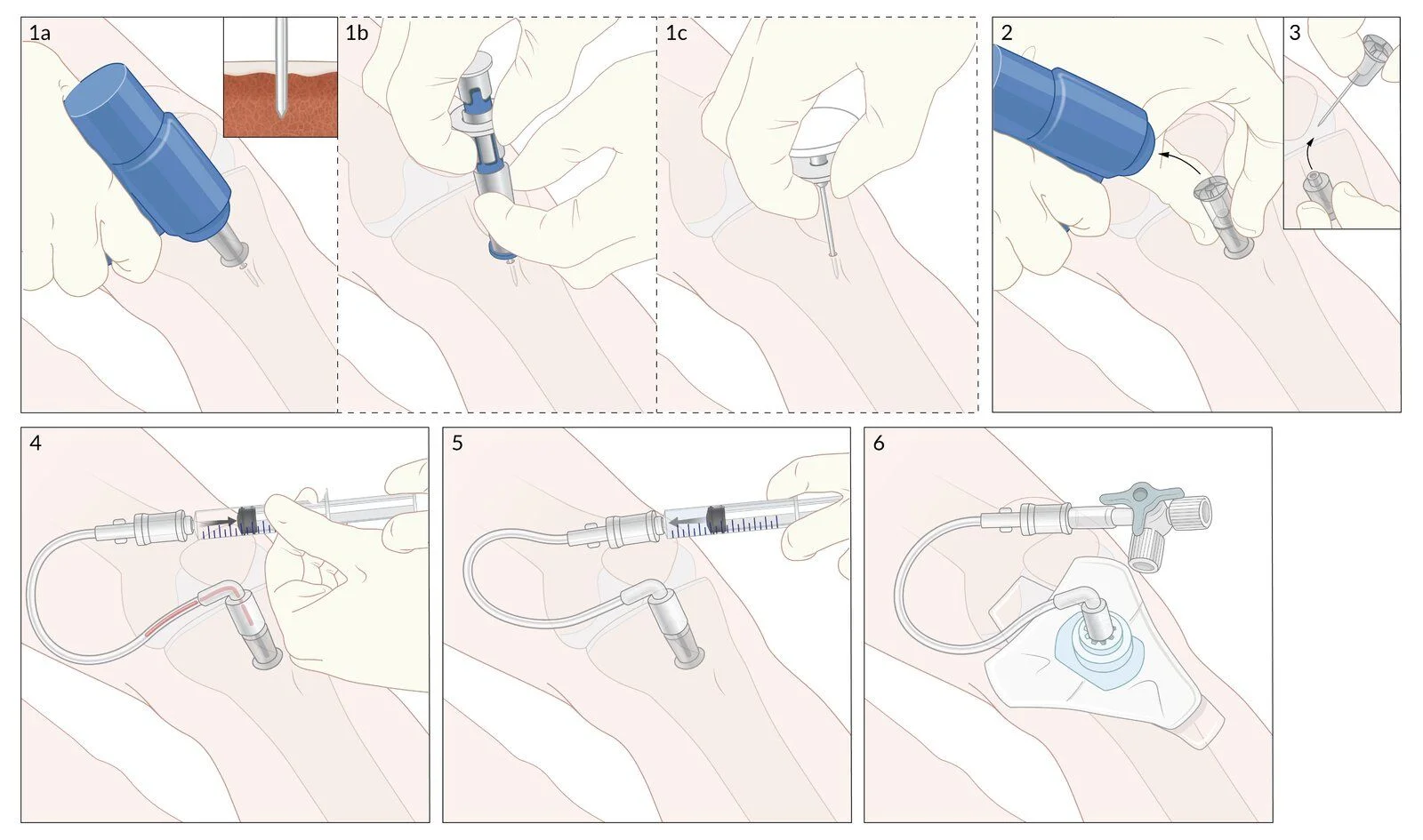
What this shows
Access
two large-bore peripheral intravenous lines.- Intraosseous if not obtained quickly (after 3 failed venous attempts): the proximal tibia (most common) or humeral head; never through a fracture, infected skin or a prior intraosseous attempt in that bone.
- A central line afterwards if vasopressors or blood products are needed.
Activate massive transfusion early
systolic pressure of 90 or less, heart rate of 120 or more, positive FAST, penetrating torso injury, or obvious exsanguination.Balanced components at about 1:1:1
packed cells, plasma, platelets, or whole blood.- Limit crystalloid (at most 1 to 2 L), because liters of saline dilute clotting factors, cool the patient and cause acidosis.
Uncrossmatched blood
an unstable patient cannot wait for crossmatching; O-negative for women of childbearing potential and children; O-positive is acceptable for men.Tranexamic acid
1 g over 10 minutes then 1 g over 8 hours, within 3 hours of injury.Prevent the lethal triad (hypothermia, acidosis, coagulopathy)
warm fluids and blankets, replace calcium (citrate binds it), give plasma and fibrinogen (cryoprecipitate when under 150 to 200 mg/dL), reverse anticoagulants.Permissive hypotension
systolic about 80 to 90 (a mean arterial pressure around 65) until surgical or endovascular hemostasis in actively bleeding adults, so clots are not disrupted.Non-hemorrhagic hypovolemia
isotonic crystalloid in 500 mL to 1 L boluses, correct the cause and the electrolytes; blood only if anemic.Endpoints
bleeding controlled, heart rate and pressure normalizing, urine output over 0.5 mL/kg/h, lactate clearing, normal mentation.- Watch for abdominal compartment syndrome and transfusion complications (hypocalcemia, hyperkalemia).
After a motorcycle crash, a man has a heart rate of 132, a blood pressure of 84/60, confusion and a positive FAST. What class of hemorrhage is this, and what are the first resuscitation steps?
Class III hemorrhage (30 to 40 percent loss: tachycardia 120 to 140, low pressure, confusion). Two large-bore lines (intraosseous if they fail), activate massive transfusion with 1:1:1 blood products (uncrossmatched O blood), limit crystalloid, tranexamic acid within 3 hours, prevent the lethal triad, and take him to laparotomy (positive FAST with instability).
How it's tested
A trauma patient with HR 125, BP 118/86, anxious, urine output 25 mL/h: class II hemorrhage — the narrowed pulse pressure and tachycardia precede hypotension; start blood and find the source.
Hypotensive after a motorcycle crash, FAST negative, pelvis unstable: retroperitoneal pelvic bleeding — binder, massive transfusion, angioembolization; the negative FAST excludes nothing.
Pale, tachycardic and hypotensive with a hemoglobin of 14 g/dL: acute hemorrhage — the number has not caught up; treat the shock.
Received 4 L of saline, now cold, acidotic and oozing from every line: dilutional coagulopathy and the lethal triad — switch to balanced blood products, warm, give calcium and TXA, get to source control.
Bleeding trauma patient with a GCS of 7: no permissive hypotension — maintain SBP ≥ 100–110 for cerebral perfusion while controlling hemorrhage.
Go deeper
Guidelines: ACS TQP Massive Transfusion in Trauma
Related Step 2 pages: Approach to Shock, Approach to Fluid Replacement, Vascular Trauma, Abdominal Aortic Aneurysm, Traumatic Aortic Injury
High-yield images2
Flashcards for this page
Card 1 of 5 · try-out only, nothing is saved
You just read one page of 236
The rest of Step 2 CK, written exactly like this.
Rapid Review is the reading layer of a full Step 1 platform: a schedule fitted to your exam date, flashcards for every page, and a mentor a message away.
Every Step 1 system
Written the same way: what to know, how it’s tested, where to go deeper.
A plan built to your exam date
Tell us when you sit, and the schedule fits the whole library and your question bank to it.
Flashcards for every page
Ready-made spaced-repetition decks linked to each topic, so nothing you read gets forgotten.
