
Rapid Review·Cardiovascular
Select any text to highlight it or add a note.
Arrhythmias: Bradycardia & Devices
T2High yieldCardiac Implantable Devices
Focus on
Three devices, three questions. Pacemaker: symptomatic bradycardia, Mobitz II or complete block without a reversible cause. ICD: survived VT/VF, or EF ≤ 35% despite optimal therapy, or a high-risk channelopathy/cardiomyopathy. CRT: EF ≤ 35% with LBBB and a wide QRS on maximal drugs. Plus the monitors that catch the rhythm in the first place.
Key takeaways
Pacemakers
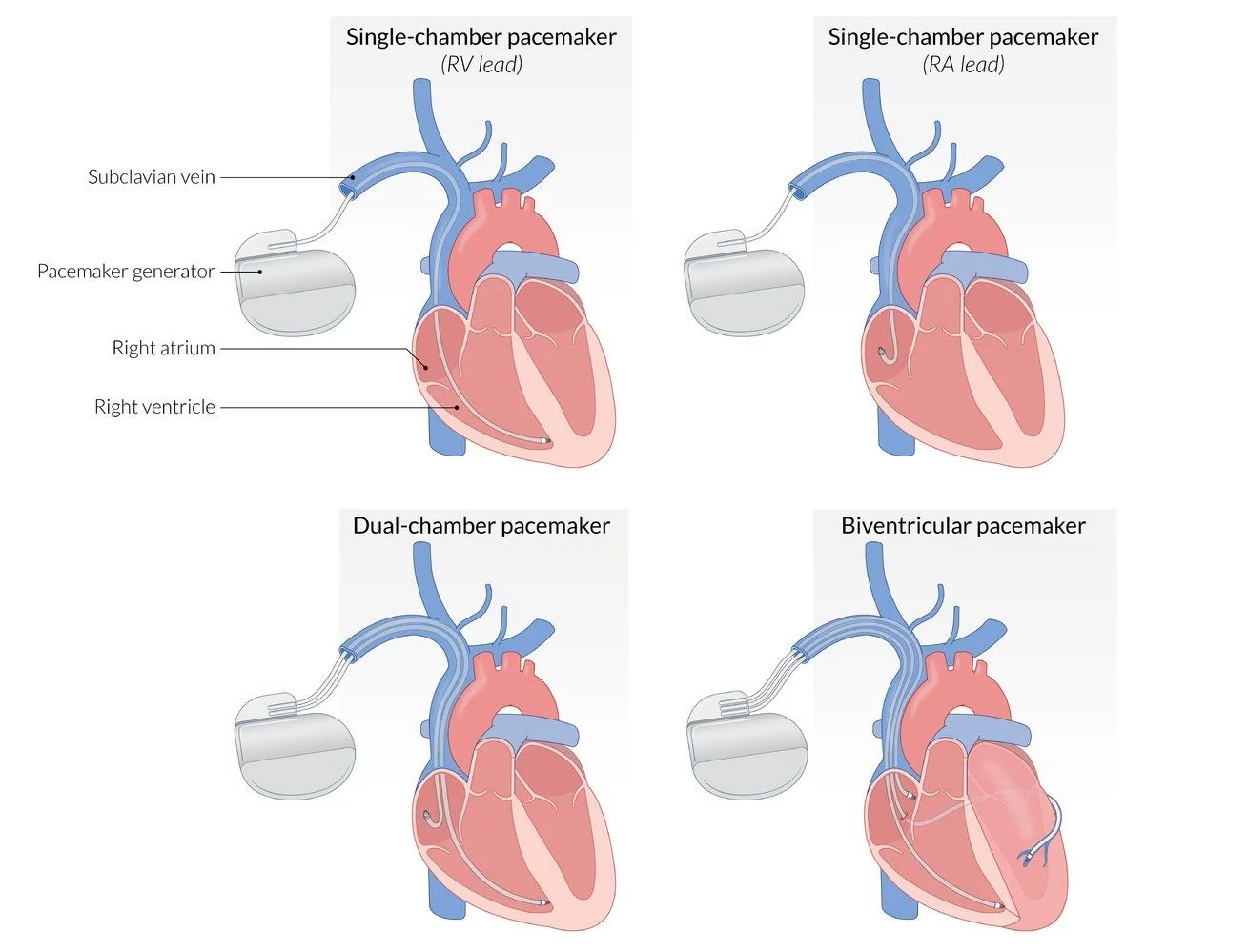
What this shows
Single vs dual chamber
a single-chamber device has one lead in the right atrium or right ventricle; a dual-chamber device has one in each and coordinates them.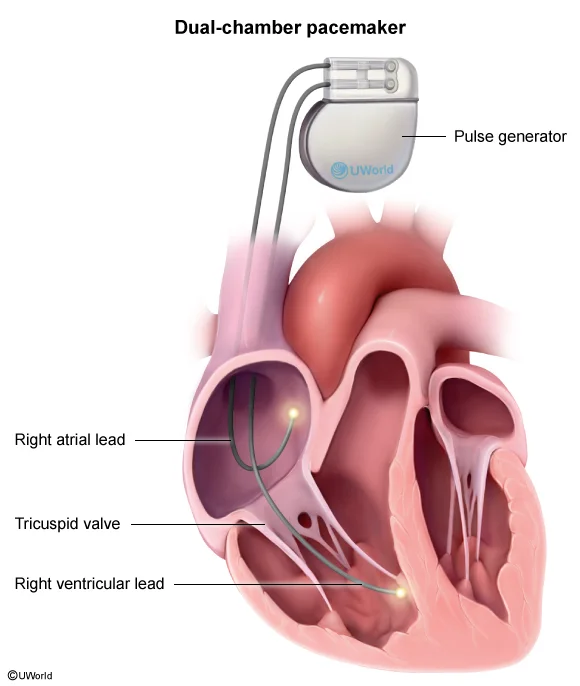
What this shows
Lead complication
the right ventricular lead can damage the tricuspid valve and cause tricuspid regurgitation.Permanent pacemaker indications
irreversible Mobitz II or complete heart block, persistent symptomatic bradycardia, and an asymptomatic rate under 40.Resynchronization and defibrillators
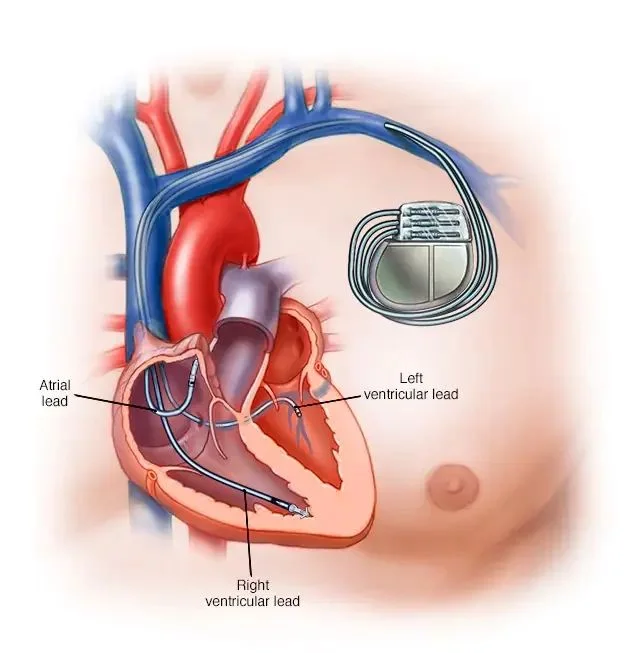
What this shows
Cardiac resynchronization therapy (CRT)
biventricular pacing with a lead in the coronary sinus, to resynchronize ventricular contraction in heart failure.- Indication: ejection fraction of 35 percent or less with a QRS over 120 ms and symptoms despite optimal medical therapy.
Implantable cardioverter-defibrillator (ICD)
a pulse generator and leads that sense ventricular fibrillation (VF) or ventricular tachycardia (VT) and shock the heart back to sinus rhythm.- The goal is to prevent sudden cardiac death.
ICD for primary prevention
channelopathies (congenital long QT, Brugada), heart failure with an ejection fraction under 35 percent in New York Heart Association (NYHA) class II or III, hypertrophic obstructive cardiomyopathy (HOCM), arrhythmogenic right ventricular cardiomyopathy (ARVC).ICD for secondary prevention
a survived sudden cardiac arrest (VF or unstable VT) or stable sustained VT.| Device | Indications |
|---|---|
| Permanent pacemaker | Symptomatic sinus node dysfunction; symptomatic or high-risk atrioventricular (AV) block |
| ICD | Primary prevention (channelopathies, ejection fraction under 35 percent with NYHA II to III, HOCM, ARVC); secondary prevention (cardiac arrest, sustained VT) |
| CRT | Heart failure with an ejection fraction of 35 percent or less and a wide QRS |
Cardiac event monitors
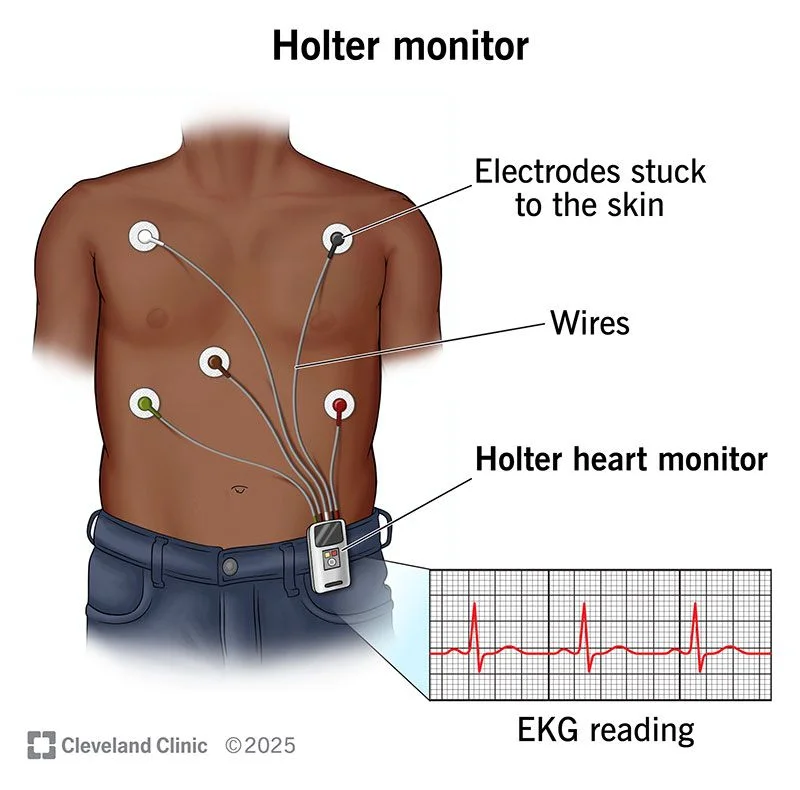
Holter monitor
continuous electrocardiogram (ECG) for 1 to 2 days.Loop event monitor
patient-activated, worn for weeks to catch palpitations.Implantable loop recorder
subcutaneous, for months.Indications
unexplained syncope or near-syncope, recurrent unexplained palpitations, atrial fibrillation monitoring, and screening for ventricular arrhythmias in structural heart disease.Approach to palpitations
a resting ECG first, which is often normal.- Under 40 with no structural heart disease: outpatient ambulatory monitoring (Holter or an insertable monitor).
- Older, structural heart disease (a prior infarction) or an abnormal ECG: admit for closer monitoring and a faster evaluation.
A patient has heart failure with an ejection fraction of 30 percent, NYHA class III symptoms despite optimal drugs, and a QRS of 150 ms. Which device prevents sudden death, which one improves the pumping, and can one box do both?
An implantable cardioverter-defibrillator (ejection fraction under 35 percent, NYHA II to III) prevents sudden death; cardiac resynchronization therapy (ejection fraction 35 percent or less with a wide QRS) resynchronizes the ventricles. They are combined in one device when both indications are met.
How it's tested
EF 28% on maximal GDMT for 4 months, NYHA II, narrow QRS: primary-prevention ICD.
Same patient with a QRS of 165 ms and LBBB: CRT-D.
VF arrest on day 1 of a STEMI, EF 50% after PCI: no ICD — early post-MI VF is reversible; reassess EF at 40 days.
Syncope with Mobitz II block in a 75-year-old, no reversible cause: dual-chamber permanent pacemaker.
ICD patient receiving repeated shocks during a run of atrial fibrillation at 160: inappropriate shocks — rate control and reprogramming, not device removal.
Fever and S. aureus bacteremia six months after pacemaker implantation: device infection — extract the whole system and treat with prolonged antibiotics.
Go deeper
Guidelines: 2018 ACC/AHA/HRS Bradycardia and Conduction Delay Guideline · 2017 AHA/ACC/HRS Ventricular Arrhythmias and Sudden Cardiac Death Guideline · 2022 AHA/ACC/HFSA Heart Failure Guideline
Related Step 2 pages: Atrioventricular Block, Sick Sinus Syndrome, Heart Failure, Ventricular Tachycardia, Cardiac Arrest & ACLS, Bundle Branch Block, Approach to Syncope
High-yield images4
You just read one page of 236
The rest of Step 2 CK, written exactly like this.
Rapid Review is the reading layer of a full Step 1 platform: a schedule fitted to your exam date, flashcards for every page, and a mentor a message away.
Every Step 1 system
Written the same way: what to know, how it’s tested, where to go deeper.
A plan built to your exam date
Tell us when you sit, and the schedule fits the whole library and your question bank to it.
Flashcards for every page
Ready-made spaced-repetition decks linked to each topic, so nothing you read gets forgotten.
