
Rapid Review·Cardiovascular
Select any text to highlight it or add a note.
Arrhythmias: Ventricular & Arrest
T3Take a glanceLong QT Syndrome
Focus on
A child or young adult who faints while swimming, on hearing an alarm, or during sleep, with a QTc over 450–460 and a family history of drowning or sudden death. Romano-Ward is dominant without deafness; Jervell and Lange-Nielsen is recessive with deafness. Beta blockers (not sotalol), trigger avoidance, and an ICD after a cardiac arrest.
Key takeaways
What it is and what causes it
Long QT syndrome
a congenital defect of sodium or potassium channels delays repolarization and predisposes to torsades de pointes.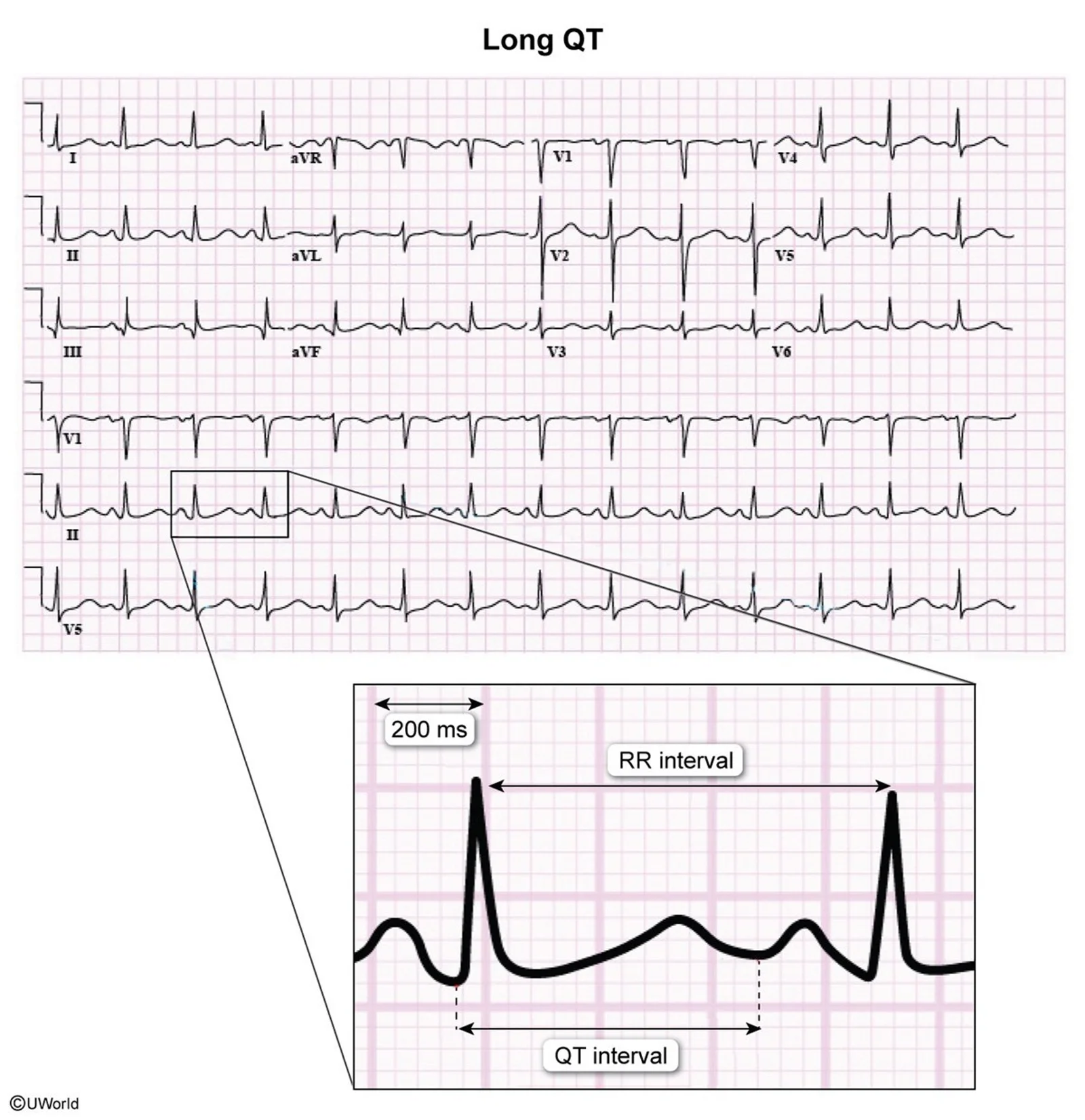
What this shows
Prolonged corrected QT (QTc)
over 450 ms in men and over 460 ms in women.- A quick check: the QT should not be longer than half the R-R interval.
Romano-Ward syndrome
autosomal dominant, no deafness.Jervell and Lange-Nielsen syndrome
autosomal recessive, with sensorineural deafness.Clinical features and management
Mostly asymptomatic
otherwise palpitations, dizziness, syncope, or cardiac arrest.Avoid the triggers
electrolyte disturbances, vigorous exercise, and drugs that block potassium channels (Torsades de Pointes for the list).Beta blocker first line
it limits the exertional heart rate and shortens the QT.Selected patients
an implantable cardioverter-defibrillator or pacemaker.A deaf 8-year-old faints while swimming; his ECG shows a corrected QT of 520 ms. What is the syndrome, its inheritance, and the first-line drug?
Jervell and Lange-Nielsen syndrome (congenital long QT with sensorineural deafness), autosomal recessive. First line is a beta blocker (not sotalol), plus avoiding QT-prolonging drugs and electrolyte disturbances.
How it's tested
A 14-year-old girl faints while swimming; her QTc is 510 ms; her uncle drowned at 20: congenital long QT syndrome (likely LQT1) — beta blocker, no competitive swimming, avoid QT-prolonging drugs, screen the family.
A deaf child with recurrent syncope and a long QT: Jervell and Lange-Nielsen syndrome — autosomal recessive; high risk, ICD is often needed.
A teenager with "seizures" every time her alarm clock rings: LQT2 — get an ECG before calling it epilepsy.
Which beta blocker must be avoided in long QT: sotalol.
Long QT patient has a cardiac arrest despite propranolol: ICD (plus consideration of sympathetic denervation).
Go deeper
Guidelines: 2017 AHA/ACC/HRS Ventricular Arrhythmias and Sudden Cardiac Death Guideline
Related Step 2 pages: Torsades de Pointes, Brugada Syndrome, Ventricular Tachycardia, Approach to Syncope, Cardiac Implantable Devices
High-yield images1
You just read one page of 236
The rest of Step 2 CK, written exactly like this.
Rapid Review is the reading layer of a full Step 1 platform: a schedule fitted to your exam date, flashcards for every page, and a mentor a message away.
Every Step 1 system
Written the same way: what to know, how it’s tested, where to go deeper.
A plan built to your exam date
Tell us when you sit, and the schedule fits the whole library and your question bank to it.
Flashcards for every page
Ready-made spaced-repetition decks linked to each topic, so nothing you read gets forgotten.
