
Rapid Review·Cardiovascular
Select any text to highlight it or add a note.
Arrhythmias: Ventricular & Arrest
T2High yieldVentricular Tachycardia
Focus on
Three or more wide beats at over 100 per minute. Non-sustained means find the cause; sustained means pulse check — defibrillate if none, cardiovert if unstable, amiodarone if stable. Then the substrate: revascularize, optimize the EF, and put in an ICD when the arrest or the EF says so.
Key takeaways
What it is and what causes it
Ventricular tachycardia (VT)
three or more consecutive premature ventricular complexes from below the bundle of His, at 120 to 250 per minute.By duration
non-sustained (under 30 seconds) or sustained (30 seconds or more).By shape
monomorphic (uniform QRS) or polymorphic (varying QRS, as in Torsades de Pointes).Causes
ischemic heart disease, non-ischemic cardiomyopathy and structural heart disease.Precipitants
potassium or magnesium abnormalities, hypoxemia or acute ischemia, high sympathetic tone (sepsis).Clinical features and diagnosis
Symptoms
often asymptomatic; otherwise palpitations, chest pain, dyspnea, dizziness, syncope, hypotension, or cardiac arrest.Electrocardiogram (ECG) in every suspected case
wide QRS (over 120 ms) with signs of atrioventricular (AV) dissociation, as in the Monomorphic VT ECG.- AV dissociation: an atrial rate different from the ventricular rate, dissociated P waves, fusion and capture beats.
Confirmation
three or more consecutive wide complexes at 100 or more with AV dissociation.Management
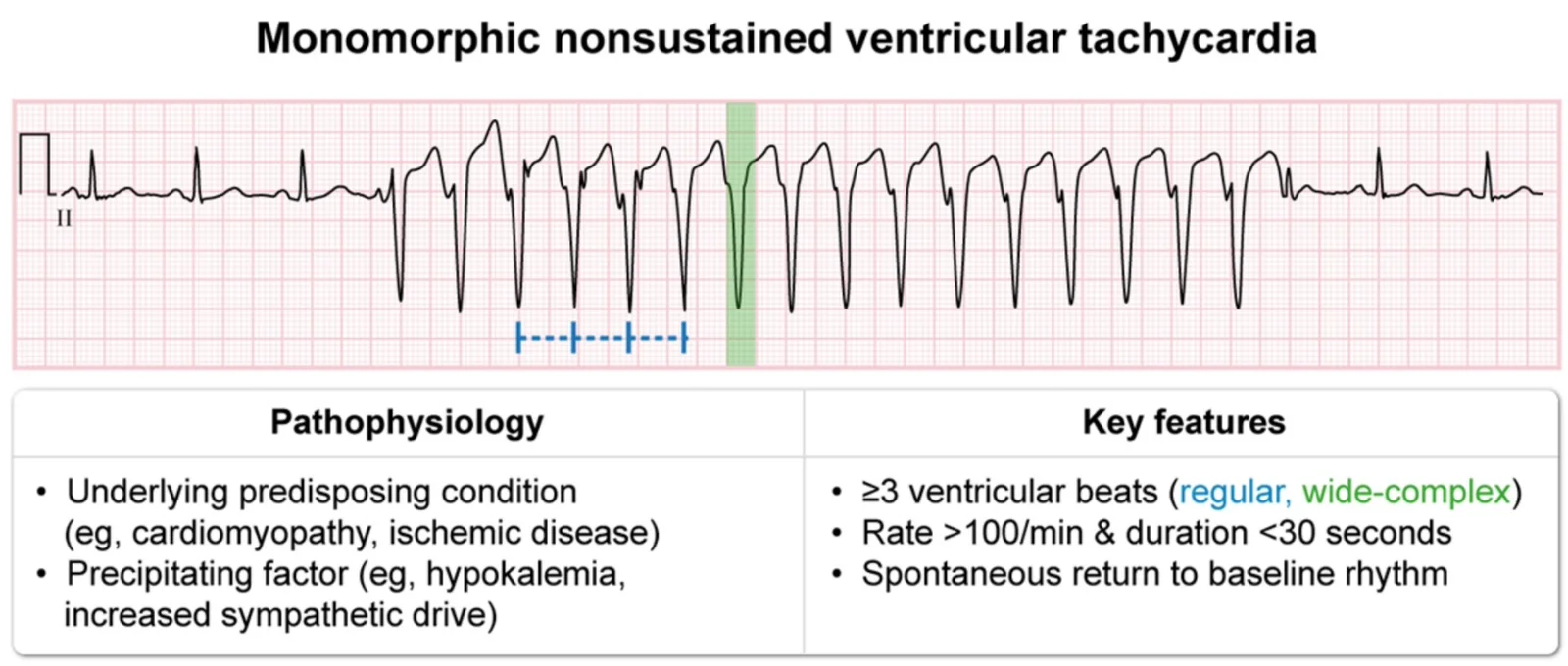
What this shows
Non-sustained
search for and correct the cause (electrolytes); in a patient with no known predisposing disease, look for one (echocardiography).Sustained, no pulse
immediate defibrillation under the cardiac arrest algorithm (Cardiac Arrest & ACLS).Sustained with a pulse, stable
intravenous amiodarone (lidocaine, procainamide or sotalol are alternatives).Sustained with a pulse, unstable
synchronized cardioversion.Unstable polymorphic VT
treated like pulseless VT, with defibrillation.Long-term care and electrical storm
Implantable cardioverter-defibrillator (ICD)
for patients at risk of recurrent VT or sudden death; beta blockers or amiodarone to suppress episodes.Electrical storm
three or more episodes of sustained VT, ventricular fibrillation or appropriate ICD shocks in 24 hours.- Most often after a myocardial infarction, in structural heart disease or an inherited arrhythmia.
- Usually an indication for amiodarone.
Two weeks after a large myocardial infarction, a patient has palpitations; he is alert with a blood pressure of 118/76, and the ECG shows a regular wide-complex tachycardia at 170 with dissociated P waves. What is the rhythm and the treatment, and what changes if he becomes hypotensive?
Sustained monomorphic VT with a pulse, stable: intravenous amiodarone. If he becomes unstable, synchronized cardioversion; if he loses his pulse, defibrillation. Long term, an implantable cardioverter-defibrillator.
How it's tested
Regular wide-complex tachycardia at 160 with independent P waves and occasional narrow "capture" beats, BP 105/70, in a man with an old anterior MI: sustained monomorphic VT — IV amiodarone; cardiovert if he deteriorates.
Same patient, BP 70/40, confused: synchronized cardioversion.
Same patient, no pulse: defibrillate and start CPR.
Asymptomatic 8-beat run of VT on telemetry after admission for pneumonia: check potassium and magnesium, look for a cause, get an echocardiogram — no antiarrhythmic yet.
Recurrent exertional VT with LBBB morphology and inferior axis in a 25-year-old with a normal MRI: idiopathic RVOT tachycardia — beta blocker or ablation; excellent prognosis.
Go deeper
Guidelines: 2017 AHA/ACC/HRS Ventricular Arrhythmias and Sudden Cardiac Death Guideline · 2025 AHA Adult Advanced Life Support Guidance
Related Step 2 pages: Ventricular Tachycardia, Torsades de Pointes, Cardiac Arrest & ACLS, Cardiac Implantable Devices, Antiarrhythmic Drugs, Post MI Complications
High-yield images2
Flashcards for this page
Card 1 of 4 · try-out only, nothing is saved

You just read one page of 236
The rest of Step 2 CK, written exactly like this.
Rapid Review is the reading layer of a full Step 1 platform: a schedule fitted to your exam date, flashcards for every page, and a mentor a message away.
Every Step 1 system
Written the same way: what to know, how it’s tested, where to go deeper.
A plan built to your exam date
Tell us when you sit, and the schedule fits the whole library and your question bank to it.
Flashcards for every page
Ready-made spaced-repetition decks linked to each topic, so nothing you read gets forgotten.
