
Rapid Review·Cardiovascular
Select any text to highlight it or add a note.
Arrhythmias: Ventricular & Arrest
T2High yieldPremature Ventricular Complexes
Focus on
A wide, bizarre early beat with no P wave and a full compensatory pause. Benign in a normal heart — remove triggers, fix potassium and magnesium, beta blocker if symptomatic. Frequent or complex PVCs in someone with heart disease, or a burden above 10%, mean echo and a search for the substrate.
Key takeaways
What it is and what causes it
Premature ventricular complex (PVC)
an ectopic ventricular beat: a wide QRS (120 ms or more) with no preceding P wave.Causes
hypokalemia, hypomagnesemia, digoxin, smoking, alcohol, coffee.Clinical features
Most patients are asymptomatic
otherwise a skipped, irregular or forceful beat.Why the next beat feels stronger
the compensatory pause lets the ventricle fill more, as in the See why the post-PVC beat feels stronger.Frequent PVCs
lightheadedness, dizziness or palpitations.Diagnosis and management
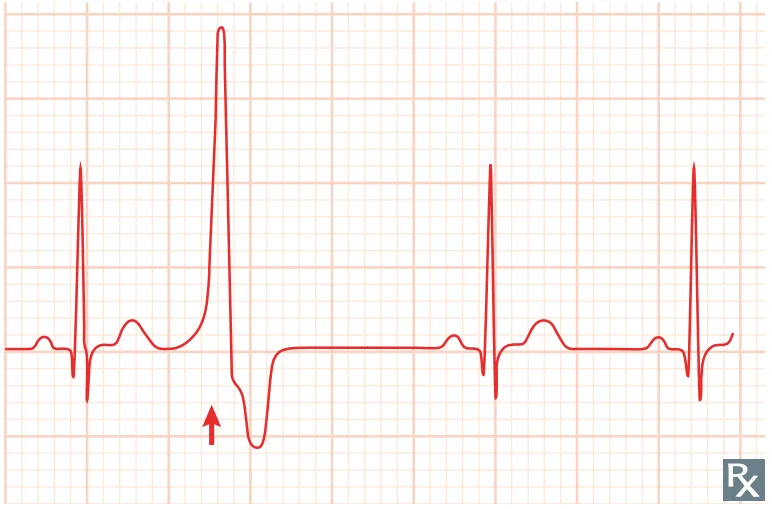
What this shows
The electrocardiogram (ECG) is confirmatory
wide premature complexes without P waves, followed by a fully compensatory pause (the surrounding R-R interval equals twice the normal one).Extra workup only if frequent or symptomatic
24-hour Holter, echocardiography, exercise stress test.Management
usually none beyond treating the cause.Symptomatic palpitations
a beta blocker; catheter ablation for symptoms that persist despite drugs.| Premature atrial complex | Premature ventricular complex | |
|---|---|---|
| QRS | Narrow | Wide (120 ms or more) |
| P wave | Present, abnormal shape | Absent |
| Pause | Not fully compensatory | Fully compensatory |
A patient on a diuretic feels a "thump" now and then; the ECG shows early wide QRS complexes with no P wave, each followed by a pause equal to twice the normal R-R. What are they, what lab should be checked, and when is more workup needed?
Premature ventricular complexes with a fully compensatory pause. Check potassium and magnesium (hypokalemia, hypomagnesemia). Holter, echo and a stress test only if they are frequent or symptomatic.
How it's tested
A healthy 35-year-old with occasional "thumps" after coffee; ECG shows an early wide beat without a P wave and a full pause: premature ventricular complexes — reassure, cut caffeine, check potassium and magnesium.
Same patient still symptomatic: low-dose beta blocker.
A Holter shows 22% PVC burden with an EF of 40% in a patient with no other cause: PVC-induced cardiomyopathy — catheter ablation; EF should recover.
Frequent PVCs and runs of non-sustained VT three days after an anterior MI: correct electrolytes, beta blocker, assess EF; no flecainide.
A patient on digoxin with bigeminy, nausea and yellow vision: digoxin toxicity — check the level and potassium.
Go deeper
Guidelines: 2017 AHA/ACC/HRS Ventricular Arrhythmias Guideline
Related Step 2 pages: Ventricular Tachycardia, Premature Atrial Complexes, Digoxin Toxicity, Cardiac Implantable Devices
High-yield images2
You just read one page of 236
The rest of Step 2 CK, written exactly like this.
Rapid Review is the reading layer of a full Step 1 platform: a schedule fitted to your exam date, flashcards for every page, and a mentor a message away.
Every Step 1 system
Written the same way: what to know, how it’s tested, where to go deeper.
A plan built to your exam date
Tell us when you sit, and the schedule fits the whole library and your question bank to it.
Flashcards for every page
Ready-made spaced-repetition decks linked to each topic, so nothing you read gets forgotten.
