
Rapid Review·Cardiovascular
Select any text to highlight it or add a note.
Syncope
T1Must knowOrthostatic Hypotension
Focus on
A fall of ≥ 20 mm Hg systolic or ≥ 10 diastolic within 3 minutes of standing. Three causes — volume loss, drugs, and autonomic failure (diabetes, Parkinson, amyloid) — separated by whether the heart rate rises. Fix the volume and the drug list first; compression, fludrocortisone and midodrine for the neurogenic form.
Key takeaways
What it is
Orthostatic hypotension
syncope from postural changes in heart rate or blood pressure after standing.The normal response
standing pools 500 to 1,000 mL of blood in the legs and splanchnic bed; the baroreflex normally answers within seconds with tachycardia and vasoconstriction (Natriuretic Peptides & Cardiovascular Reflexes).Failure of that compensation
from too little volume, drugs that block the response, or autonomic failure; common in the elderly and a major cause of falls.Causes
Sort by the clue
three groups.| Clue | Cause | Examples |
|---|---|---|
| History consistent with volume loss; heart rate rises on standing; dry mucosa | Hypovolemia | Hemorrhage, vomiting, diarrhea, diuretics, poor intake, adrenal insufficiency |
| Recent start or dose increase; heart rate rises (except with beta blockers) | Medications | Vasodilators and antihypertensives, alpha-1 blockers (tamsulosin, prazosin), diuretics, beta blockers (block the chronotropic response), tricyclics, antipsychotics, levodopa |
| Advanced age with a predisposing disease; heart rate fails to rise despite a large fall; supine hypertension; anhidrosis, constipation, erectile dysfunction, urinary retention | Autonomic dysfunction | Diabetes mellitus, Parkinson disease, multiple system atrophy, amyloidosis, B12 deficiency |
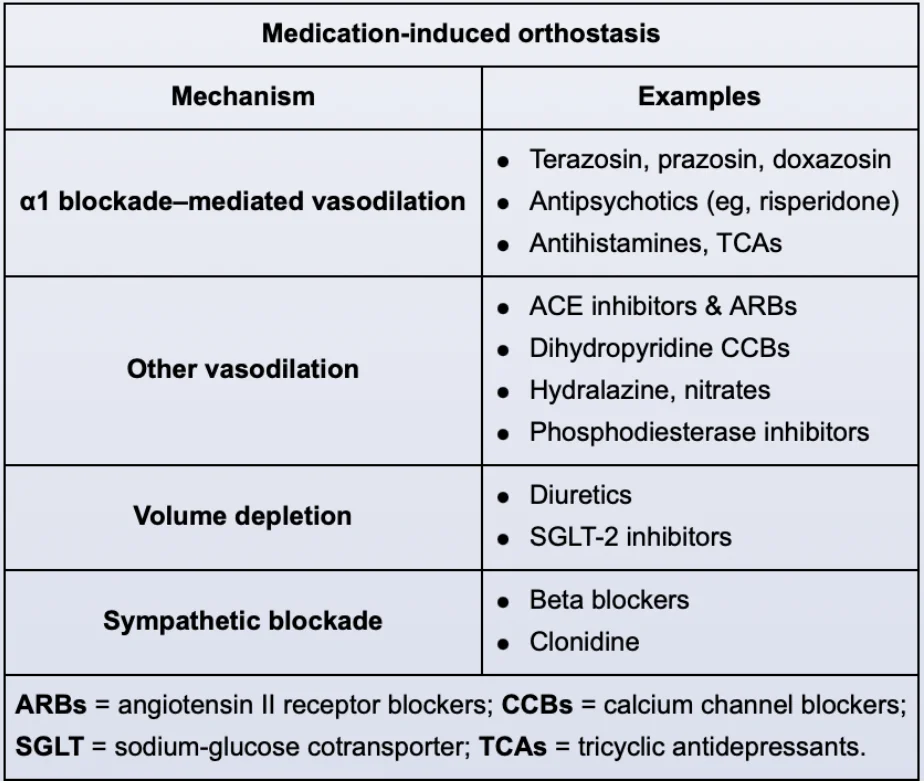
What this shows
Drugs by mechanism
four ways a drug drops the standing pressure.Clinical features and diagnosis
Symptoms
lightheadedness and dizziness on standing, or syncope on standing or after prolonged standing.- Also after meals, in the heat and in the morning; falls and fractures in the elderly.
Orthostatic vitals
within 2 to 5 minutes of standing from supine, a fall of 20 mm Hg or more systolic or 10 mm Hg or more diastolic.The heart-rate response sorts the cause
an appropriate rise points to volume or drugs; a blunted rise (under 15 per minute) points to neurogenic failure.Look for the cause
blood count, electrolytes, glucose, B12, cortisol if adrenal insufficiency is suspected, medication review, electrocardiogram.Postural tachycardia syndrome
a rate rise of 30 or more on standing without a pressure fall, typically in young women.Management
Hypovolemic
sufficient hydration (oral 2 to 3 L/day, intravenous if depleted) and liberal salt unless heart failure or hypertension forbids.Medications
stop or reduce the offending drug; move antihypertensives to bedtime, replace alpha blockers, review diuretics.Non-drug measures for all
rise slowly in stages, compression stockings (at least thigh-high) or an abdominal binder, counterpressure maneuvers, raise the head of the bed.- Smaller meals and less alcohol for postprandial hypotension; avoid heat and prolonged standing.
Refractory
midodrine (alpha-1 agonist; last dose by mid-afternoon to limit supine hypertension).Neurogenic
fludrocortisone (volume expansion; watch potassium, edema and supine hypertension), midodrine, or droxidopa; treat the underlying disease.- Accept moderate supine hypertension to prevent falls.
Complications
falls and fractures, syncope with injury, cognitive decline from reduced cerebral perfusion, supine hypertension from treatment.A 72-year-old with long-standing diabetes gets dizzy on standing; his pressure falls from 138/80 to 108/66 on standing while the heart rate goes from 72 to 76. He also has constipation and erectile dysfunction. What is the cause, and what drug is used if non-drug measures fail?
Neurogenic orthostatic hypotension from diabetic autonomic dysfunction (a fall over 20/10 with a blunted heart-rate rise under 15). After non-drug measures (slow rising, thigh-high stockings, fluids and salt), use fludrocortisone (or midodrine or droxidopa).
How it's tested
An 82-year-old started on tamsulosin and furosemide becomes dizzy on standing; supine BP 150/85, standing 112/70 with a heart rate of 96 from 72: drug-induced orthostatic hypotension — stop or replace the alpha blocker, reduce the diuretic, hydrate.
A 60-year-old with 20 years of diabetes: standing BP falls 40 mm Hg and the heart rate stays at 78; also has gastroparesis and erectile dysfunction: neurogenic orthostatic hypotension from autonomic neuropathy — non-pharmacologic measures, then fludrocortisone or midodrine.
A Parkinson patient with orthostatic dizziness and a supine BP of 180/100: neurogenic hypotension with supine hypertension — head-up bed, midodrine in the morning only, no nocturnal antihypertensives except perhaps a short-acting one.
A 22-year-old woman: heart rate climbs from 70 to 115 on standing with no fall in pressure, palpitations, fatigue: POTS, not orthostatic hypotension — fluids, salt, exercise, compression; propranolol or ivabradine.
Orthostatic hypotension with hyperkalemia, hyponatremia and hyperpigmentation: adrenal insufficiency — cortisol and ACTH, hydrocortisone.
Go deeper
Guidelines: 2017 ACC/AHA/HRS Syncope Guideline
Related Step 2 pages: Approach to Syncope, Reflex Syncope, Exercise-Induced Postural Hypotension, Antihypertensive Drugs, Natriuretic Peptides & Cardiovascular Reflexes
High-yield images1
You just read one page of 236
The rest of Step 2 CK, written exactly like this.
Rapid Review is the reading layer of a full Step 1 platform: a schedule fitted to your exam date, flashcards for every page, and a mentor a message away.
Every Step 1 system
Written the same way: what to know, how it’s tested, where to go deeper.
A plan built to your exam date
Tell us when you sit, and the schedule fits the whole library and your question bank to it.
Flashcards for every page
Ready-made spaced-repetition decks linked to each topic, so nothing you read gets forgotten.
