Rapid Review·Cardiovascular
Select any text to highlight it or add a note.
Valvular Heart Disease
T1Must knowPulmonary Stenosis
Focus on
Almost always congenital — Noonan syndrome, tetralogy, rubella — with a crescendo–decrescendo murmur at the left upper sternal border that gets louder on inspiration, an ejection click that gets softer on inspiration, and a widely split S2. Balloon valvuloplasty fixes it.
Key takeaways
Causes
Congenital
usually an isolated defect.Acquired (rare)
carcinoid syndrome.Clinical features
Severity sets the age
mild stenosis gives dyspnea in early adulthood; severe stenosis gives right heart failure in childhood.The murmur
a crescendo-decrescendo murmur at the left upper sternal border that gets louder on inspiration.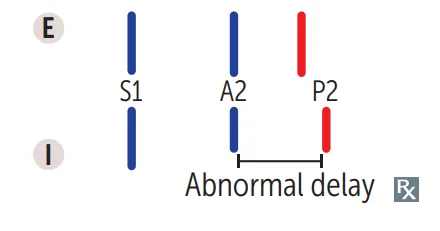
What this shows
Other sounds
a systolic ejection click, and a widely split S2 that widens further on inspiration.Diagnosis and management
Transthoracic echocardiography
confirms it.Percutaneous balloon valvulotomy
preferred; surgical repair in some cases.A child with short stature has a crescendo-decrescendo murmur at the left upper sternal border that gets louder on inspiration, an ejection click, and a widely split S2. What is the lesion, how is it confirmed, and what is the preferred treatment?
Pulmonary stenosis, almost always congenital. Confirm with transthoracic echocardiography; percutaneous balloon valvulotomy is preferred, with surgical repair in some cases.
How it's tested
A child with short stature, webbed neck, low-set ears and a systolic ejection murmur at the left upper sternal border that increases on inspiration: Noonan syndrome with pulmonary stenosis — echocardiogram.
Which sound gets softer with inspiration: the pulmonic ejection click.
Asymptomatic teenager with PS and a peak gradient of 70 mm Hg: percutaneous balloon valvuloplasty.
Flushing and diarrhea with new right-sided murmurs: carcinoid heart disease — PS and TR from fibrous plaques.
Go deeper
Guidelines: 2020 ACC/AHA Valvular Heart Disease Guideline
Related Step 2 pages: Pulmonary Regurgitation, Tetralogy of Fallot, Aortic Stenosis, Heart Sounds & Murmurs, Approach to Congenital Heart Disease
High-yield images1
Flashcards for this page
Card 1 of 3 · try-out only, nothing is saved
You just read one page of 236
The rest of Step 2 CK, written exactly like this.
Rapid Review is the reading layer of a full Step 1 platform: a schedule fitted to your exam date, flashcards for every page, and a mentor a message away.
Every Step 1 system
Written the same way: what to know, how it’s tested, where to go deeper.
A plan built to your exam date
Tell us when you sit, and the schedule fits the whole library and your question bank to it.
Flashcards for every page
Ready-made spaced-repetition decks linked to each topic, so nothing you read gets forgotten.
