
Rapid Review·Cardiovascular
Select any text to highlight it or add a note.
Arrhythmias: Supraventricular
T1Must knowSinus Tachycardia
Focus on
A normal P wave before every narrow QRS at a rate over 100 is not an arrhythmia to treat — it is a sign to explain. Hypovolemia, sepsis, PE, pain, fever, anemia, thyrotoxicosis, drugs and withdrawal. Treat the cause; the rate follows.
Key takeaways
What it is and what causes it
Sinus tachycardia
the most common supraventricular arrhythmia; the sinoatrial node fires faster, usually from raised sympathetic tone.Physiologic
exercise, stress, emotion.Baroreceptor response to hypotension
an early sign of shock, before the blood pressure falls.- Volume loss, vasodilation, heart failure, or obstruction (pulmonary embolism, tamponade, tension pneumothorax).
Metabolic demand
hypoxemia, hypercapnia, thyrotoxicosis, anemia, fever, systemic inflammation.Catecholamines
anxiety, pain, pheochromocytoma, sympathomimetics (cocaine, amphetamines, caffeine), dobutamine, and withdrawal of beta blockers or clonidine.Anticholinergics
atropine, tricyclic antidepressants, which remove parasympathetic braking.Inappropriate sinus tachycardia
rare, mostly in healthy young women, from autonomic dysfunction.Clinical features and diagnosis
Usually asymptomatic
palpitations in inappropriate sinus tachycardia.Rate tracks severity
the higher the rate, the more serious the underlying cause.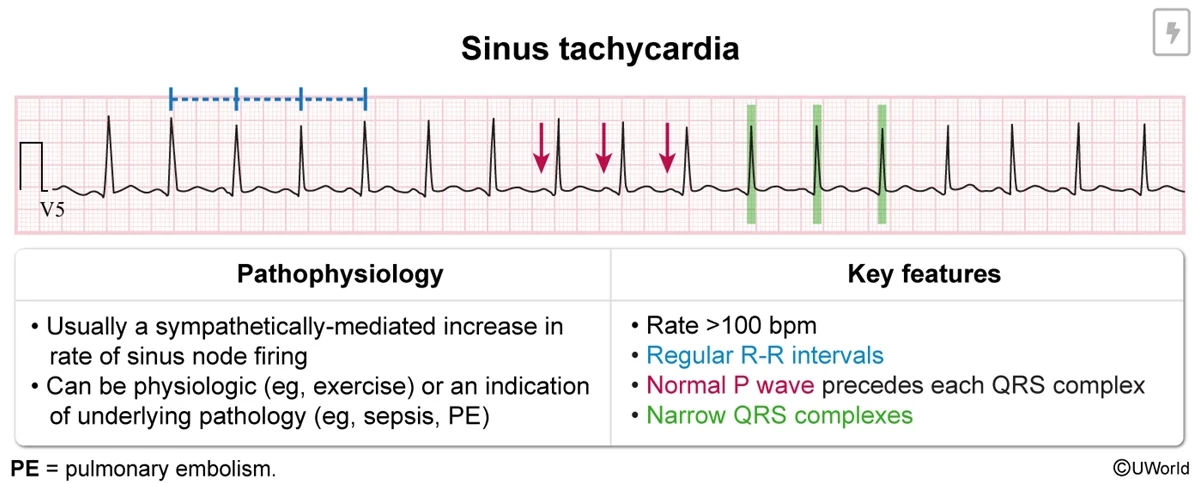
What this shows
Electrocardiogram (ECG)
a regular rhythm over 100 per minute (usually not above about 180), with normal P waves before every narrow QRS.Management and complications
Management
treat the cause, not the rate.Complication
tachycardia-induced cardiomyopathy if it persists for weeks.A patient bleeding from a peptic ulcer has a heart rate of 125 with normal P waves before every narrow QRS; the blood pressure is still normal. What is the rhythm, what does it signal, and how is it treated?
Sinus tachycardia, here a baroreceptor response and an early sign of shock before the blood pressure falls. Treat the cause (volume loss), not the rate.
How it's tested
A trauma patient with a heart rate of 125 and a blood pressure of 118/80: class II hemorrhage — tachycardia precedes hypotension; give fluids and find the bleeding, do not give a beta blocker.
Post-operative day 2, heart rate 130, mild dyspnea, saturation 91%: pulmonary embolism until proven otherwise — CT angiography; sinus tachycardia is the most common ECG finding in PE.
Regular narrow tachycardia at 140 in a febrile patient with pneumonia that slows as the fever falls: sinus tachycardia — antipyretics and antibiotics, no adenosine.
Weight loss, tremor, heat intolerance and a resting rate of 115: thyrotoxicosis — TSH, then propranolol and an antithyroid drug.
Go deeper
Related Step 2 pages: Approach to Tachyarrhythmias, Approach to Shock, AV Nodal Reentrant Tachycardia, Atrial Flutter, Approach to Syncope
High-yield images1
You just read one page of 236
The rest of Step 2 CK, written exactly like this.
Rapid Review is the reading layer of a full Step 1 platform: a schedule fitted to your exam date, flashcards for every page, and a mentor a message away.
Every Step 1 system
Written the same way: what to know, how it’s tested, where to go deeper.
A plan built to your exam date
Tell us when you sit, and the schedule fits the whole library and your question bank to it.
Flashcards for every page
Ready-made spaced-repetition decks linked to each topic, so nothing you read gets forgotten.
