
Rapid Review·Cardiovascular
Select any text to highlight it or add a note.
Cardiac & Vascular Tumors
T3Take a glanceAngiosarcoma
Focus on
A malignant tumor of vascular endothelium with three classic settings: a bruise-like purple plaque on the scalp or face of an elderly man, a tumor in a chronically lymphedematous arm after mastectomy (Stewart-Treves), and a liver tumor after vinyl chloride, arsenic or thorium exposure. The most common primary malignant cardiac tumor, arising in the right atrium.
Key takeaways
What it is
Angiosarcoma
a rare, aggressive malignant tumor of vascular endothelium with early spread to the lungs.Where it arises
skin (most common), breast, liver and the heart.In the heart
the most common primary malignant cardiac tumor (right atrium, men 30 to 50).Risk factors (the three classic settings)
Chronic sun exposure
the scalp and face of the elderly.Prior radiation therapy and chronic lymphedema
radiation to breast, cervix or lymphoma fields; lymphedema after mastectomy with axillary dissection (Stewart-Treves syndrome).Vinyl chloride and arsenic
for hepatic angiosarcoma (also thorium dioxide contrast).Clinical features and diagnosis
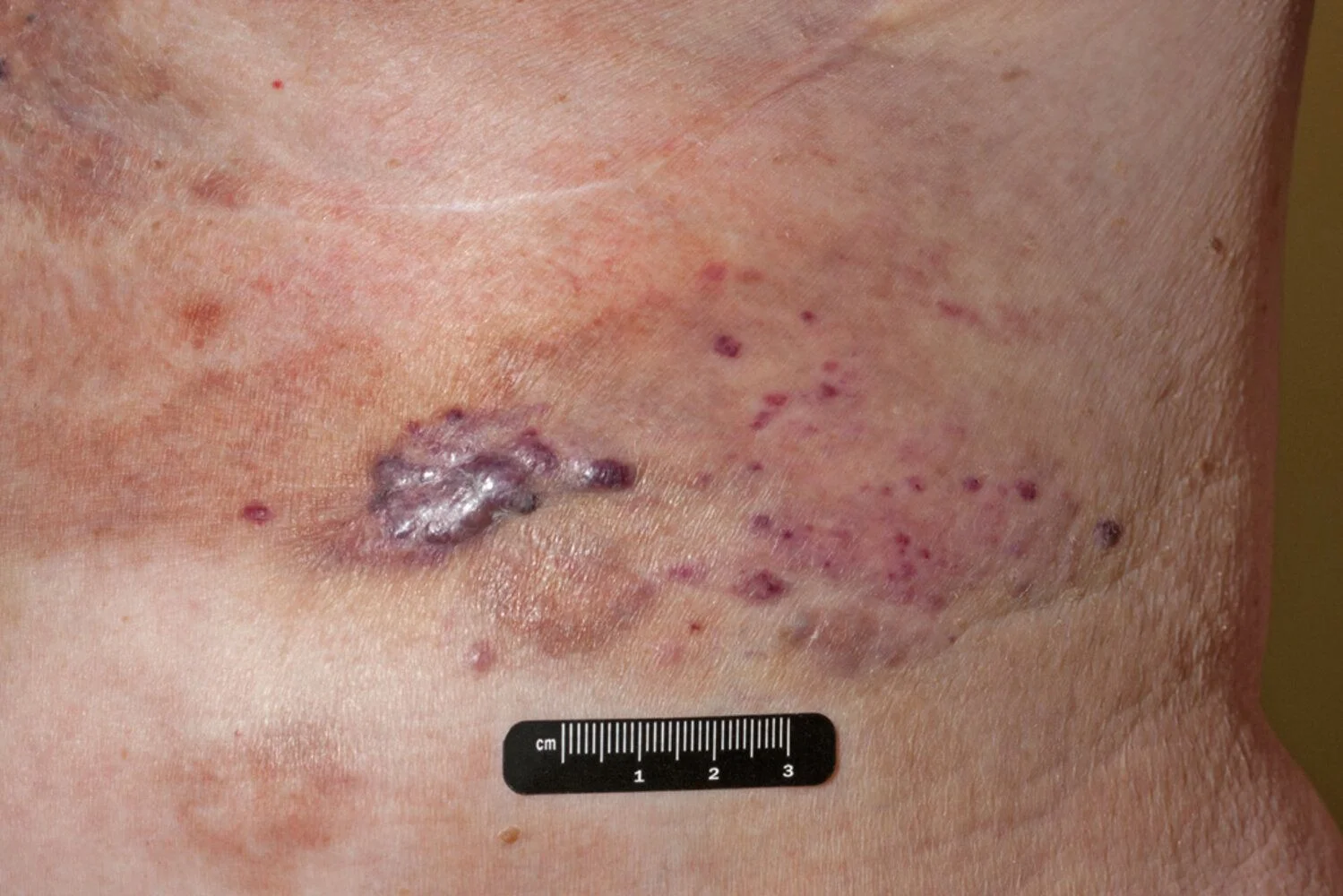
What this shows
Cutaneous
highly variable lesions, classically a blue or purple bruise-like macule or plaque on the head, neck or scalp that enlarges, then bleeds or ulcerates.- Purple nodules on a chronically swollen limb in lymphedema.
Breast
a rapidly enlarging mass or skin discoloration in a previously irradiated breast.Hepatic
abdominal pain, hepatomegaly, weight loss, hemoperitoneum from rupture.Cardiac
non-specific at first, then hemorrhagic pericardial effusion and tamponade, right heart failure, arrhythmia; metastases at diagnosis are common.Biopsy is definitive
irregular anastomosing vascular channels lined by atypical endothelial cells, positive for CD31 and CD34.Imaging
computed tomography (CT) or magnetic resonance imaging (MRI) to assess extent; echocardiography for cardiac tumors.| Angiosarcoma | Kaposi sarcoma | Hemangioma or pyogenic granuloma | |
|---|---|---|---|
| Patient | Elderly sun-exposed skin; post-radiation; chronic lymphedema; toxin-exposed liver | HIV, transplant, elderly Mediterranean men | Infants (hemangioma); pregnancy or trauma (pyogenic granuloma) |
| Cause | Sporadic, radiation, lymphedema, vinyl chloride or arsenic | Human herpesvirus 8 | Benign proliferation |
| Lesion | Bruise-like purple plaque that ulcerates and spreads | Violaceous patches, plaques, nodules; oral and gut involvement | Red papule or nodule that bleeds easily |
| Behavior | Highly malignant, early lung metastases | Indolent unless immunosuppressed | Benign |
| Treatment | Wide excision, radiation, chemotherapy | Antiretrovirals, local therapy | Observation or excision |
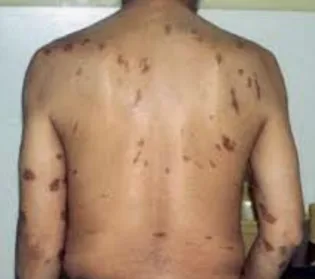
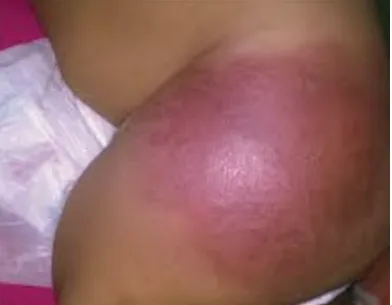
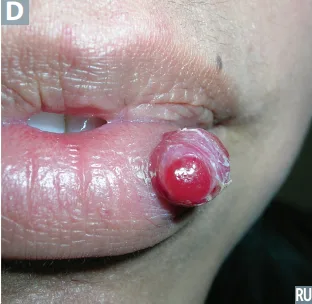
Management and prognosis
Complete resection with wide margins
when feasible (difficult, because the tumor is multifocal and infiltrative).Radiation and chemotherapy (paclitaxel, doxorubicin)
for unresectable or metastatic disease.Cardiac angiosarcoma
resection when possible, pericardial drainage for tamponade, chemotherapy.Prognosis
poor; local recurrence and pulmonary metastases are the rule, worst for hepatic and cardiac disease.Twelve years after a mastectomy with axillary dissection, a woman with a chronically swollen arm develops purple nodules on it. What is the diagnosis, how is it confirmed, and what is the treatment?
Angiosarcoma in chronic lymphedema (Stewart-Treves syndrome). Biopsy confirms it (atypical endothelial channels, CD31 and CD34 positive). Treat with complete resection with wide margins when feasible, and radiation and chemotherapy for unresectable disease.
How it's tested
An 80-year-old man with a spreading purple "bruise" on his scalp that has begun to bleed: cutaneous angiosarcoma — biopsy; wide excision and radiation.
A woman with a chronically swollen arm 12 years after mastectomy and axillary dissection develops purple nodules on it: Stewart-Treves syndrome — lymphangiosarcoma.
A worker in a PVC plant with a hypervascular liver mass: hepatic angiosarcoma from vinyl chloride.
A 40-year-old man with a right atrial mass and a hemorrhagic pericardial effusion: cardiac angiosarcoma — the most common primary malignant cardiac tumor.
Go deeper
Related Step 2 pages: Cardiac Tumors, Pericardial Effusion, Cardiac Tamponade
High-yield images4
You just read one page of 236
The rest of Step 2 CK, written exactly like this.
Rapid Review is the reading layer of a full Step 1 platform: a schedule fitted to your exam date, flashcards for every page, and a mentor a message away.
Every Step 1 system
Written the same way: what to know, how it’s tested, where to go deeper.
A plan built to your exam date
Tell us when you sit, and the schedule fits the whole library and your question bank to it.
Flashcards for every page
Ready-made spaced-repetition decks linked to each topic, so nothing you read gets forgotten.
