
Rapid Review·Cardiovascular
Select any text to highlight it or add a note.
Cardiothoracic Surgery
T2High yieldSternal Dehiscence & Mediastinitis
Focus on
A sternum that clicks or rocks with coughing after a sternotomy has come apart; drainage from the wound means the mediastinum may be infected. Image with CT, rewire an uninfected dehiscence promptly, and treat mediastinitis with surgical debridement, drainage and weeks of IV antibiotics — the obese diabetic smoker with bilateral mammary grafts is the classic patient.
Key takeaways
What it is and who gets it
Sternal dehiscence
a gap at the site of the sternal division after a median sternotomy (the wires cut through or break, usually in the first 2 weeks).The link to infection
it may be sterile, but the unstable sternum invites deep sternal wound infection (post-operative acute mediastinitis), and infection in turn loosens the bone.Patient risk factors (shared by both)
obesity, diabetes, smoking; also chronic lung disease (coughing), steroids, malnutrition, and nasal colonization with Staphylococcus aureus (mediastinitis).Procedure risk factors
prolonged cardiopulmonary bypass and bypass surgery, especially with bilateral internal mammary harvest (devascularizes the sternum), re-exploration for bleeding.Clinical features and diagnosis
Dehiscence
sternal instability, a palpable rocking or an audible click with coughing or chest movement, increased wound drainage, pain or tenderness at rest.Mediastinitis
purulent drainage and local erythema, fever, tachycardia, hypotension, chest pain, crepitus.Clinical confirmation
palpate the sternal edges during a cough to feel the instability.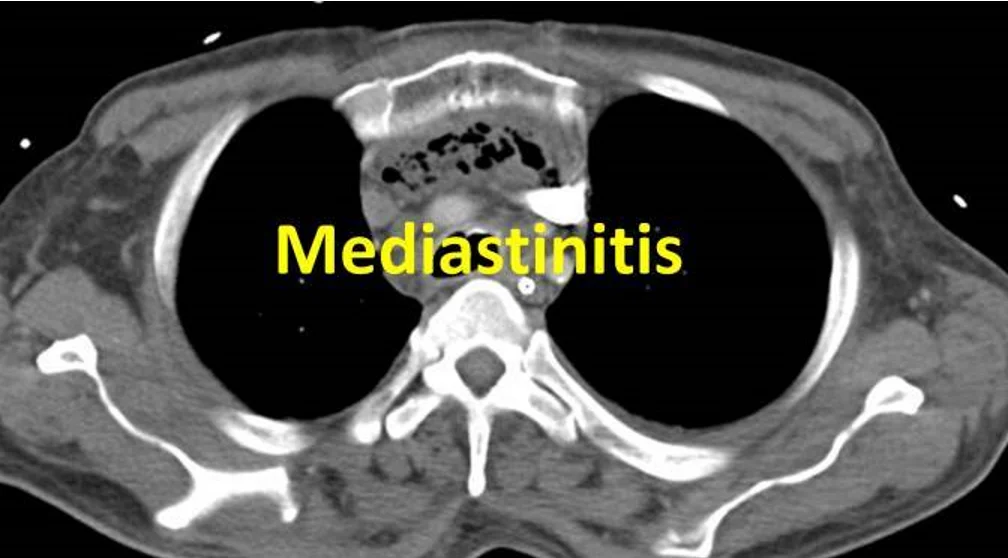
What this shows
Chest radiograph or computed tomography (CT, preferred)
lateral displacement of the sternal wires and a vertical midsternal lucent stripe (not always present).- Mediastinitis adds mediastinal widening, pleural effusion, pneumomediastinum or air-fluid levels.
Mediastinitis labs
leukocytosis and raised inflammatory markers; blood and deep tissue cultures (superficial swabs mislead).- Organisms: Staphylococcus aureus (including methicillin-resistant), coagulase-negative staphylococci, gram-negatives.
| Sternal dehiscence (sterile) | Post-operative mediastinitis | |
|---|---|---|
| Timing | Days 5 to 14 | Days to weeks (up to months) |
| Key sign | Sternal click or rocking with cough; serous drainage | Fever, purulent drainage, erythema, instability, sepsis |
| Imaging | Displaced or broken wires, a midline lucency | The same plus retrosternal fluid, gas, mediastinal widening |
| Labs | Normal or mild | Leukocytosis, raised markers, positive cultures |
| Treatment | Immediate re-closure (rewiring or plate fixation) | Debridement and drainage with antibiotics for at least 4 to 6 weeks |
Management and complications
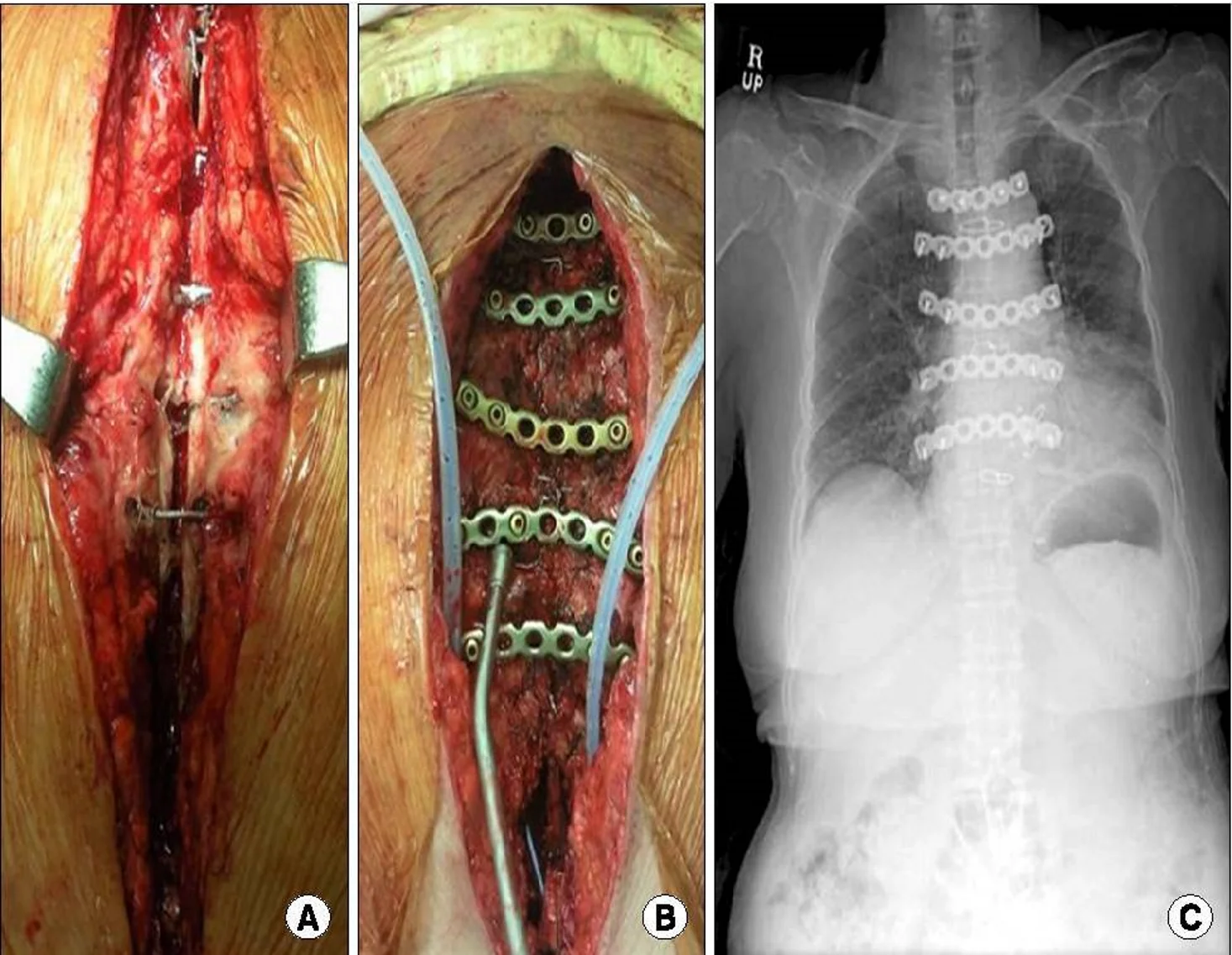
What this shows
Dehiscence
immediate closure (sternal rewiring or plate fixation) before infection and wire erosion into vessels occur.Mediastinitis
surgical debridement and drainage (removal of wires and infected tissue, then vacuum therapy or flap reconstruction) with prolonged intravenous antibiotics (minimum 4 to 6 weeks).- Cover methicillin-resistant staphylococci and gram-negatives, narrowed to cultures.
Prevention
nasal Staphylococcus aureus decolonization, perioperative cefazolin, tight glucose control, sternal support and lifting restrictions for 6 to 8 weeks, smoking cessation.Complications
post-operative acute mediastinitis after dehiscence; wire displacement with hemorrhage from puncture of the right ventricle, great vessels, main bronchus or pleura; sepsis, sternal osteomyelitis and non-union, prosthetic valve or graft infection.Nine days after bypass surgery, an obese diabetic patient notices a clicking in his chest when he coughs, with serous wound drainage and no fever; CT shows displaced sternal wires. What is the diagnosis and the treatment, and what would change it to debridement and weeks of antibiotics?
Sternal dehiscence: immediate re-closure (rewiring or plate fixation). Mediastinitis (fever, purulent drainage, erythema, retrosternal fluid or gas, positive deep cultures) needs surgical debridement and drainage plus at least 4 to 6 weeks of intravenous antibiotics.
How it's tested
Ten days after CABG a 300-lb diabetic smoker notices a click in his chest when he coughs; the wound is draining clear fluid and he is afebrile: sternal dehiscence — CT to exclude mediastinitis, then prompt rewiring.
Same patient with fever of 39 °C, purulent drainage and a tender erythematous incision; CT shows a retrosternal fluid collection with gas: post-operative mediastinitis — blood and deep cultures, IV vancomycin plus gram-negative coverage, surgical debridement and drainage, 4–6 weeks of antibiotics.
Which surgical technique raises the risk most: bilateral internal mammary artery harvesting, especially in a diabetic — it devascularizes the sternum.
Afebrile patient with copious sternal drainage two weeks post-operatively: still image for mediastinitis — it may present without fever or chest pain.
Sudden massive hemoptysis and shock in a patient with a known unstable sternum: wire erosion into a great vessel or bronchus — a surgical emergency.
Go deeper
Guidelines: [STS Practice Guideline on Deep Sternal Wound Infection](https://www.annalsthoracicsurgery.org/article/S0003-4975(16)31651-7/fulltext)
Related Step 2 pages: Coronary Artery Bypass Grafting, Post-Cardiac Injury Syndrome, Infective Endocarditis, Prosthetic Heart Valves
High-yield images2
Flashcards for this page
Card 1 of 4 · try-out only, nothing is saved
You just read one page of 236
The rest of Step 2 CK, written exactly like this.
Rapid Review is the reading layer of a full Step 1 platform: a schedule fitted to your exam date, flashcards for every page, and a mentor a message away.
Every Step 1 system
Written the same way: what to know, how it’s tested, where to go deeper.
A plan built to your exam date
Tell us when you sit, and the schedule fits the whole library and your question bank to it.
Flashcards for every page
Ready-made spaced-repetition decks linked to each topic, so nothing you read gets forgotten.
