
Rapid Review·Cardiovascular
Select any text to highlight it or add a note.
Vascular: Peripheral
T1Must knowSubclavian Steal Syndrome
Focus on
Arm exercise that brings on dizziness, vertigo or syncope, with a blood pressure 15 mm Hg or more lower in that arm. A proximal subclavian stenosis makes the vertebral artery run backwards to feed the arm, stealing from the brainstem. Duplex or angiography shows reversed vertebral flow; stenting or bypass fixes the symptomatic patient.
Key takeaways
Mechanism and causes
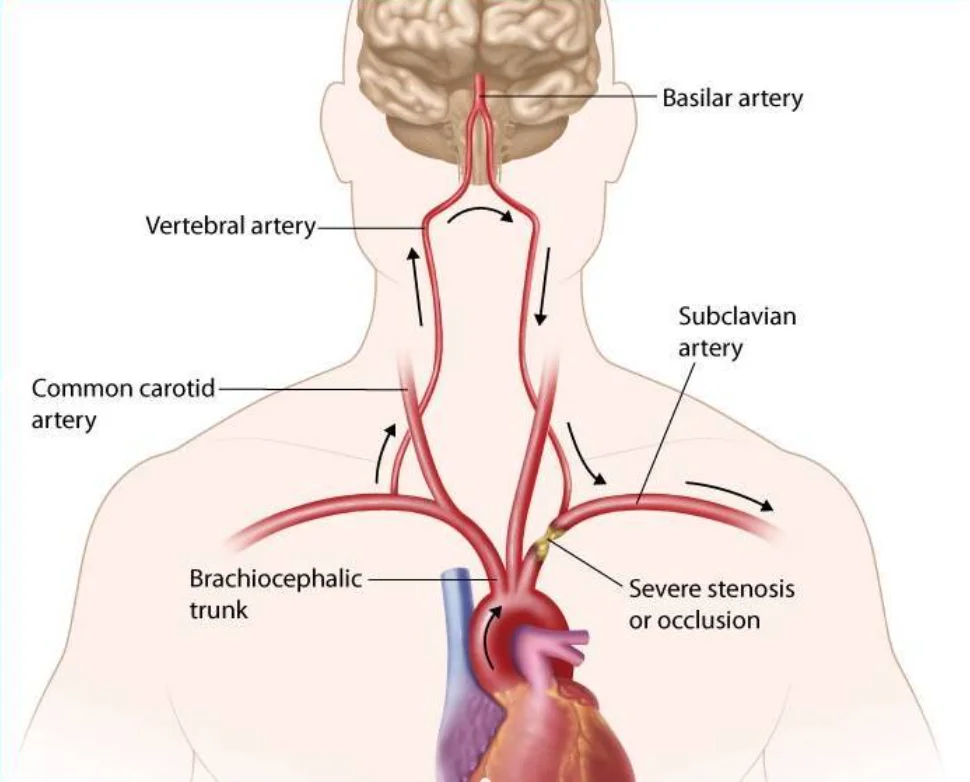
What this shows
The steal
significant stenosis or occlusion of the subclavian artery proximal to the vertebral origin lowers distal pressure, so the ipsilateral vertebral artery carries blood retrograde from the basilar system down into the arm.Phenomenon vs syndrome
at rest this is a silent finding (the steal phenomenon); with arm exercise the steal is large enough to cause vertebrobasilar ischemia (the syndrome).Left side in most
the left subclavian arises directly from the arch.Causes
atherosclerosis overwhelmingly; Takayasu arteritis in young Asian women; coronary-subclavian steal after bypass with a left internal mammary graft (angina with arm exercise).Clinical features and diagnosis
Arm ischemia with use
exercise-induced fatigue, claudication, coolness and paresthesias of the affected arm.Vertebrobasilar ischemia with arm exercise
dizziness, vertigo, syncope, diplopia, ataxia, drop attacks (Vertebrobasilar Insufficiency).- Most patients with the phenomenon are asymptomatic.
Arm findings
blood pressure over 15 mm Hg lower and a weaker, delayed pulse in the affected arm; a supraclavicular bruit.Diagnosis
clinical presentation plus bilateral arm blood pressures (the screening step).- Duplex ultrasound or magnetic resonance (MR) angiography showing reversed vertebral flow and the subclavian stenosis; computed tomography (CT) angiography to plan intervention.
| Subclavian steal | Vertebrobasilar Insufficiency (atherosclerotic) | Thoracic outlet syndrome | |
|---|---|---|---|
| Trigger | Arm exercise | Neck rotation, hypotension | Arm elevation, overhead work |
| Arm findings | Lower pressure and pulse on that side, bruit | None | Positional pulse loss, hand pallor or edema, paresthesias (C8 to T1) |
| Brain symptoms | Vertebrobasilar: vertigo, syncope | Vertebrobasilar | None |
| Key test | Duplex: reversed vertebral flow | CT angiography: vertebral or basilar stenosis | Provocative maneuvers, duplex with arm abduction |
Management
Asymptomatic phenomenon
no intervention; risk-factor control (antiplatelet, statin, blood pressure, smoking cessation), because the stenosis marks systemic atherosclerosis.Symptomatic patients
angioplasty and stenting of the subclavian stenosis (first line), or surgical revascularization (carotid-subclavian bypass or transposition) for occlusions or failed stenting.Takayasu arteritis
immunosuppression first.A 66-year-old smoker gets dizzy and nearly faints while painting a ceiling with his left arm; his left arm pressure is 30 mm Hg lower than the right. What is the diagnosis, which test shows it, and how is it treated?
Subclavian steal syndrome: left subclavian stenosis with reversed flow in the left vertebral artery on duplex or MR angiography. Symptomatic patients get angioplasty and stenting (or surgical bypass), plus risk-factor control.
How it's tested
A 62-year-old smoker gets dizzy and nearly faints whenever he washes windows with his left arm; left arm BP is 105/70, right 145/85, with a supraclavicular bruit: subclavian steal syndrome — duplex showing reversed vertebral flow; stenting.
A patient with a prior CABG using the left internal mammary artery develops angina when using the left arm: coronary-subclavian steal — proximal left subclavian stenosis; angiography and stenting.
Incidental reversed vertebral flow on duplex in an asymptomatic patient: subclavian steal phenomenon — antiplatelet and risk-factor control, no procedure.
A young Asian woman with absent radial pulses, arm claudication, hypertension and a high ESR: Takayasu arteritis — the inflammatory cause; steroids before any stent.
Go deeper
Guidelines: 2024 ACC/AHA Peripheral Artery Disease Guideline
Related Step 2 pages: Vertebrobasilar Insufficiency, Approach to Leg Pain & Ulcers, Approach to Syncope, Coronary Artery Bypass Grafting, Carotid Artery Stenosis
High-yield images1
You just read one page of 236
The rest of Step 2 CK, written exactly like this.
Rapid Review is the reading layer of a full Step 1 platform: a schedule fitted to your exam date, flashcards for every page, and a mentor a message away.
Every Step 1 system
Written the same way: what to know, how it’s tested, where to go deeper.
A plan built to your exam date
Tell us when you sit, and the schedule fits the whole library and your question bank to it.
Flashcards for every page
Ready-made spaced-repetition decks linked to each topic, so nothing you read gets forgotten.
