
Rapid Review·Cardiovascular
Select any text to highlight it or add a note.
Cardiomyopathy
T1Must knowTakotsubo Cardiomyopathy
Focus on
A postmenopausal woman with chest pain and ST elevation hours after a bereavement or a medical catastrophe, a troponin bump, apical ballooning on echo and clean coronaries. It looks exactly like a STEMI until the angiogram — so the angiogram is still done. Supportive care; the ventricle recovers in weeks.
Key takeaways
What it is
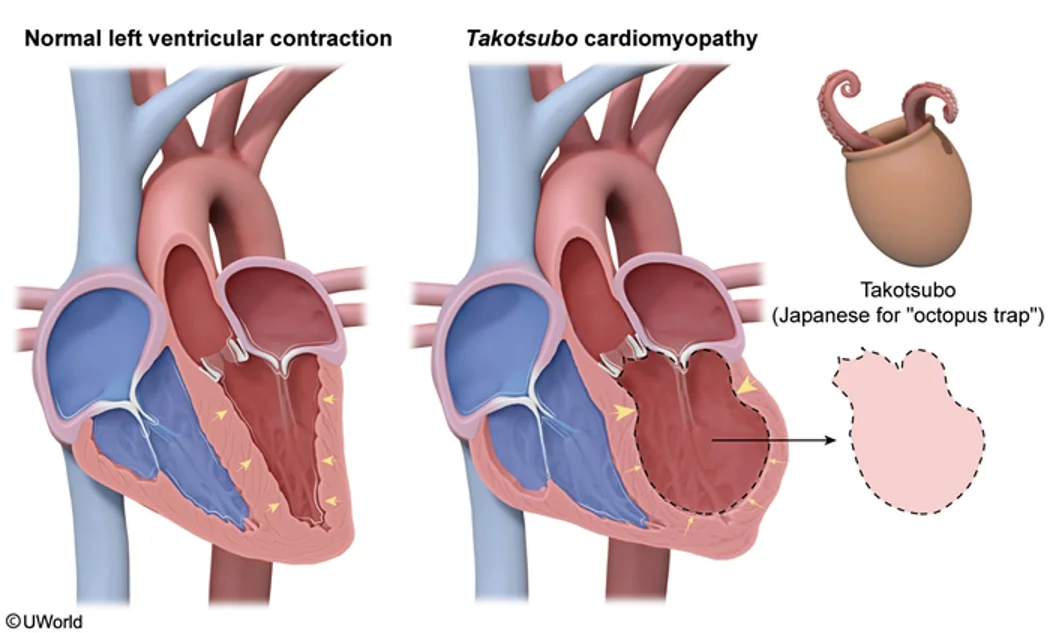
What this shows
Stress (Takotsubo) cardiomyopathy
non-ischemic, temporary hypokinesis of the myocardium.Mechanism
a surge of catecholamines after physical or emotional stress causes microvascular spasm, ischemia and myocardial stunning.Typical patient
classically a postmenopausal woman.Clinical features
It mimics a heart attack
chest pain that mimics a myocardial infarction, and signs of decompensated heart failure.Diagnosis
Labs and the electrocardiogram (ECG) look like an infarct
raised troponin, creatine kinase-MB (CK-MB) and B-type natriuretic peptide (BNP).- The ECG is abnormal in over 95 percent: ST elevation (the most common finding, usually in the precordial leads) or T-wave inversions.
Coronary angiography is normal
which excludes acute coronary syndrome.Echocardiography
a reduced ejection fraction with mid and apical hypokinesis and basal hyperkinesis.- So the left ventricle balloons at the apex.
Management
Supportive
cardiac function usually returns to normal within several weeks.A 68-year-old woman develops chest pain and precordial ST elevation the day after her husband's funeral. Troponin is raised but the coronary angiogram is normal. What does the echo show, and what is the treatment?
Takotsubo (stress) cardiomyopathy: the echo shows mid and apical hypokinesis with basal hyperkinesis, so the left ventricle balloons at the apex. Treatment is supportive; function usually returns within weeks.
How it's tested
A 68-year-old woman develops crushing chest pain and precordial ST elevation the day after her husband's funeral; troponin is mildly raised; angiography shows normal coronaries; echo shows apical ballooning: takotsubo cardiomyopathy — supportive care, beta blocker and ACE inhibitor until EF recovers.
Should she still go to the cath lab: yes — the presentation is a STEMI until the angiogram says otherwise.
Takotsubo with hypotension and a new systolic murmur with a 60 mm Hg LVOT gradient: fluids and a beta blocker; dobutamine and nitrates would worsen the obstruction.
Follow-up echo at six weeks: normal EF — the recovery is what confirms the diagnosis.
Go deeper
Related Step 2 pages: Dilated Cardiomyopathy, Acute Coronary Syndrome, Approach to Chest Pain, Hypertrophic Cardiomyopathy, Approach to Shock
High-yield images1
Flashcards for this page
Card 1 of 2 · try-out only, nothing is saved
You just read one page of 236
The rest of Step 2 CK, written exactly like this.
Rapid Review is the reading layer of a full Step 1 platform: a schedule fitted to your exam date, flashcards for every page, and a mentor a message away.
Every Step 1 system
Written the same way: what to know, how it’s tested, where to go deeper.
A plan built to your exam date
Tell us when you sit, and the schedule fits the whole library and your question bank to it.
Flashcards for every page
Ready-made spaced-repetition decks linked to each topic, so nothing you read gets forgotten.
