
Rapid Review·Cardiovascular
Select any text to highlight it or add a note.
Congenital Heart Disease
T1Must knowVentricular Septal Defect
Focus on
The most common congenital heart defect. A harsh holosystolic murmur at the left lower sternal border — louder when the hole is smaller — that appears at a few weeks of age as pulmonary resistance falls. Small ones close by themselves; large ones cause heart failure by 1–2 months (tachypnea, sweating with feeds, no weight gain) and need diuretics, an ACE inhibitor and surgical closure before the lungs are damaged.
Key takeaways
What it is and who gets it
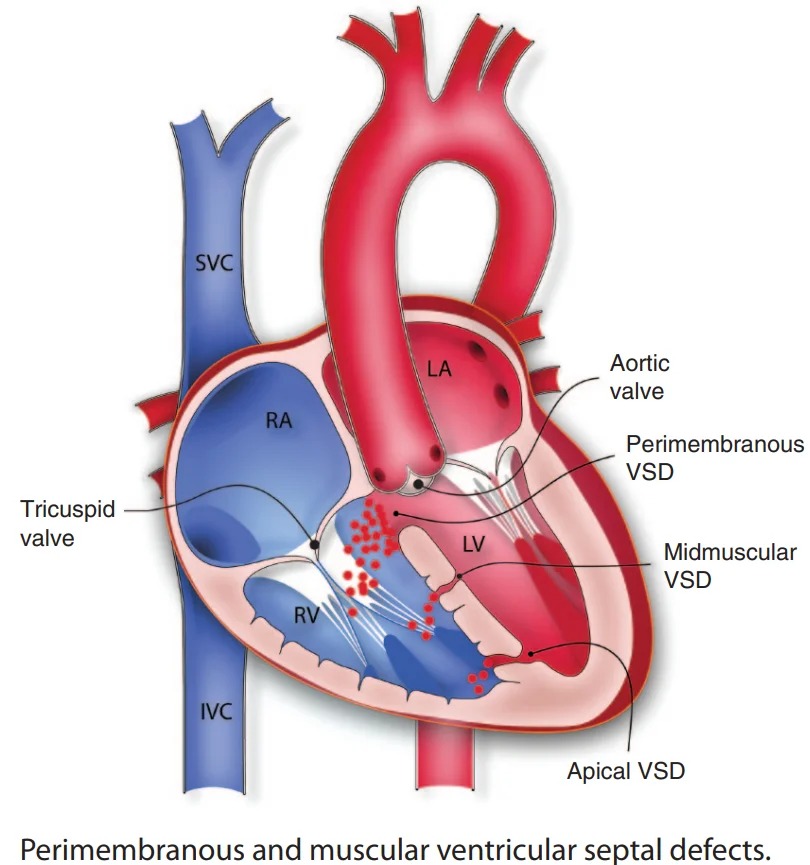
What this shows
Ventricular septal defect
the most common congenital heart defect, typically in the membranous septum.The shunt
blood shunts left to right in systole, volume-loading the right ventricle, lungs and left heart.Risk factors
often idiopathic; Down syndrome, fetal alcohol syndrome, maternal diabetes, intrauterine infections.- Acquired septal rupture after myocardial infarction (MI) (Post MI Complications).
Clinical features and diagnosis
Small defects are asymptomatic
a harsh holosystolic murmur at the left sternal border (third to fifth spaces), louder the smaller the defect.Large defects are silent at first
pulmonary resistance is high at birth, then heart failure at 1 to 2 months as resistance falls: tachypnea, sweating with feeds, failure to thrive.Severe defects
an apical diastolic rumble (functional mitral stenosis from the high flow returning to the left ventricle), a hyperdynamic apex and a sternal lift.- A loud pulmonic S2 means pulmonary hypertension.
Transthoracic echocardiography is confirmatory
size, location, gradient, pulmonary pressure.Medium to large defects
the electrocardiogram shows left and right ventricular hypertrophy with left atrial enlargement (P mitrale); the chest film shows increased pulmonary vascular markings.| Small (restrictive) | Large | |
|---|---|---|
| Murmur | Loud, harsh, holosystolic, with a thrill | Softer, plus an apical diastolic rumble and a loud P2 |
| Symptoms | None; normal growth | Heart failure at 1 to 2 months |
| Electrocardiogram and film | Normal | Biventricular hypertrophy, left atrial enlargement; plethoric lungs |
| Natural history | Spontaneous closure is common | Pulmonary hypertension and Eisenmenger if unrepaired |
| Management | Serial echocardiography | Diuretics, ACE inhibitor, then surgical closure |
Management and complications
Small or asymptomatic
monitor with echocardiography, because spontaneous closure is common.- No activity restriction and no endocarditis prophylaxis for an isolated defect.
Large or symptomatic
medical therapy of infant heart failure, then definitive surgical repair.- Diuretics for volume, an angiotensin-converting-enzyme (ACE) inhibitor to lower systemic resistance and the shunt, inotropes if needed, high-calorie feeds.
Closure is contraindicated
once irreversible pulmonary vascular disease (Eisenmenger) has developed.Complications
failure to thrive and recurrent pneumonia, pulmonary hypertension and Eisenmenger syndrome, infective endocarditis, aortic regurgitation from a prolapsing cusp, heart block after surgical closure.A 2-month-old has poor weight gain and sweating with feeds, a holosystolic murmur at the left lower sternal border and an apical diastolic rumble. What is the lesion, why did it appear now, and what is the treatment?
A large ventricular septal defect: pulmonary resistance has fallen since birth, so the left-to-right shunt and heart failure appear at 1 to 2 months (the rumble is functional mitral stenosis from the extra flow). Treat with diuretics and an ACE inhibitor, then surgical closure before pulmonary vascular disease sets in.
How it's tested
A 3-week-old with a grade 4 harsh holosystolic murmur at the left lower sternal border, feeding well and gaining weight: small VSD — echocardiogram, then observation; most close on their own.
A 2-month-old who breathes fast, sweats with feeds and has fallen off the growth curve, with a soft systolic murmur, an apical diastolic rumble and a loud P2: large VSD with heart failure — furosemide, an ACE inhibitor, calorie supplementation and surgical closure.
Why does the large VSD become symptomatic only after a few weeks: pulmonary vascular resistance is high at birth and falls over the first weeks, so the left-to-right shunt grows.
A 20-year-old with an unrepaired VSD, cyanosis, clubbing and a hematocrit of 60%: Eisenmenger syndrome — closure is now contraindicated.
Which is louder, the murmur of a small or a large VSD: the small one — turbulence through a restrictive orifice.
Go deeper
Guidelines: 2018 AHA/ACC Adult Congenital Heart Disease Guideline
Related Step 2 pages: Approach to Congenital Heart Disease, Atrial Septal Defect, Eisenmenger Syndrome, Approach to Pediatric Murmurs, Cardiac Embryology Essentials, Post MI Complications
High-yield images1
Flashcards for this page
Card 1 of 5 · try-out only, nothing is saved
You just read one page of 236
The rest of Step 2 CK, written exactly like this.
Rapid Review is the reading layer of a full Step 1 platform: a schedule fitted to your exam date, flashcards for every page, and a mentor a message away.
Every Step 1 system
Written the same way: what to know, how it’s tested, where to go deeper.
A plan built to your exam date
Tell us when you sit, and the schedule fits the whole library and your question bank to it.
Flashcards for every page
Ready-made spaced-repetition decks linked to each topic, so nothing you read gets forgotten.
