
Rapid Review·General Pathology
Select any text to highlight it or add a note.
CELLULAR INJURY
T2High yieldApoptosis
P204
Focus on
ATP-dependent, caspase-driven cellular suicide that leaves no inflammation behind, and the three separate pathways that trigger it.
Key takeaways
What apoptosis is
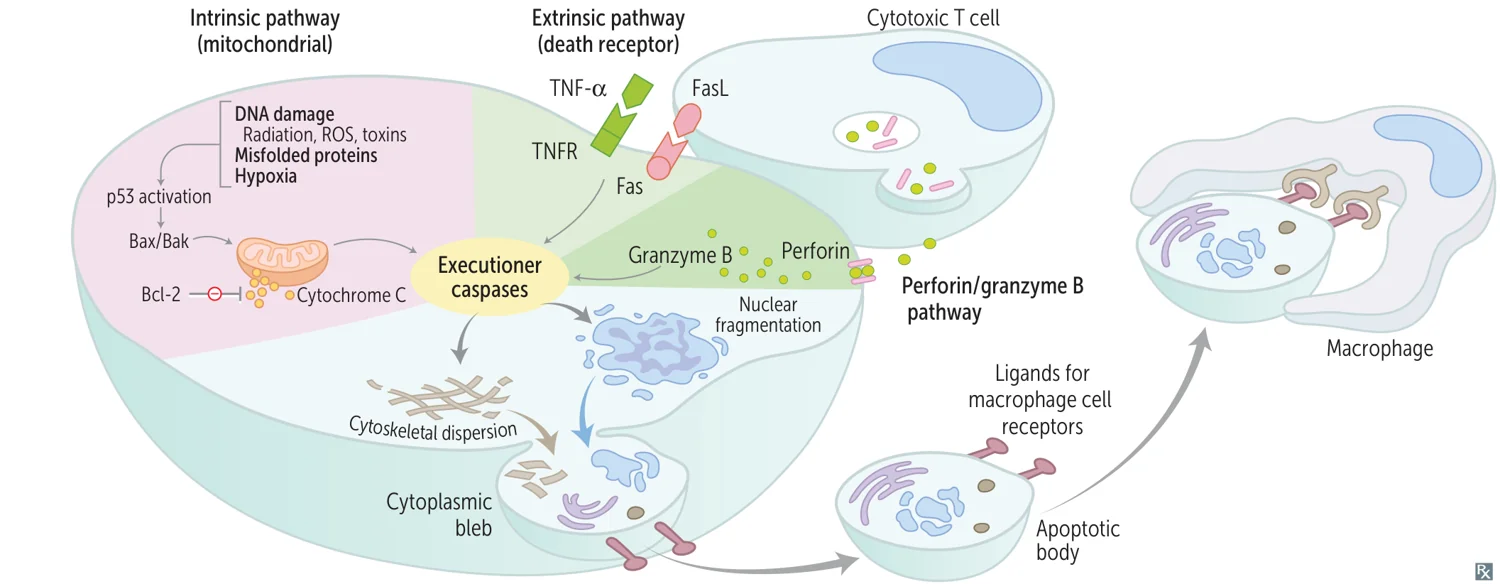
What this shows
Morphology
the cell shrinks, with deeply eosinophilic cytoplasm and a basophilic nucleus, chromatin condensation, membrane blebbing, and apoptotic bodies that get phagocytosed.- The membrane stays intact, so there is NO inflammation. This is the single contrast that separates it from necrosis.
- DNA laddering in multiples of 180 bp is the sensitive lab indicator, because endonuclease cleaves between nucleosomes.
Three pathways, one set of caspases
Intrinsic (mitochondrial)
Intrinsic (mitochondrial) pathway
triggered by DNA damage, radiation, ROS, toxins, misfolded proteins, hypoxia, or withdrawal of a growth factor (↓ IL-2 after an immune reaction kills off effector T cells).- Regulated by the Bcl-2 family: BAX and BAK are proapoptotic ("Bad for survival"); Bcl-2 and Bcl-xL are antiapoptotic ("Be clever, live").
- BAX/BAK form pores in the outer mitochondrial membrane → cytochrome c escapes into the cytosol → apoptosome assembly → caspase activation.
Extrinsic (death receptor)
Extrinsic (death receptor) pathway
FasL binds Fas (CD95), or TNF-α binds TNFR → DISC formation → caspases.- Fas-FasL is required for thymic medullary negative selection.
- Autoimmune lymphoproliferative syndrome (ALPS): defective Fas-FasL → failure of clonal deletion → lymphadenopathy, hepatosplenomegaly, autoimmune cytopenias.
Perforin and granzyme B
Perforin/granzyme B pathway
cytotoxic T cells and NK cells release granules; perforin drills the pore, granzyme B enters and activates caspases directly.Seeing apoptosis on a slide
Apoptosis is visible on histology
in Burkitt lymphoma the "starry sky" pattern is a purple sea of B cells dotted with pale tingible-body macrophages, and those pale cells are macrophages that have eaten apoptotic debris.Apoptosis vs necrosis
| Feature | Apoptosis | Necrosis |
|---|---|---|
| Energy | ATP-dependent (active) | ATP-depleted (passive) |
| Trigger | Physiologic or DNA damage | Exogenous injury/ischemia |
| Cell size | Shrinks | Swells |
| Membrane | Intact (blebs, apoptotic bodies) | Ruptures |
| Inflammation | None | Marked |
| Nucleus | Pyknosis, karyorrhexis | Pyknosis → karyorrhexis → karyolysis |
| DNA | Laddering (180 bp multiples) | Random smear |
A child has chronic lymphadenopathy, hepatosplenomegaly and autoimmune cytopenias. Which apoptotic pathway is defective, and what fails as a result?
The extrinsic (death receptor) pathway: defective Fas-FasL signaling, autoimmune lymphoproliferative syndrome (ALPS). Self-reactive lymphocytes escape clonal deletion and accumulate.
How it's tested
Two traps. (1) Hepatocyte death in viral hepatitis is T-cell-mediated apoptosis via the extrinsic death receptor pathway. "Direct viral cytopathic effect" and "intrinsic mitochondrial pathway" are both distractor answers.
(2) Follicular lymphoma's t(14;18) puts BCL2 under the IgH promoter → Bcl-2 overexpression → the mitochondrial membrane stays impermeable → cytochrome c cannot escape → no caspase activation. The B cells don't proliferate faster; they simply fail to die. If a research question overexpresses BCL-2 in any cell line, the answer is "increased lifespan of the cell population."
Go deeper
First Aid "Apoptosis"; Pathoma Ch. 1 "Apoptosis"; Boards & Beyond Apoptosis. Anchor the three routes (intrinsic = Bcl-2/BAX/cytochrome c; extrinsic = Fas/TNF, thymic negative selection; CTL = perforin/granzyme B) and that caspases are the shared executioners.
High-yield images1
Flashcards for this page
Card 1 of 5 · try-out only, nothing is saved
A decrease in (...) after a completed immunologic reaction causes apoptosis of proliferating effector cells
You just read one page of 944
The rest of Step 1, written exactly like this.
Rapid Review is the reading layer of a full Step 1 platform: a schedule fitted to your exam date, flashcards for every page, and a mentor a message away.
Every Step 1 system
Written the same way: what to know, how it’s tested, where to go deeper.
A plan built to your exam date
Tell us when you sit, and the schedule fits the whole library and your question bank to it.
Flashcards for every page
Ready-made spaced-repetition decks linked to each topic, so nothing you read gets forgotten.
