
Rapid Review·Cardiovascular
Select any text to highlight it or add a note.
Pericardial Disease
T1Must knowAcute Pericarditis
Focus on
Sharp pleuritic pain that eases sitting forward, a triphasic rub, diffuse concave ST elevation with PR depression — two of four criteria make the diagnosis. Viral/idiopathic gets NSAID plus colchicine; post-MI gets aspirin (no NSAIDs, no steroids); uremic gets dialysis; purulent gets drainage. Steroids invite recurrence.
Key takeaways
What it is and what causes it
Acute pericarditis
inflammation of the pericardial sac.Viral infection is the most common cause
coxsackievirus, echovirus, adenovirus (idiopathic cases are presumed viral).- Also bacterial (tuberculosis) and fungal.
Uremia
in acute or chronic renal failure.After a myocardial infarction (MI)
two different timings.- Fibrinous pericarditis early: a friction rub 2 days after an ST-elevation MI (STEMI), localized.
- Dressler syndrome late: 2 to 6 weeks, diffuse.
Other causes
autoimmune disease (systemic lupus erythematosus (SLE)), cardiac surgery (post-pericardiotomy syndrome), trauma, radiation, and neoplasm (Hodgkin lymphoma).Drugs
procainamide, isoniazid, hydralazine, methyldopa, doxorubicin, phenytoin.Clinical features
Pleuritic chest pain
severe, worse lying flat and relieved by sitting up and leaning forward.Low-grade intermittent fever.
Pericardial friction rub
the specific finding.- A triphasic scratchy or squeaky sound in atrial systole, ventricular systole and early diastole.
- Best heard at the left sternal border during expiration, with the patient sitting up and leaning forward.
Diagnosis
Clinical criteria
2 or more of these four.- Positional chest pain.
- A friction rub.
- Typical ECG changes.
- An effusion on imaging.
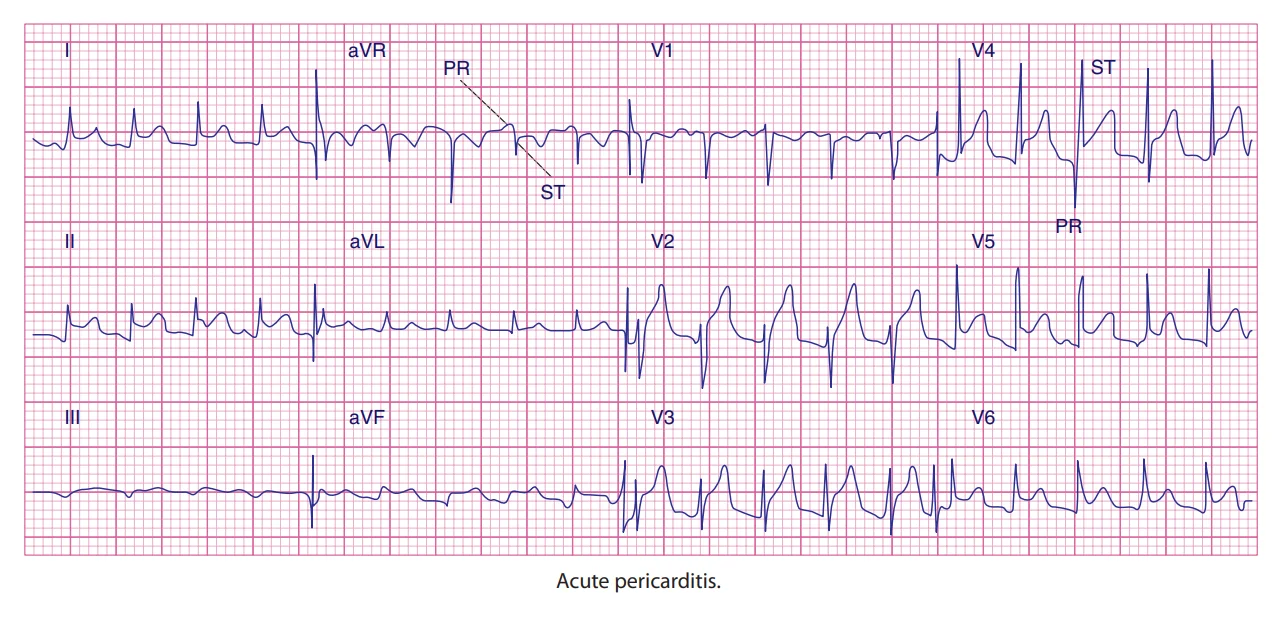
What this shows
Electrocardiogram (ECG)
diffuse ST elevation with diffuse PR depression.Transthoracic echocardiography
the initial imaging test, done in every case to exclude an effusion, which is present in about half.Uremic pericarditis
usually lacks the typical ECG changes, because the inflammation does not reach the myocardium.- More than half have an effusion.
Management
Usually self-limited
resolving in 1 to 3 weeks; treatment follows the cause, and every patient should limit physical activity.Idiopathic or viral
a non-steroidal anti-inflammatory drug (NSAID) (ibuprofen or indomethacin) plus colchicine.- Glucocorticoids only when NSAIDs are contraindicated (renal failure, late pregnancy) or for autoimmune pericarditis (SLE).
Post-MI fibrinous pericarditis
supportive care with high-dose aspirin with or without acetaminophen.- Early reperfusion is the best prevention.
Dressler syndrome
NSAIDs with or without colchicine.- Avoid anticoagulation, which can cause a hemorrhagic effusion.
Uremic
dialysis if stable.- If unstable (tamponade), pericardiocentesis first, then dialysis.
Post-pericardiotomy syndrome
autoimmune febrile pericarditis or pleuritis 1 to 6 weeks after cardiac surgery.- Fever, malaise, chest pain with or without dyspnea, tachycardia, a friction rub.
- Treat with NSAIDs or prednisone; drain the pericardium or create a pericardial window if needed.
A young man has sharp chest pain that eases when he sits forward, a scratchy three-part sound at the left sternal border, and ST elevation in most leads with PR depression. What is the treatment, and why is an echo still done?
Acute (viral or idiopathic) pericarditis: treat with an NSAID (ibuprofen or indomethacin) plus colchicine and limit activity. Transthoracic echo is done in every case to exclude an effusion, present in about half.
How it's tested
A 25-year-old with a recent cold has sharp chest pain relieved by leaning forward, a rub, and diffuse ST elevation with PR depression: viral pericarditis — echo, then ibuprofen plus colchicine, rest.
Should he get prednisone: no — steroids raise the recurrence rate; they are reserved for NSAID contraindications and autoimmune disease.
Chest pain and a rub three days after a STEMI: peri-infarction pericarditis — high-dose aspirin, echo to exclude rupture; no ibuprofen or steroids.
ESRD patient who missed dialysis with pleuritic pain, a rub and a normal ECG: uremic pericarditis — urgent dialysis after echo excludes tamponade.
Fever of 39.5 °C, toxicity and a large effusion after cardiac surgery: purulent pericarditis — drain and give IV antibiotics.
Go deeper
Guidelines: 2025 ESC Myocarditis and Pericarditis Guideline
Related Step 2 pages: Acute Pericarditis, Pericardial Effusion, Cardiac Tamponade, Constrictive Pericarditis, Myocarditis, Post MI Complications, Post-Cardiac Injury Syndrome
High-yield images1
Flashcards for this page
Card 1 of 5 · try-out only, nothing is saved
You just read one page of 236
The rest of Step 2 CK, written exactly like this.
Rapid Review is the reading layer of a full Step 1 platform: a schedule fitted to your exam date, flashcards for every page, and a mentor a message away.
Every Step 1 system
Written the same way: what to know, how it’s tested, where to go deeper.
A plan built to your exam date
Tell us when you sit, and the schedule fits the whole library and your question bank to it.
Flashcards for every page
Ready-made spaced-repetition decks linked to each topic, so nothing you read gets forgotten.
